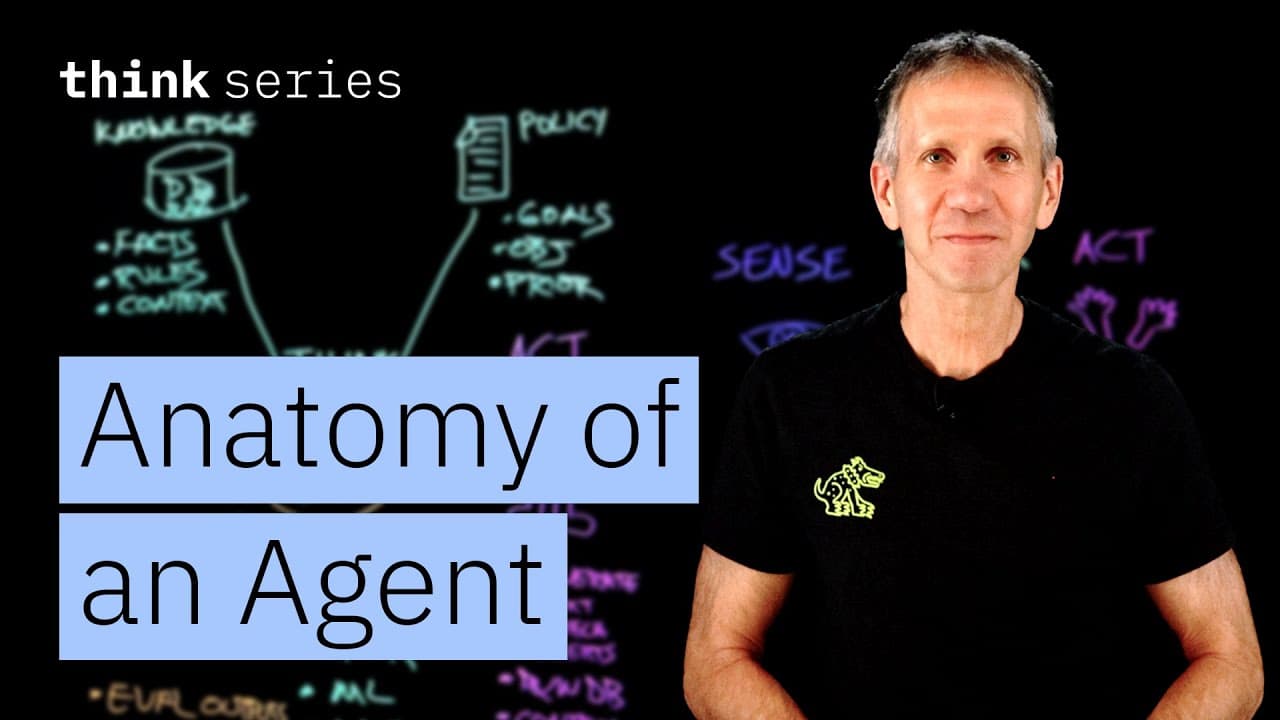
How AI Agents Work: Sensing, Thinking, and Acting
TL;DR
AI agents operate by sensing their environment, processing inputs through a knowledge base, and executing actions based on reasoning and learned patterns. They utilize sensors, databases, and policies to make informed decisions and continuously improve through feedback loops. This process enhances their efficiency and effectiveness in performing complex tasks.
Transcript
AI agents are popping up everywhere, from smart assistants to autonomous research tools to self-driving cars. But what actually makes these things tick? In this video, we're gonna break down the anatomy of an AI agent. We'll peel back the layers, sensing, thinking and acting, to show how data from the real world turns into decisions and then is tra... Read More
Key Insights
- AI agents operate by sensing, thinking, and acting on data from their environment.
- Sensing involves gathering information through text, sensors, or APIs.
- Thinking requires a knowledge base with facts, rules, and goals for context.
- Reasoning uses logic, planning, and machine learning to make decisions.
- Generative actions produce outputs like text, speech, or physical actions.
- Feedback loops enable AI agents to evaluate and refine their performance.
- Reinforcement learning with human feedback helps improve decision-making.
- AI agents can automate complex tasks, enhancing speed and efficiency.
Install to Summarize YouTube Videos and Get Transcripts
Explore YouTube Video Summarizer or Get YouTube Transcript Extractor
Questions & Answers
Q: How do AI agents gather information?
AI agents gather information through various inputs such as text, sensors, and APIs. Text inputs can be processed via natural language processing, while sensors like cameras and microphones capture environmental data. APIs and other triggered events also serve as sources of input for AI agents.
Q: What role does a knowledge base play in AI agents?
A knowledge base provides essential context for AI agents by storing facts, rules, goals, and policies. This information is crucial for the thinking process, enabling AI agents to make informed decisions by considering all relevant data, priorities, and objectives within their reasoning logic.
Q: How do AI agents use reasoning in decision-making?
AI agents employ reasoning through logic and planning, using 'if-then-else' constructs and task decomposition to break down complex goals. They leverage machine learning to identify patterns and make decisions, continuously refining their reasoning capabilities through feedback and reinforcement learning.
Q: What outputs can AI agents generate?
AI agents can generate a variety of outputs, including text, speech, alerts, and video. They can also perform physical actions, such as controlling devices or vehicles, by interfacing with actuators. These outputs are the result of the agent's decision-making process and are designed to achieve specific goals.
Q: How do feedback loops enhance AI agent performance?
Feedback loops allow AI agents to evaluate their outputs and performance, ensuring alignment with intended goals. Through reinforcement learning with human feedback, agents receive guidance on their actions, enabling them to adjust strategies and improve accuracy, efficiency, and personalization over time.
Q: What is reinforcement learning with human feedback?
Reinforcement learning with human feedback involves AI agents receiving evaluative input from users, such as thumbs up or down, to guide their learning process. This feedback helps agents refine their decision-making, correcting course when necessary, and improving their ability to achieve desired outcomes.
Q: How do AI agents automate complex tasks?
AI agents automate complex tasks by integrating sensing, thinking, and acting processes. They gather data, process it with a knowledge base, and execute decisions through reasoning. Feedback loops enable continuous improvement, allowing agents to handle intricate tasks with greater speed and efficiency.
Q: What potential do AI agents have in improving efficiency?
AI agents hold significant potential to improve efficiency by automating repetitive and complex tasks. By handling data processing and decision-making, they free up human resources for higher-level activities, enhancing productivity and enabling more effective use of time and skills in various applications.
Summary & Key Takeaways
-
AI agents function by integrating sensing, thinking, and acting processes. They gather data through various inputs, process it using a knowledge base, and execute decisions through reasoning and machine learning. This enables them to perform complex tasks efficiently, continuously improving through feedback loops.
-
The sensing component involves collecting information via text, sensors, or APIs. In the thinking phase, AI agents utilize a knowledge base containing facts, rules, and policies to provide context for decision-making. This phase is critical for reasoning and planning.
-
Generative actions entail producing outputs such as text or physical actions. Feedback mechanisms, including reinforcement learning with human input, allow AI agents to self-evaluate and enhance their capabilities over time, making them more effective at task automation.
Read in Other Languages (beta)
Share This Summary 📚
Summarize YouTube Videos and Get Video Transcripts with 1-Click
Try YouTube Summary with ChatGPT & Claude or YouTube Transcript Generator
Explore More Summaries from IBM Technology 📚


Summarize YouTube Videos and Get Video Transcripts with 1-Click
Try YouTube Summary with ChatGPT & Claude or YouTube Transcript Generator