How to Build an AI Startup That Survives
TL;DR
Build and release useful products quickly, then improve them through direct user feedback. AI has compressed simple software creation from months to minutes or hours, but founders still need durable problems, strong distribution, and defensibility because competitors can recreate commodity applications and platform updates can threaten businesses built on shallow advantages.
Transcript
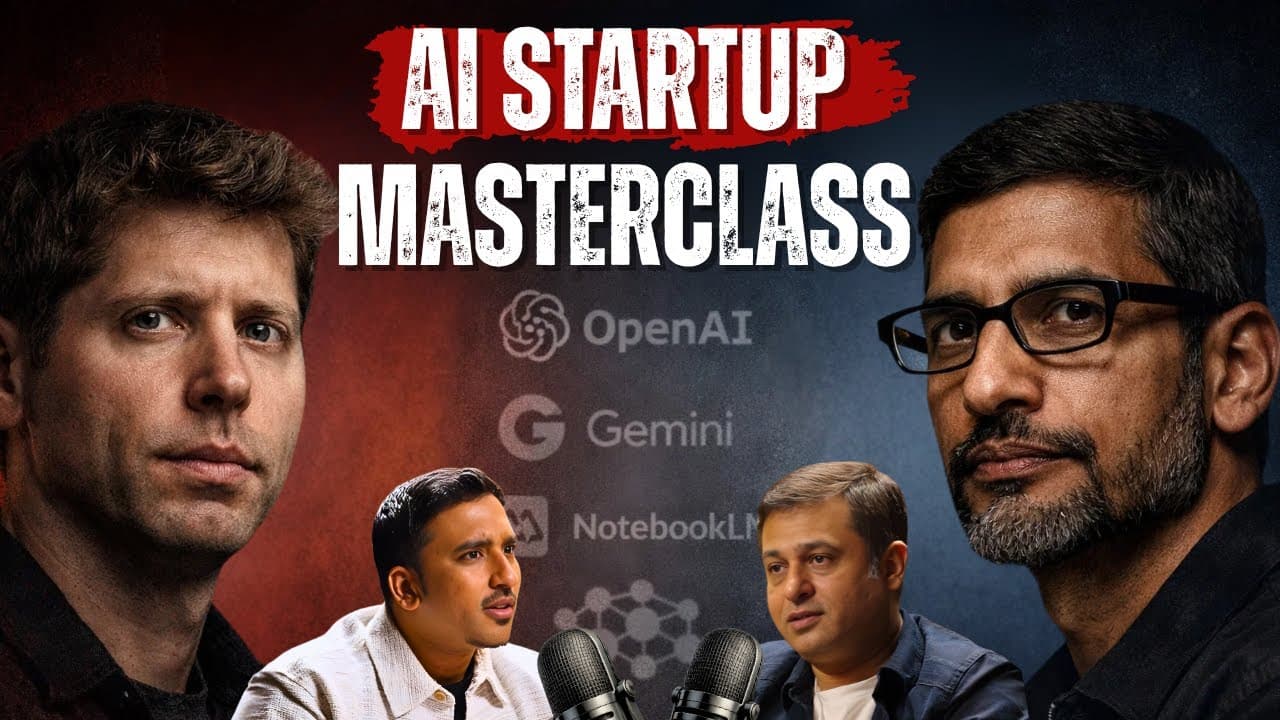
When Sam Alpin was asked are we in a bubble he said yes we might be in a bubble. >> How does the AI economics are really working? So I'll give you a simple example. >> Meet Manav Girk. He is the founder of Together Fund which is the visionary firm fueling India's most explosive AI companies. [music] Today they back massive outliers in the market in... Read More
Key Insights
- AI spending is heavily concentrated in infrastructure. Garg estimates that $70 of every $100 spent goes to compute, chips, and cloud providers, while model-training companies receive $20 and application businesses compete for the remaining $10.
- Vibe coding is an automated approach to software creation. A user can describe a target audience, business need, and desired application, then receive a working result within roughly 15 minutes to one hour without assembling a traditional development team.
- Software creation costs can decline by approximately tenfold through vibe coding. Garg contrasts a conventional application costing $50,000 to $100,000, plus ongoing expenses, with an AI-generated application costing around $1,000 or approximately $10,000 when made production-ready.
- AI-generated software still has technical limits. Emergent can reportedly handle about 300,000 lines of code, but larger and more complex codebases remain difficult for current technology to manage, preserve, and modify reliably without skilled software engineers.
- Vibe coding expands access to application development. People who previously lacked the budget, development team, or technical ability to build personal and business tools can turn their own ideas into applications and refine their needs without translation through intermediaries.
- Software engineers remain important despite increasing automation. Complex enterprise systems still require engineers who can design reliable software foundations, while younger technical founders can use AI tools to build, test, and ship products at a speed that was previously unavailable.
- Product defensibility depends partly on reproduction difficulty. Garg evaluates opportunities by asking how long another person with similar skills would need to create a comparable application, especially as software becomes easier and cheaper to produce through AI tools.
- India is presented as a significant AI market. The discussion identifies India as OpenAI’s second-largest market and says that 9 million of GMA’s 70 million users are Indian, supporting Garg’s advice that founders should not ignore Indian customers.
Install to Summarize YouTube Videos and Get Transcripts
Explore YouTube Video Summarizer or Get YouTube Transcript Extractor
Questions & Answers
Q: How should founders identify an AI problem worth solving?
Founders should evaluate whether the problem is meaningful and whether the resulting application will remain difficult to reproduce. Garg uses a practical framework: ask how long someone with a similar skill set would need to create a comparable product if software becomes a commodity. A durable opportunity needs more than rapid construction, because easy replication weakens the business’s differentiation.
Q: How does spending across the AI industry break down?
Garg describes a hypothetical allocation for every $100 spent on AI. Approximately $70 goes to compute and infrastructure, including chips and cloud hosting providers such as Azure and AWS. Model-training companies such as OpenAI and Anthropic receive about $20. The final $10 remains for application-layer companies, where many software and service-oriented businesses compete for value.
Q: What is vibe coding and how does it work?
Vibe coding is a method of creating software by describing the intended users, their problems, and the desired product to an AI-powered platform. The platform automates work that traditionally required developers and designers. In the Emergent example, the requested application can appear within approximately 15 minutes to one hour, allowing the user to explore an idea directly.
Q: How much can vibe coding reduce software costs?
A conventionally developed application can cost a European or United States business between $50,000 and $100,000, followed by annual spending equal to roughly 20 percent for changes, plus domain and hosting expenses. Garg says an application made through vibe coding might cost around $1,000, or approximately $10,000 when the goal is a production-ready product.
Q: Will vibe coding eliminate software engineering jobs?
Vibe coding does not remove the stated need for software engineers because current systems struggle as applications and codebases become more complex. Emergent can reportedly manage about 300,000 lines of code, but larger systems remain difficult. Engineers are still needed to build proper software systems and create foundations that help organizations use AI reliably at enterprise scale.
Q: What should a 21-year-old engineering student do in AI?
A young engineering student should begin building products, release them publicly, observe what users value, and revise what users reject. Garg argues that engineers already possess leverage because they can create software. Distribution has also changed, since builders can present their work through channels such as Twitter and Instagram instead of waiting for a traditional company or launch process.
Q: Why does vibe coding expand the software market?
Vibe coding allows people without development teams or large budgets to create applications for needs that previously would not justify conventional software costs. Garg gives the example of a personal food-tracking application that records meals and shares information with a nutritionist or doctor. Lower costs therefore enable new use cases instead of merely replacing existing development work.
Q: How can an AI startup avoid being displaced by an OpenAI update?
An AI startup should avoid relying only on functionality that a platform provider or similarly skilled competitor can reproduce quickly. The discussion’s defensibility framework asks how long another builder would need to create the same application. Founders should pursue substantial problems, develop distinguishing value, and consider whether their product would remain useful after a major underlying platform update.
Summary & Key Takeaways
-
AI spending is concentrated below the application layer. Manav Garg estimates that, from every $100 spent on AI, $70 goes to compute and infrastructure, $20 goes to model-training companies, and $10 remains for applications. This structure helps explain both the opportunity and the economic pressure facing application-focused AI startups today.
-
Vibe coding automates much of the traditional software creation process. A simple application that previously required designers, developers, hosting, and months of work can now be produced in minutes or under an hour. Garg says costs can fall from roughly $100,000 to about $1,000, or $10,000 for a production-ready application.
-
Founders should pursue meaningful problems, ship products rapidly, and learn from real users. Young engineers are especially equipped because software gives them leverage, while social platforms provide distribution. However, builders must consider how easily competitors can reproduce their applications and whether a single platform update could eliminate their product’s distinguishing value.
Read in Other Languages (beta)
Share This Summary 📚
Summarize YouTube Videos and Get Video Transcripts with 1-Click
Try YouTube Summary with ChatGPT & Claude or YouTube Transcript Generator
Explore More Summaries from Think School 📚






Summarize YouTube Videos and Get Video Transcripts with 1-Click
Try YouTube Summary with ChatGPT & Claude or YouTube Transcript Generator