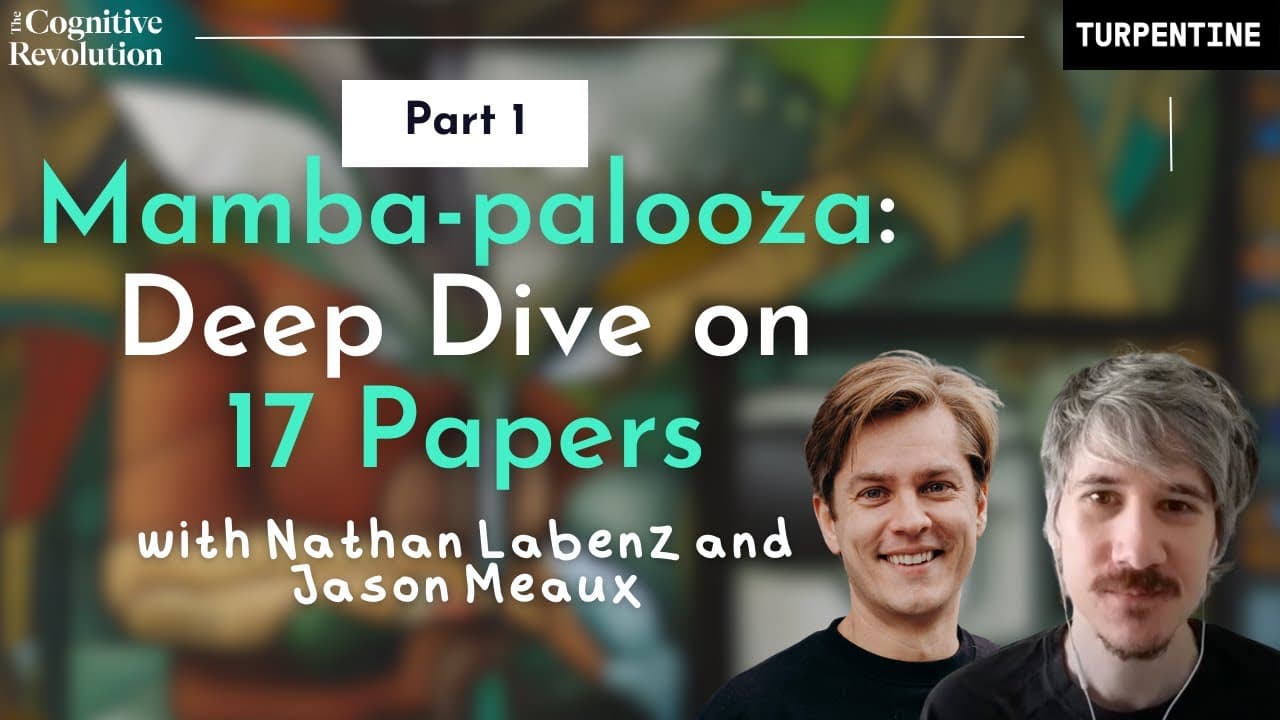
Mamba-Palooza: 90 Days of Mamba-Inspired Research with Jason Meaux: Part 1
TL;DR
Mamba-inspired research is exploring selective state spaces, hybrid architectures, mixture-of-experts strategies, longer context windows, and applications in computer vision. Nathan and Jason Meaux survey the first 30 Mamba-inspired publications identified within 90 days of the original paper, examining the relative strengths of selective state space and attention mechanisms. Read on for the episode’s key research themes, architectural questions, and emerging applications.
Transcript
hello and welcome back to the cognitive Revolution today we're doing something a bit different which I am really excited about and hope will become a regular part of the show with everything in AI going exponential all at once I've been challenging myself to find new ways to keep my AI worldview as accurate and upto-date as possible and also to bet... Read More
Key Insights
- Mamba architecture presents a new mechanism that operates without attention, offering linear scaling advantages over traditional Transformers.
- Mamba's selective state space mechanism allows for dynamic computation, improving performance in various tasks, including text modeling.
- The architecture shows strengths in handling noisy environments but struggles with tasks requiring precise recall of earlier context.
- Hybrid models combining Mamba and Transformer elements outperform standalone architectures in diverse synthetic tasks.
- Mamba's application in image segmentation and computer vision is gaining traction, with numerous papers exploring these modalities.
- Mixture of experts (MoE) architectures applied to Mamba show promising results, indicating potential for scalable, efficient models.
- The interpretability of Mamba's internal state remains a challenge, with ongoing research needed to decode its representation mechanisms.
- The ease of integrating Mamba into existing frameworks like nanogpt suggests potential for widespread adoption and experimentation.
Install to Summarize YouTube Videos and Get Transcripts
Explore YouTube Video Summarizer or Get YouTube Transcript Extractor
Questions & Answers
Q: What does Mamba-Palooza: Part 1 cover?
Nathan and Jason Meaux survey Mamba and state space model research published during the first 90 days after the original Mamba paper. Their two-part discussion covers the first 30 Mamba-inspired research publications Jason identified.
Q: What is Mamba’s selective state space mechanism?
It is a mechanism introduced in the original Mamba paper that operates without attention and offers linear scaling advantages over traditional Transformers. The episode examines its mechanistic function and compares its strengths and weaknesses with those of attention.
Q: How does Mamba compare with Transformers?
Mamba is strong at identifying and updating relevant information in noisy sequences, while Transformers can provide more precise recall of earlier context. The discussion therefore highlights the emerging value of architectures that combine selective state space and attention mechanisms.
Q: Why are hybrid Mamba-Transformer architectures important?
Hybrid architectures combine Mamba’s efficient state-space processing with attention mechanisms that support precise recall. The existing research summary reports that these combinations outperform standalone architectures across diverse synthetic tasks.
Q: How is Mamba being used in computer vision?
Mamba models are being investigated for image segmentation and other computer vision tasks. The surveyed work also includes applications such as image restoration and dehazing, reflecting growing research interest beyond text modeling.
Q: How are mixture-of-experts strategies applied to Mamba?
The discussed approach replaces feedforward layers with multiple MLP blocks and activates only a subset during computation. Research on MoE Mamba and Black Mamba is presented as promising evidence for scalable and efficient Mamba-based models.
Q: What open questions surround Mamba’s hidden states?
Researchers still face questions about how best to handle Mamba’s internal hidden states and what additional capabilities those states might enable. The episode also identifies multiple internal states as an important emerging research theme and notes that interpreting the internal state remains difficult.
Q: What other themes emerged from the first 90 days of Mamba research?
The survey highlights longer context windows, multiple internal states, and the need to represent input data types as sequences. It also discusses using multiple scans over input data and the emerging dominance of hybrid architectures.
Summary & Key Takeaways
-
In this episode, Nathan and Jason Meaux explore the first 90 days of research inspired by the Mamba architecture, highlighting its capabilities and applications. They discuss Mamba's selective state space mechanism, its advantages over Transformers, and the potential for hybrid models.
-
The conversation delves into Mamba's strengths in handling noisy environments, its challenges with tasks requiring recall, and the benefits of combining Mamba with Transformer elements. They also touch upon Mamba's application in image segmentation and computer vision tasks.
-
The episode concludes with insights into the mixture of experts architectures applied to Mamba, the interpretability challenges of its internal state, and the potential for integrating Mamba into existing AI frameworks, paving the way for future research and development.
Read in Other Languages (beta)
Share This Summary 📚
Summarize YouTube Videos and Get Video Transcripts with 1-Click
Try YouTube Summary with ChatGPT & Claude or YouTube Transcript Generator
Explore More Summaries from Cognitive Revolution "How AI Changes Everything" 📚






Summarize YouTube Videos and Get Video Transcripts with 1-Click
Try YouTube Summary with ChatGPT & Claude or YouTube Transcript Generator