How to Overcome Resistance and Create Consistently
TL;DR
Treat creative ambition like a professional commitment by showing up consistently, working through fear, and focusing on steady progress rather than immediate results. Resistance appears as procrastination, dread, self-doubt, and self-sabotage, but it can also reveal which goals matter most. Organization, patience, mentorship, collaboration, and continual learning help weaken its influence.
Transcript
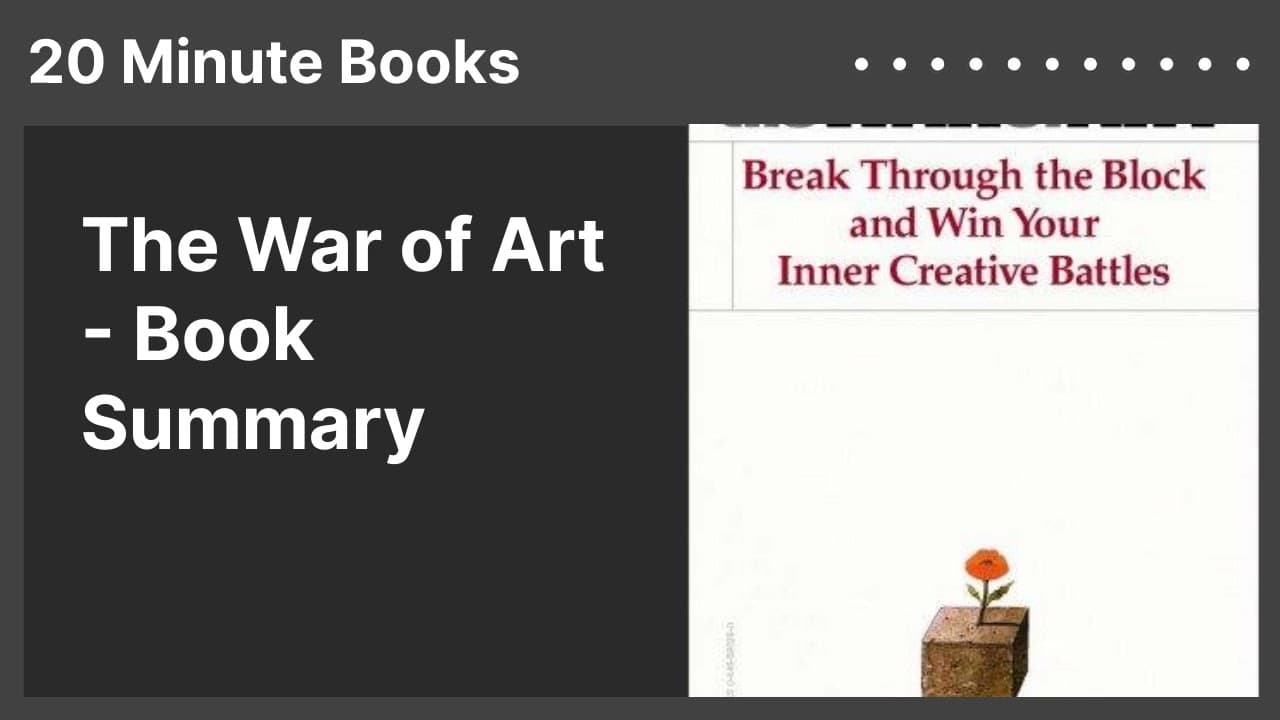
hello knowledge seekers in this episode of 20 minute books we delve into Steven pressfield's the war of art a powerful volume crafted to guide individuals through the inner battles of fear and self-doubt that hinder the pursuit of creative and professional aspirations pressfield best known for his best-selling works such as Gates of Fire And The Le... Read More
Key Insights
- Resistance is a universal mental force that discourages innovation, positive change, and meaningful work by promoting fear, procrastination, dread, self-doubt, and self-sabotage. Its presence is not a personal curse, and even accomplished performers can continue experiencing it throughout successful careers.
- Resistance must be confronted repeatedly because overcoming it is not a single, permanent victory. The practical response is an everyday commitment to redirect attention toward meaningful goals, dedicate time to the chosen craft, and accept that the internal struggle may continue alongside productive work.
- Fear can identify a meaningful calling because people rarely feel intense anxiety about pursuits that do not matter to them. When a creative role or ambitious project feels frightening, that reaction may reveal emotional investment and point toward work that deserves serious attention.
- Professionalism begins with treating a passion as seriously as paid employment. Showing up at a regular time, working despite distractions, completing necessary tasks, and continuing through routine or unpleasant periods can transform an aspiration from an occasional interest into a sustained practice.
- Inspiration is cultivated through disciplined effort rather than passively awaited. The professional establishes a dependable routine and begins working whether enthusiasm is present or not, creating the conditions in which useful ideas and creative momentum can emerge with greater regularity.
- Self-knowledge is essential to professional work because creators need to understand both their strengths and their limits. Recognizing when a task falls outside personal expertise makes thoughtful delegation and collaboration possible, allowing other people's abilities to strengthen the larger vision.
- Mastery requires continuing guidance and development even after significant achievement. The examples of coaching, mentorship, and artistic reinvention show that professionals remain students of their crafts, seek informed assistance, and continue evolving instead of treating past success as proof that learning is finished.
- Steady progress is more effective than a frantic attempt to finish immediately. Organization, patience, perseverance, and attention to each stage of the process help creators withstand intensified resistance while avoiding excessive fixation on the final outcome.
- Related book: The War of Art
- Export your Kindle highlights to Glasp: How to Download Highlights and Notes from Kindle
- More videos about this book:
- More from this channel: 20 Minute Books
Install to Summarize YouTube Videos and Get Transcripts
Explore YouTube Video Summarizer or Get YouTube Transcript Extractor
Questions & Answers
Q: What is resistance in creative work?
Resistance is the invisible mental blockage that interferes with creative, professional, entrepreneurial, or altruistic ambitions. It can appear as fear, dread, procrastination, self-doubt, delay, or self-sabotage. Its purpose is effectively to preserve the familiar situation and discourage movement into uncertain but meaningful work. Recognizing these different expressions as forms of the same obstacle is the first step toward responding deliberately.
Q: How can you overcome resistance and start creating?
Overcoming resistance requires a daily decision to focus on the desired work and take practical action despite uncomfortable feelings. It is not presented as a final victory after which fear disappears. Instead, creators repeatedly show up, redirect attention toward their goals, complete the task in front of them, and prepare for an ongoing internal struggle between purposeful effort and avoidance.
Q: Why can fear point toward your true purpose?
Fear can function as a useful signal because it often becomes intense when a goal carries genuine emotional importance. Apathy does not usually produce the same reaction. Instead of allowing fear or self-doubt to decide which opportunities to avoid, a person can examine what the discomfort reveals and consider moving toward the role, project, or challenge that matters deeply.
Q: How should you treat a creative passion professionally?
A creative passion should receive the same consistency and responsibility commonly given to paid employment. That means beginning at a planned time, working through distractions, completing necessary tasks, and continuing even when the process is routine or difficult. Professional commitment does not promise constant enjoyment. It provides a dependable structure that allows sustained progress without making action depend on mood or inspiration.
Q: Should creators wait for inspiration before working?
Creators should not rely on inspiration arriving before they begin. The transcript presents disciplined routine as a way to cultivate inspiration through action. A professional starts at a consistent time and works day after day, even without immediate enthusiasm. Regular effort creates opportunities for ideas to emerge and prevents uncertainty or temporary lack of motivation from controlling whether meaningful work gets done.
Q: Why are collaboration and delegation important for creators?
Collaboration and delegation are important because professional self-knowledge includes recognizing the limits of personal expertise. A creator or director does not need to perform every task alone. Understanding where another person's talent can improve the project allows the leader to assemble complementary abilities around the central vision. Accepting limits is therefore presented as strategic judgment rather than an admission of weakness.
Q: Why do successful professionals still need mentors and coaching?
Successful professionals still need guidance because mastery is described as a continuing process rather than a completed destination. The transcript uses Tiger Woods's continued coaching to illustrate how an accomplished person can remain a student of the craft. Mentorship, feedback, and ongoing learning help professionals refine their abilities, address limitations, and continue developing even after they have earned recognition.
Q: How do organization and patience weaken resistance?
Organization and patience weaken resistance by turning a large ambition into a sequence of manageable actions. The transcript contrasts steady, methodical progress with frantic attempts to finish a major project quickly. By concentrating on the current stage of the process, maintaining a consistent routine, and persevering when resistance intensifies, creators reduce their dependence on immediate results and protect their commitment over time.
Summary & Key Takeaways
-
Resistance is an invisible mental barrier that obstructs creative work, professional growth, entrepreneurship, activism, and other meaningful ambitions. It commonly appears as fear, procrastination, dread, delay, and self-sabotage. Because everyone experiences it, progress depends on recognizing its disguises and repeatedly choosing purposeful action instead of waiting for permanent confidence.
-
Fear and self-doubt can serve as a compass because they often become strongest around work that carries deep personal importance. Rather than interpreting discomfort as proof that a goal should be abandoned, creators can treat it as evidence of emotional investment and move toward the project, role, or challenge that matters.
-
A professional approach replaces dependence on inspiration with consistent effort, organization, patience, and resilience. It also includes understanding personal strengths and limitations, seeking mentors, delegating tasks to capable collaborators, and remaining willing to learn. Steady attention to the process makes ambitious work more manageable and helps keep resistance under control.
Read in Other Languages (beta)
Share This Summary 📚
Summarize YouTube Videos and Get Video Transcripts with 1-Click
Try YouTube Summary with ChatGPT & Claude or YouTube Transcript Generator
Explore More Summaries from 20 Minute Books 📚


Summarize YouTube Videos and Get Video Transcripts with 1-Click
Try YouTube Summary with ChatGPT & Claude or YouTube Transcript Generator