How Does Falsehood Undermine Democratic Truth?
TL;DR
Democratic truth erodes when political leaders, partisan media, and online platforms replace verifiable facts with emotionally useful narratives. Michiko Kakutani connects current polarization to older resistance against reason, showing how confirmation bias, tribalism, extreme subjectivism, propaganda, and rapidly distributed misinformation make citizens less able to distinguish evidence from fabrication.
Transcript
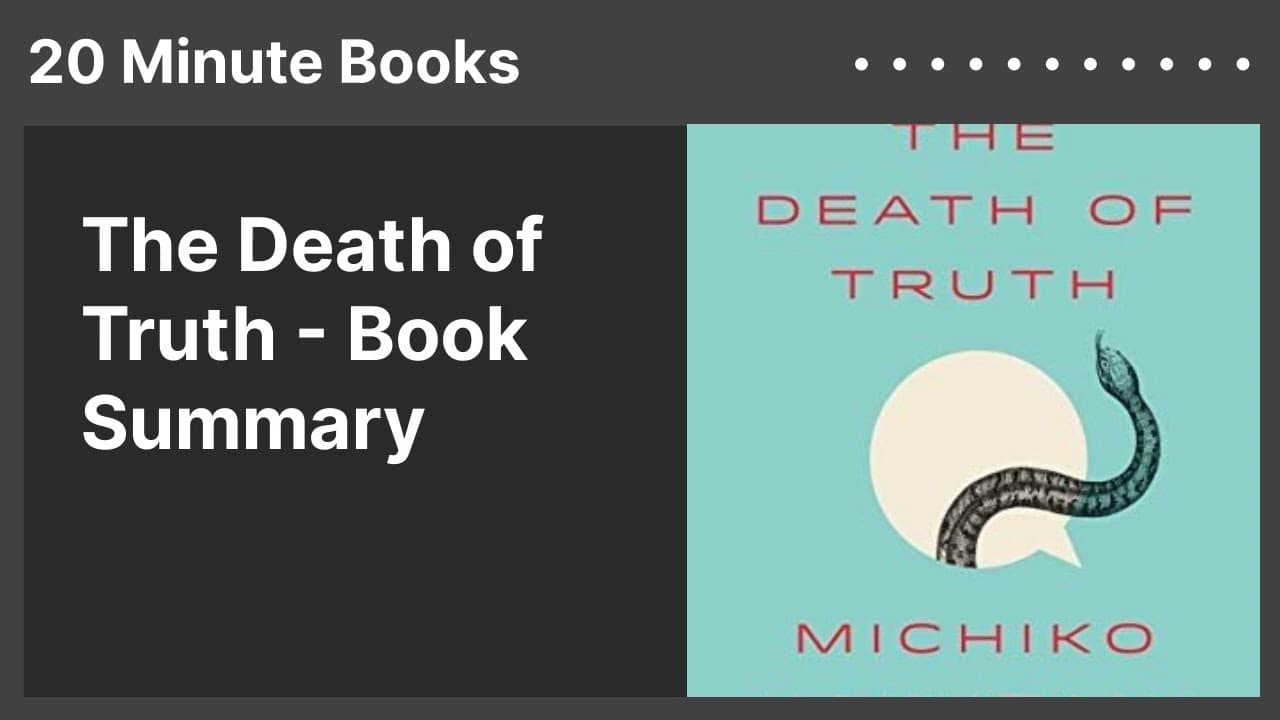
hello knowledge seekers in this episode of 20 minute books we delve into The thought-provoking Narrative of the death of Truth by Macho kakutani published in 2018 this enlightening book analyzes the current political climate of the United States painting a vivid picture of the divisive State of Affairs kakutani a seasoned literary critic with more ... Read More
Key Insights
- Reason is presented as a safeguard against tyranny and a foundation for the rule of law. Abraham Lincoln emphasized its importance in 1839, yet American history has repeatedly featured movements that resist reason, progress, religious tolerance, and other principles associated with the Enlightenment.
- The Know Nothing Party was an anti-immigrant and anti-Catholic political force with 43 members in Congress in 1855. Kakutani connects its supporters with modern groups that feel marginalized, lack agency, and blame globalization or technology for their economic and social difficulties.
- Fringe conspiracy theories and intolerant ideas entered mainstream politics in 2017 after being amplified by Breitbart bloggers and retweeted by President Trump. This amplification illustrates how political authority and partisan media can give previously marginal claims broader legitimacy and visibility.
- Partisan media ecosystems turn truth into something shaped by ideology, perspective, and agenda. Fox News, Breitbart, Rush Limbaugh, and Sinclair Broadcast Group are presented as parts of a right-wing information environment that frequently sidelines facts, data, and evidence on major public issues.
- Confirmation bias is the tendency to favor information that supports existing beliefs. It helps create partisan or content silos in which people encounter carefully selected narratives, become increasingly isolated from contrary evidence, and reinforce the assumptions shared by their ideological communities.
- Political tribalism makes open discussion harder by encouraging people to associate primarily with those who share their views. A 2016 Pew survey found that 45% of Republicans considered Democratic policies a national threat, while 41% of Democrats felt similarly about Republican policies.
- Postmodern subjectivism becomes dangerous when the valid recognition of differing experiences is extended to verifiable facts. Although alternative perspectives helped expose government deception after the Vietnam War and Watergate, extreme subjectivism allows objective evidence and reality itself to be treated as matters of political preference.
- The internet enables propaganda and fabricated news to spread with exceptional speed. Tim Berners-Lee envisioned the web in 1989 as a collaborative information repository, but its distribution power also became an efficient mechanism for misinformation, especially as the boundary between news and entertainment blurred.
Install to Summarize YouTube Videos and Get Transcripts
Explore YouTube Video Summarizer or Get YouTube Transcript Extractor
Questions & Answers
Q: What is the central argument of The Death of Truth?
The central argument is that democratic society is endangered when shared facts are replaced by partisan narratives, propaganda, and subjective claims about reality. Michiko Kakutani uses literature, history, media analysis, and contemporary politics to show that attacks on reason are not entirely new, but the internet and political polarization have increased their reach and influence.
Q: How does resistance to reason threaten democracy?
Resistance to reason threatens democracy by weakening the rule of law and removing the shared factual basis required for public deliberation. The summary cites Abraham Lincoln's 1839 argument that reason protects against tyranny. When leaders and citizens reject evidence, conspiracy theories and intolerance can move from the political margins into mainstream institutions and policy decisions.
Q: What does the Know Nothing Party reveal about modern politics?
The Know Nothing Party shows that resentment toward immigrants, religious minorities, and social change has historical precedents in the United States. In 1855, this anti-immigrant and anti-Catholic party had 43 members in Congress. Kakutani compares its supporters with modern working-class groups who feel marginalized and blame globalization or technology for their reduced sense of agency.
Q: How do partisan media create information silos?
Partisan media create information silos by selecting stories and interpretations that support a particular ideology while sidelining conflicting facts, data, or evidence. Audiences then repeatedly encounter narratives that confirm their existing beliefs. The summary identifies Fox News, Breitbart, Rush Limbaugh, and Sinclair Broadcast Group as contributors to this increasingly fragmented information environment.
Q: What is confirmation bias in post-truth politics?
Confirmation bias is the psychological tendency to prefer information that reinforces beliefs a person already holds. In post-truth politics, it encourages people to dismiss contrary evidence as a product of the establishment or a deep state. Combined with filtered media and ideologically uniform social groups, it produces partisan silos that deepen polarization and discourage reasonable conversation.
Q: Why can extreme subjectivism undermine factual truth?
Extreme subjectivism undermines factual truth when the reasonable idea that experiences differ by factors such as gender or class is expanded into the claim that all facts are merely perspectives. Kakutani argues that this distortion allows political actors to dispute verifiable matters, reject scientific evidence, and make reality dependent on ideology or strategic advantage.
Q: How is fear used to advance false political narratives?
Fear is used by presenting fabricated or misleading claims that give frustrated voters identifiable groups to blame. The summary says Trump described crime as escalating despite it being at an all-time low and portrayed immigrants as dangerous and economically burdensome. Such claims directed resentment toward immigrants, women, Black people, and Muslims while strengthening political divisions.
Q: Why does the internet accelerate fake news and propaganda?
The internet accelerates fake news and propaganda because it can distribute information and misinformation at extremely high speed. Tim Berners-Lee originally envisioned the web in 1989 as a platform for collaboration and a repository of digital information. Its same distribution efficiency, however, allows fabricated claims to travel rapidly through an environment where news and entertainment increasingly overlap.
Summary & Key Takeaways
-
Michiko Kakutani examines the United States through literature and history, arguing that the current post-truth climate reflects warnings previously expressed by writers including Philip Roth, George Orwell, Aldous Huxley, Victor Klemperer, Robert Heinlein, Neil Postman, and Hannah Arendt about powerful actors manipulating facts, language, and public perceptions of reality.
-
American political culture has long contained a counternarrative hostile to Enlightenment commitments such as reason, liberty, progress, and religious tolerance. The anti-immigrant, anti-Catholic Know Nothing Party of 1855 illustrates an earlier version of the resentment, scapegoating, conspiracy thinking, racial intolerance, and resistance to social and technological change visible in contemporary politics.
-
The modern information environment intensifies division by filtering news through partisan outlets, social networks, confirmation bias, and ideologically uniform communities. When subjective interpretation expands into denial of verifiable facts, propaganda can exploit fear and resentment, while the internet distributes fabricated claims rapidly and weakens the shared factual foundation required for democratic discussion.
Read in Other Languages (beta)
Share This Summary 📚
Summarize YouTube Videos and Get Video Transcripts with 1-Click
Try YouTube Summary with ChatGPT & Claude or YouTube Transcript Generator
Explore More Summaries from 20 Minute Books 📚


Summarize YouTube Videos and Get Video Transcripts with 1-Click
Try YouTube Summary with ChatGPT & Claude or YouTube Transcript Generator