How Could a US Recession Threaten India's Economy?
TL;DR
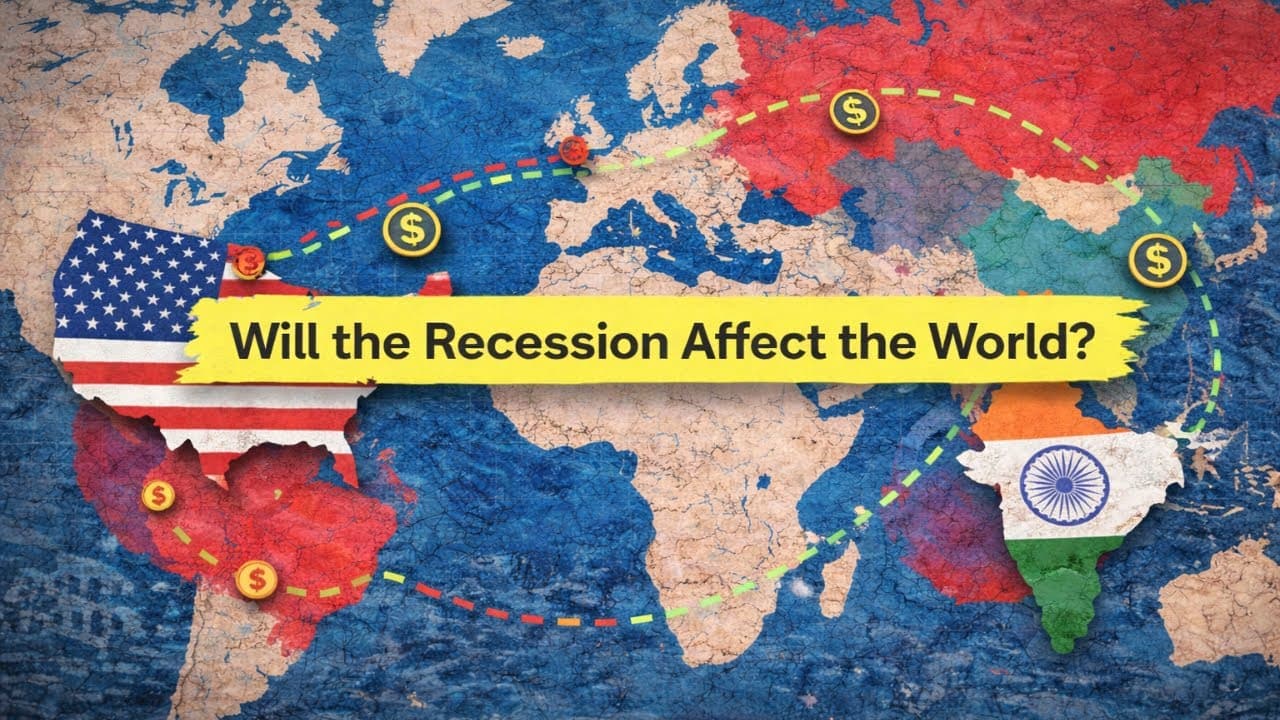
A US recession could threaten India by prompting foreign investors to withdraw money, increasing market volatility, and deepening economic uncertainty. Although US GDP growth merely slowed from 3.1% to 2.3%, high interest rates, cooling employment, turbulent stocks, and an inverted yield curve are presented as warning signs. Read on to understand the recession indicators and why they matter for India.
Transcript
Hi everybody. In the past 20 days, the US stock market just lost $4 trillion. Wiping out $4 trillion in market value from the S&P 500. The S&P 500 had its biggest one-day drop. The chance of recession is higher than most people believe. So much sharp. Many experts believe the US could enter a recession this year. $4 trillion is like wiping out the ... Read More
Key Insights
- A technical recession is defined in the discussion as GDP shrinking for two consecutive quarters, while a real recession is assessed using a broader collection of economic conditions rather than GDP alone.
- The National Bureau of Economic Research framework described here examines employment, income levels, consumer spending, and industrial production to judge whether economic activity is experiencing a broad decline.
- The US economy is showing mixed signals because GDP is still growing, although growth has slowed from 3.1% to 2.3%, while employment is cooling, interest rates are high, and stock markets remain extremely volatile.
- A bond's interest rate is fixed by the government when the bond is issued, but its yield changes according to the price that buyers are willing to pay in the secondary market.
- Bond prices and yields move in opposite directions because the fixed payment represents a larger return when the purchase price falls and a smaller return when the purchase price rises.
- A healthy yield curve normally slopes upward because short-term bonds offer lower yields and longer-term bonds offer higher yields, compensating investors for committing their money over a longer period.
- An inverted yield curve occurs when short-term yields rise above long-term yields, reflecting strong demand for longer-term government bonds and weaker confidence in the economy's short-term outlook.
- India is exposed to US economic stress because foreign investors are already pulling money out, Indian markets are becoming volatile, and uncertainty is rising as American markets, rates, tariffs, and recession concerns unsettle investors.
Install to Summarize YouTube Videos and Get Transcripts
Explore YouTube Video Summarizer or Get YouTube Transcript Extractor
Questions & Answers
Q: How could a US recession threaten India's economy?
A US recession could weaken investor confidence and cause foreign investors to pull money out of India. The discussion says withdrawals are already occurring while Indian markets are volatile and economic uncertainty is rising.
Q: Has the US already entered a recession?
The evidence presented does not confirm that the US is already in a real recession. GDP is still growing, though growth has slowed from 3.1% to 2.3%, and the job market is cooling rather than collapsing.
Q: What is the difference between a technical recession and a real recession?
A technical recession occurs when GDP shrinks for two consecutive quarters. The broader assessment described in the discussion considers employment, income levels, consumer spending, and industrial production rather than relying only on GDP.
Q: Why are people worried about a US recession?
US stocks lost $4 trillion in market value over 20 days, while interest rates reached a 20-year high and credit card defaults reached a 14-year high. Housing affordability, volatile markets, and the trade conflict with China add to concerns about inflation and economic growth.
Q: What is a bond yield, and how does it differ from a bond's interest rate?
A bond's stated interest rate remains fixed after the government issues it, but its yield changes with its market price. In the example, a bond paying 2,000 rupees annually has a 4% yield when bought for 50,000 rupees, even though its original interest rate remains 2%.
Q: Why do bond prices and yields move in opposite directions?
The bond's fixed payment does not change when its market price changes. If a bond paying 2,000 rupees annually falls from 1 lakh rupees to 50,000 rupees, the buyer earns a higher percentage return because less money was invested.
Q: What is an inverted yield curve?
An inverted yield curve occurs when short-term government bonds offer higher yields than longer-term bonds. The discussion explains that fearful investors may favor long-term government bonds, pushing their prices up and yields down, while weaker demand lowers short-term bond prices and raises their yields.
Q: Why can an inverted yield curve warn of a recession?
An inversion reflects weaker confidence in the economy's short-term outlook and stronger demand for longer-term government bonds. The discussion says every major US recession cited from the past 50 years followed an inversion, including downturns associated with 1970, the dotcom collapse, and the 2008 financial crash.
Summary & Key Takeaways
-
The US economy is producing mixed signals rather than confirming a recession. GDP growth has slowed from 3.1% to 2.3%, employment is cooling without collapsing, interest rates remain high, and stock markets are volatile. The discussion distinguishes a technical recession from the broader assessment used by the National Bureau of Economic Research.
-
A bond's stated interest rate remains fixed after issuance, while its yield changes as the bond's market price changes. When a bond becomes less attractive than newly issued alternatives, its price may fall and its yield rise. Conversely, stronger demand raises the bond's price and lowers the return available to its buyer.
-
A normal yield curve slopes upward because longer-term bonds offer higher yields than shorter-term bonds. Fear can reverse this relationship when investors favor safer long-term government bonds and avoid short-term exposure. The resulting inverted curve is presented as a recession warning with potentially serious consequences for India through capital withdrawals and market volatility.
Read in Other Languages (beta)
Share This Summary 📚
Summarize YouTube Videos and Get Video Transcripts with 1-Click
Try YouTube Summary with ChatGPT & Claude or YouTube Transcript Generator
Explore More Summaries from Think School 📚






Summarize YouTube Videos and Get Video Transcripts with 1-Click
Try YouTube Summary with ChatGPT & Claude or YouTube Transcript Generator