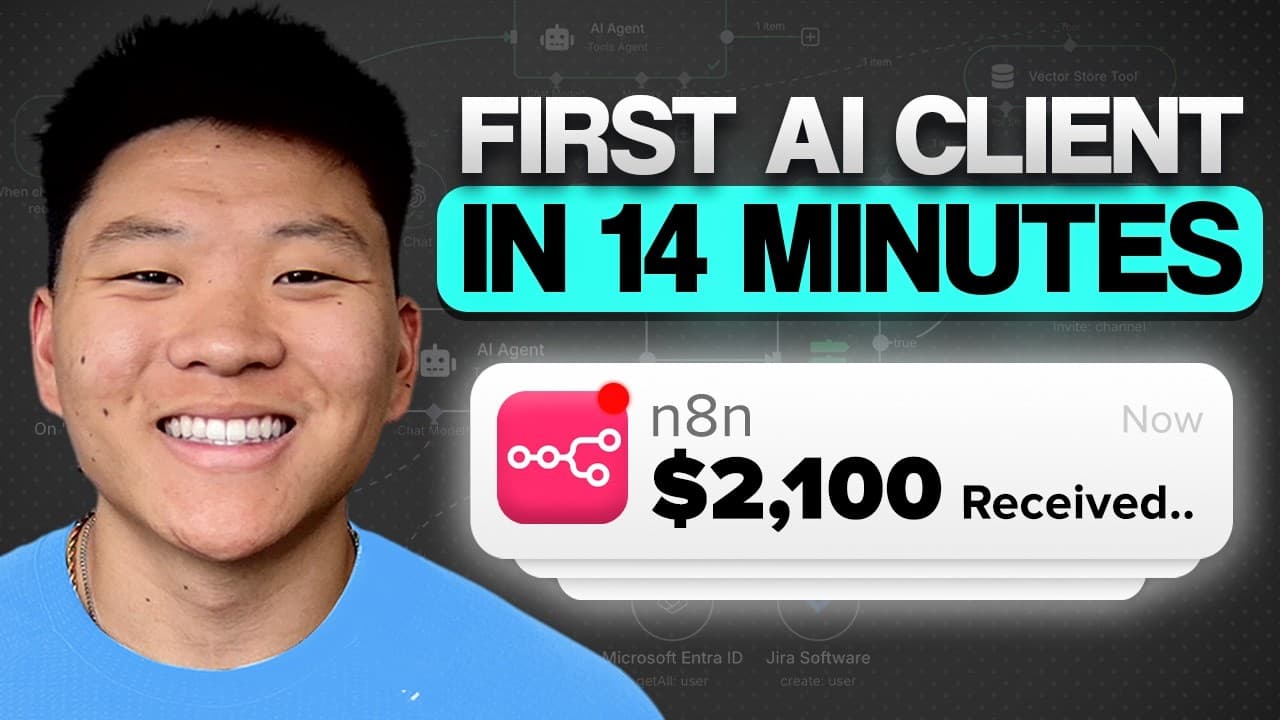
How to Land Your First AI Automation Client
TL;DR
Start by solving one painful, repetitive business problem for one person, then sell the measurable outcome rather than the AI technology behind it. Choose a familiar niche, validate recurring bottlenecks through conversations, create a low-risk offer, and contact warm connections with personalized messages. Begin as a freelancer, refine the offer from objections, and consider building an agency only after understanding the complete process.
Transcript
Most people who try to make money with AI start completely wrong. They think that they need to start an agency, hire developers, build a brand, when in reality, you can get your first paying AI automation client without any of that. When I started, I had no team and I had no clue what I was doing. But one simple workflow I built landed me my first ... Read More
Key Insights
- A first AI automation client can be won by solving one painful problem for one person. The creator reports that a single workflow secured his first $1,200 client, despite having no team and initially lacking experience.
- An agency structure is unnecessary at the beginning because business value does not depend on appearing like a fully developed company. Beginners can start as freelancers, develop into consultants, and build agencies only after understanding prospecting, sales, and delivery.
- AI automation should be positioned through business outcomes rather than technical novelty. Business owners can readily understand benefits such as faster lead follow-ups, streamlined onboarding, and less repetitive reporting, while the term AI may introduce hesitation about risk or experimentation.
- A practical automation balance is 60% traditional automation, 30% AI-assisted functionality, and 10% human input or approval. This approach uses AI to make workflows smarter while preserving human oversight instead of presenting automation as a replacement for people.
- A useful niche is one the provider already understands, finds interesting, or can access through existing relationships. Strong opportunities appear where workers repeatedly lose time to direct messages, scheduling, reporting, CRM maintenance, or other administrative processes.
- The LRP research framework means listen, repeat, and poke. It helps uncover how people spend their working days, which tasks drain their time, and which problems recur often enough to justify a focused automation service.
- A compelling offer combines result, roadmap, risk reversal, and review. It defines a measurable outcome, explains the implementation path, lowers the buyer's initial risk, and uses objections from sales conversations to improve future versions of the pitch.
- Warm outreach begins with people who already recognize the provider's name. Email histories, social media followers and conversations, phone contacts, former classmates, coworkers, friends, and family can create introductions or conversations without requiring direct pressure or immediate selling.
- More videos from this channel:
- More from this channel: Nate Herk | AI Automation
Install to Summarize YouTube Videos and Get Transcripts
Explore YouTube Video Summarizer or Get YouTube Transcript Extractor
Questions & Answers
Q: How can I get my first AI automation client?
Choose one niche you understand or can access, identify a repetitive and costly problem, and define a workflow you can confidently improve. Package the service around a clear time-saving or cost-saving result, explain the implementation roadmap, and reduce the prospect's risk. Begin with personalized outreach to warm contacts, then use every question and objection to sharpen the offer.
Q: Do I need to start an agency to sell AI automation?
No. The recommended path is to begin as a freelancer who solves one specific problem for one client. As you learn the complete process, you can evolve into a consultant and eventually build an agency. A team, elaborate brand, large developer group, and massive outreach operation are not prerequisites for delivering useful business outcomes or securing an initial engagement.
Q: How should I choose a niche for automation services?
Select an industry you have worked in, care about, understand, or can easily discuss with people in your network. Look for repeated time drains involving direct messages, scheduling, reporting, lead follow-ups, CRM updates, or administrative work. Validate the pattern through conversations and online discussions, then write one sentence identifying exactly whom you help and which recurring problem you address.
Q: Should I sell AI technology or business outcomes?
Sell the business outcome rather than emphasizing AI itself. Some owners may interpret AI as risky or experimental, but they can immediately understand an offer to automate lead follow-ups, streamline onboarding, or eliminate repetitive reporting. AI can make the system smarter and faster, while the pitch should focus on saved time, reduced cost, reliable execution, and additional leverage for existing staff.
Q: What are the four Rs of an AI automation offer?
The four Rs are result, roadmap, risk reversal, and review. Result defines the measurable outcome, such as reducing a five-hour onboarding process to 30 minutes. Roadmap explains how the change will be delivered. Risk reversal reduces hesitation through terms such as a free build, guarantee, or satisfaction-based payment. Review turns prospect questions and objections into improvements for the offer.
Q: How can a beginner reduce risk for a first automation client?
A beginner can make the initial offer easier to accept by providing a free build in exchange for a testimonial, offering a money-back guarantee, or using a pay-only-if-satisfied arrangement. These options reduce hesitation while helping the provider earn early wins. The chosen promise should support a specific workflow that the provider knows can be delivered confidently and explained clearly.
Q: Where can I find warm prospects for automation services?
Start with existing email history, social media connections, and phone contacts. That pool can include anyone you have emailed, people who follow you or have exchanged direct messages with you, former classmates, coworkers, friends, and family. These contacts already recognize your name and may read a personalized message, introduce you to someone relevant, or discuss problems within their industries.
Q: How should I approach warm contacts without pressuring them?
Open a natural conversation instead of immediately trying to sell. Personalize the message by mentioning something genuine and specific, such as a new job, a move, a recent post, or the person's business. The purpose is to reconnect and open doors, not pressure friends into purchasing. Use the conversation to understand their work, uncover recurring problems, and identify possible introductions.
Summary & Key Takeaways
-
Beginners do not need an agency, development team, large audience, elaborate brand, or massive outreach system to secure a first client. A service-based automation business can begin with basic software, API credits, and dedicated learning time. The recommended progression is freelancer first, consultant next, and agency only after mastering delivery and sales.
-
Select a niche you understand or can easily access, then investigate repetitive tasks such as lead follow-ups, scheduling, reporting, CRM updates, and administration. Use conversations, social platforms, personal contacts, and AI research tools to identify repeated pain. Reduce the research to one sentence describing the customer and the specific problem you solve.
-
Build the offer around a defined result, a clear delivery roadmap, risk reversal, and continuous review. Lead with measurable time or cost savings, explain how you will study and automate the workflow, and reduce initial buyer hesitation. Record questions and objections, then revise the pitch to address hidden costs before future prospects raise them.
Read in Other Languages (beta)
Share This Summary 📚
Summarize YouTube Videos and Get Video Transcripts with 1-Click
Try YouTube Summary with ChatGPT & Claude or YouTube Transcript Generator
Explore More Summaries from Nate Herk | AI Automation 📚




Summarize YouTube Videos and Get Video Transcripts with 1-Click
Try YouTube Summary with ChatGPT & Claude or YouTube Transcript Generator