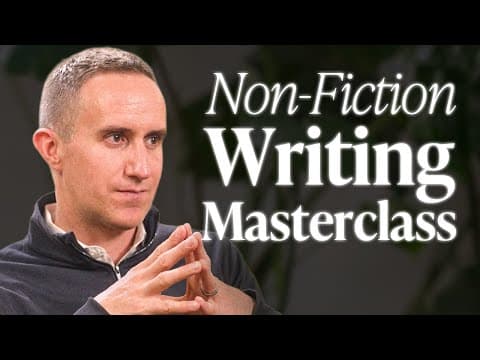
How Does Fareed Zakaria Write Consistently Well?
TL;DR
Consistent writing comes from external structure, not willpower: deadlines force you to produce every week, and skill compounds the more you do it. Fareed Zakaria says a column that once took half a week now takes two hours after 25 years of weekly practice. Books, being important but not urgent, need a deliberate research plan.
Transcript
as you think about writing your books, Post-American World, The Case for Liberal Education, how does that kind of get into orbit? Right? Like with a with an article, with a take, the cycles are faster, right? It's kind of a fast oscillation. With a book takes years and also that book becomes almost like a part of who you are. It's you say you have ... Read More
Key Insights
- Deadlines are the engine of consistent writing. Zakaria chose journalism over academia because he lacked the self-discipline to write unprompted, and the obligation to 'pull up and shoot' pretty much every week for 25 years gave him the structure he needed.
- Writing skill compounds with volume. When Zakaria started his Newsweek column around 2000 it took half the week to write; after 25 years of practice he can research, think, and write the same column in about two hours.
- Books are 'important but not urgent' work that resists deadlines. Zakaria writes them from two forces: guilt (the sense that real scholarship is the true intellectual work) and learning, since he learns more writing a book than at any other time.
- Deep writing requires deep reading. For a single chapter on the French Revolution, Zakaria read around 20 books plus academic articles and translated excerpts, digesting it all into a 40-to-50-page chapter so the reader does not have to.
- Many writers prefer having written to writing. Quoting Bill Buckley's line about two kinds of people, Zakaria identifies with those who find the act of writing painful and arduous but find having digested and conveyed knowledge a thrilling feeling.
- Zakaria's mentor Sam Huntington wrote every morning from 6 to 10 before teaching, on the principle that you must start the day with the real work. Zakaria concluded he personally could not sustain that self-motivation without external structure.
- AI serves best as a research assistant, not a writer. Zakaria finds Gemini extraordinary for questions with definite answers, like feeding it symptoms and blood tests for medical questions, but limited for deep dives because it lacks access to the best source books.
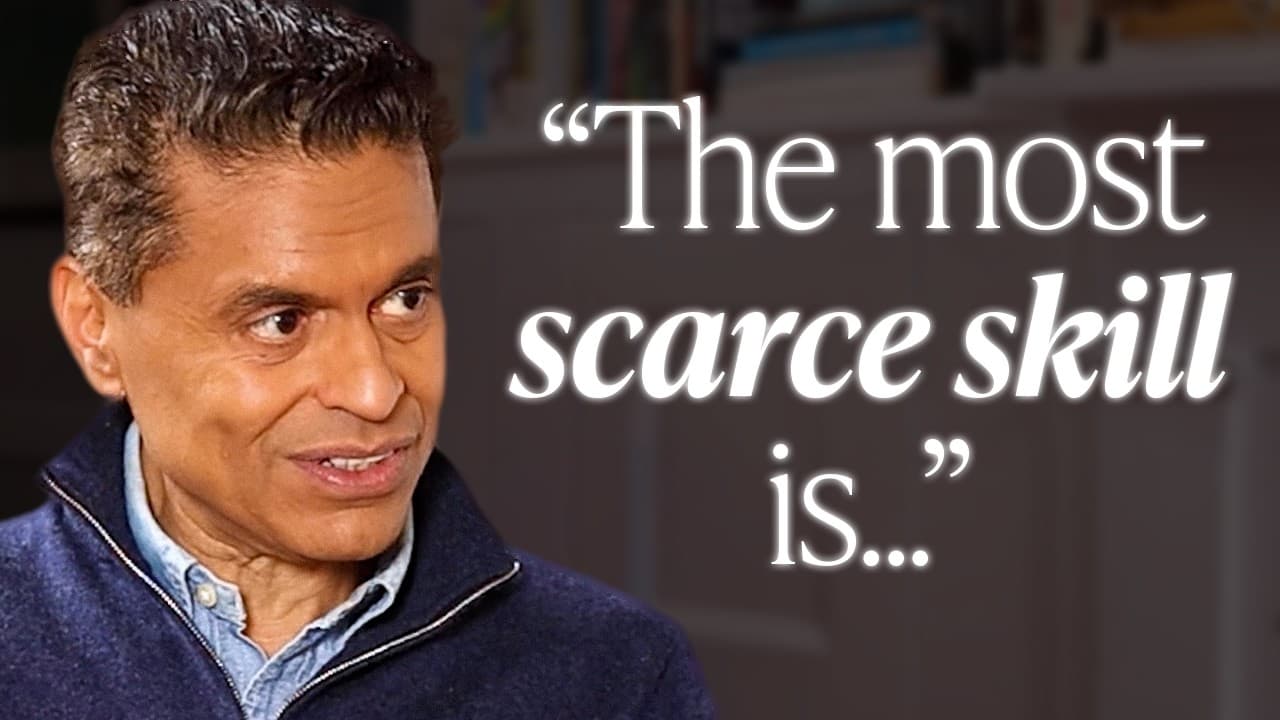
- Judgment is the skill that stays scarce as AI advances. AI defaults to non-controversial 'on the one hand, on the other' answers and cannot put a reputation on the line; a human must supply the courage to make an argument and the judgment of what is right.
Install to Summarize YouTube Videos and Get Transcripts
Explore YouTube Video Summarizer or Get YouTube Transcript Extractor
Questions & Answers
Q: How does Fareed Zakaria write consistently?
Zakaria relies on external structure, specifically deadlines, rather than willpower. He deliberately went into journalism because he doubted he could write unprompted like his self-motivated mentor. Having to produce a column pretty much every week for 25 years gave him the structure he needed, and the repeated practice made writing faster and easier over time. He admits he lacks the self-discipline to write without that obligation.
Q: Why does Fareed Zakaria write books if he finds writing painful?
He writes books out of two forces: guilt and learning. The guilt stems from his abandoned academic path, where if he is not working on a book he feels he is goofing off and wasting his life, since real scholarship feels like the true intellectual work. The learning is that he learns more writing a book than at any other point in his professional life, because it forces deep dives into a subject. He identifies with people who love having written more than writing itself.
Q: How long does it take Fareed Zakaria to write a column now versus when he started?
When Zakaria started writing his Newsweek column around 2000, it would take him about half the week to write a single column. After roughly 25 years of weekly practice, he can now sit down and write the column in about two hours, though it still involves substantial research and thinking. He attributes the improvement to having done it so many times that he can 'pull up and shoot' relatively easily. Books, however, remain much harder and slower.
Q: What was Sam Huntington's writing routine and what did Zakaria learn from it?
Sam Huntington, Zakaria's biggest mentor at Harvard, got up every morning at 6:00 and worked in the basement study of his townhouse on his next big book or article until about 10:00, four hours, before taking the subway into Boston to teach and attend meetings. His principle was that you must start the day doing the real work. Watching this, Zakaria concluded he personally lacked that self-discipline and self-motivation, which pushed him toward journalism's deadline-driven structure instead.
Q: How does Fareed Zakaria use AI in his writing and research?
Zakaria tries to use AI actively as a research assistant rather than a writer. He finds it extraordinary for questions that have definite answers, such as medical questions where he fed Gemini his symptoms and blood test results and it suggested three questions to ask his doctor. For deep intellectual work it falls short because it cannot access the best source books, so it reads only reviews or excerpts, producing work that feels like a sophomore bullshitting. He rejects letting AI do the actual writing.
Q: Why can't AI replace a writer according to Fareed Zakaria?
Zakaria argues part of how a writer develops thoughts is by reading, talking to smart people, and ingesting ideas to arrive at a distinctive original argument, which AI cannot do for you. More importantly, AI lacks the political and intellectual courage to make an argument and put a name behind it. If asked to write, AI usually gives non-committal 'on the one hand, on the other' answers to avoid controversy, and an argument is meaningless unless a human stakes their reputation and credibility on it.
Q: What skill will remain scarce as AI advances, according to Fareed Zakaria?
Zakaria says the skill that will always be scarce is judgment. Even in a scenario of AI singularity, the vague but crucial ability to decide what is the right thing to weigh in on, and what combination of moral and political values to express on a subject, cannot be replicated by AI. This connects to his point that a human must have the courage to advocate a position and put their reputation on the line, something AI can never do.
Q: How has Fareed Zakaria changed the way he writes books?
Zakaria has shifted from a haphazard approach to a structured, team-based one. He used to go into the archives, reread material, then simply sit down and start writing chapter one, filling holes later. Now he plans deliberately: identifying the research needed for each chapter, the topic, and the most important books on the subject, then directing his research assistant to find relevant material. He has gotten much better at using research assistance over his last two books, treating writing as more of a teamwork effort.
Summary & Key Takeaways
-
Zakaria writes books out of guilt and a desire to learn. The guilt comes from his abandoned academic path, where working on a book feels like real scholarship and anything less feels like wasting his life. The learning comes from deep dives that force him to genuinely master a subject before writing.
-
Consistency depends on external structure rather than willpower. Watching his mentor Huntington write four hours every morning, Zakaria realized he lacked that self-discipline, so he entered journalism deliberately for its deadlines, which have forced him to write nearly every week for 25 years and made columns dramatically faster.
-
AI is a powerful research assistant but cannot replace the writer's original thinking or judgment. It excels at questions with clear answers but lacks access to the best sources for deep work, and it cannot supply the intellectual courage to advance an argument under one's own name.
Read in Other Languages (beta)
Share This Summary 📚
Summarize YouTube Videos and Get Video Transcripts with 1-Click
Try YouTube Summary with ChatGPT & Claude or YouTube Transcript Generator
Explore More Summaries from David Perell 📚


Summarize YouTube Videos and Get Video Transcripts with 1-Click
Try YouTube Summary with ChatGPT & Claude or YouTube Transcript Generator