How Did Henry Ford’s Business Strategy Make Ford a Billion-Dollar Company?
TL;DR
Henry Ford made cars affordable and built Ford into a billion-dollar company by combining division of labor, specialized machinery, scientific management, worker incentives, and a moving assembly line. Model T production was divided into 84 steps, while chassis assembly fell from 12 hours and 8 minutes to 93 minutes. These efficiencies supported a $5 daily wage and a $360 Model T price. Read on to see how the strategy reinforced itself.
Transcript
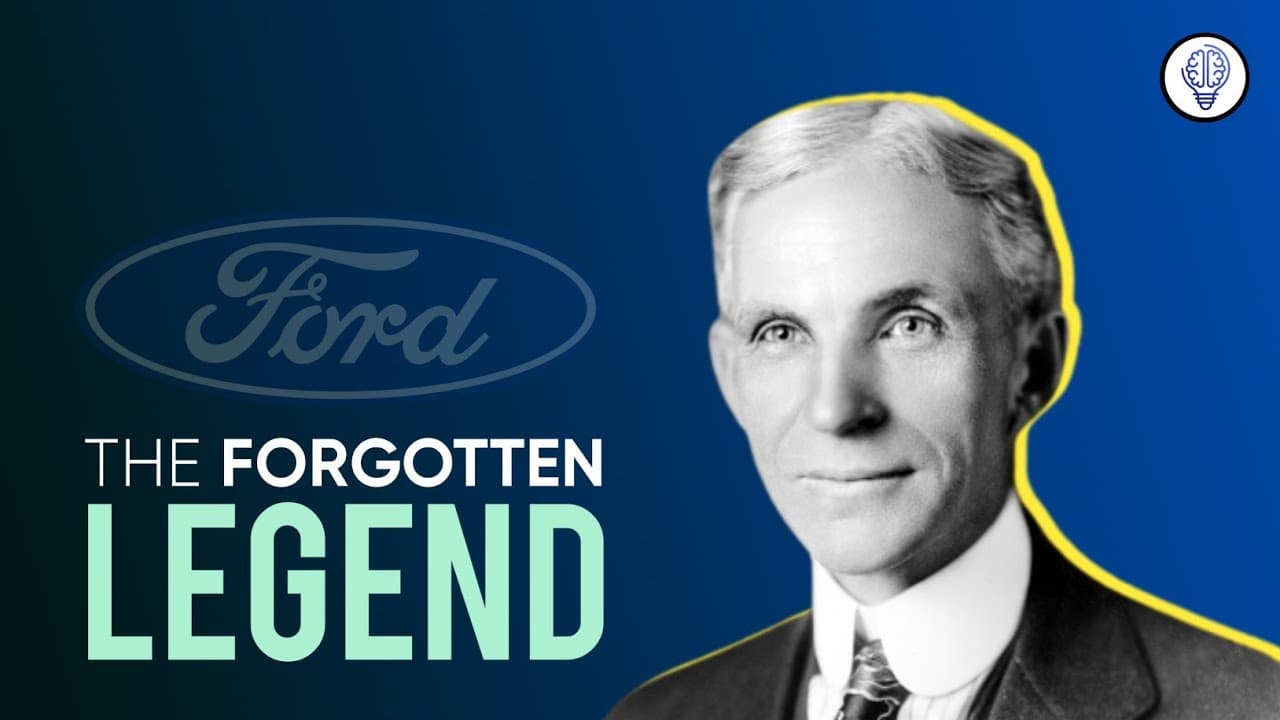
Hi everybody. Henry Ford is one of the greatest businessman of the 20th century. And the most astonishing thing about him is that way back in 1900 itself, in spite of having just $28,000 in investment, he turned the Ford Motor Company into a billion dollar company in just 22 years. And not just that, while every other company during that time was p... Read More
Key Insights
- Ford’s target market was the common consumer, because Henry Ford believed competition for a small group of wealthy car buyers would prevent the company from scaling. Reaching lower market segments required Ford to make profitable cars at prices previously considered impractical.
- Division of labor increased efficiency by breaking complicated production into specialized micro-activities. Ford applied this principle throughout Model T manufacturing, dividing the process into 84 discrete steps so individual workers could concentrate on a narrow, repeatable responsibility.
- Ford’s production system reduced dependence on highly skilled craftspeople by dividing components and creating separate machines for specific tasks. One worker could manage a machine or repeat a small procedure, making workers easier to substitute and reducing wage costs associated with specialized labor.
- Scientific management works by studying movements, energy use, pacing, rest, hydration, and incentives. Frederick Taylor’s pig-iron example increased daily output from 12 tons to 47 tons by prescribing how workers should move, carry materials, drink water, and take frequent short breaks.
- Worker incentives linked higher compensation to measurable productivity. Taylor offered increases of up to 60 percent when workers followed prescribed procedures and achieved targets, while the resulting productivity increase reached 300 percent, illustrating how additional pay could accompany much larger output gains.
- Ford’s $5 workday doubled the prevailing daily wage described in the transcript. Announced on January 5, 1914, the policy attracted workers from across the world, encouraged dedication among those hired, and helped support greater efficiency and profits despite the higher labor expense.
- The moving assembly line brought the car to stationary workers instead of requiring workers to move around a stationary vehicle. Ford adopted the idea after observing meat progress through specialized workstations at a Chicago meatpacking plant, then adapted that workflow to automobile assembly.
- Ford’s efficiency cycle connected specialized work, lower costs, increased demand, larger order volumes, and mass production. These reinforcing effects helped reduce Model T chassis assembly from 12 hours and 8 minutes to 93 minutes while supporting higher wages and a lower selling price.
Install to Summarize YouTube Videos and Get Transcripts
Explore YouTube Video Summarizer or Get YouTube Transcript Extractor
Questions & Answers
Q: How did Henry Ford make the Model T affordable?
Ford redesigned manufacturing around division of labor, specialized machinery, scientific management, worker incentives, and a moving assembly line. Model T production was divided into 84 discrete steps, and chassis assembly time fell from 12 hours and 8 minutes to 93 minutes. These efficiencies reduced production costs and helped bring the Model T’s price down to $360 by 1917.
Q: How did Henry Ford’s business strategy make Ford a billion-dollar company?
Ford targeted ordinary consumers rather than limiting sales to wealthy buyers, then redesigned production to make lower prices profitable. Greater efficiency reduced costs, lower prices increased demand, and higher order volumes supported further mass production. According to the transcript, Ford grew from an investment of $28,000 into a billion-dollar company in 22 years.
Q: Why did Ford target ordinary consumers instead of wealthy buyers?
Henry Ford believed the wealthy automobile market was too small and crowded with competitors such as Chalmer, Cadillac, and 10 other companies. He concluded that Ford could not scale by selling only to rich customers, so the company pursued lower market segments. Doing so required making cars profitably at prices previously considered impractical.
Q: How did division of labor improve Ford’s factories?
Ford divided Model T production into 84 discrete steps and assigned workers narrow, repetitive responsibilities. Workers moved less, avoided switching between activities, and became highly efficient at one procedure. Specialized machines and simpler assignments also reduced Ford’s dependence on highly skilled craftspeople.
Q: What role did scientific management play at Ford?
Scientific management sought efficient ways to perform work by studying movement, pacing, energy use, hydration, rest, and incentives. Frederick Taylor’s pig-iron example increased daily output from 12 tons to 47 tons by prescribing how workers should move materials and take short breaks. Ford collaborated with Taylor and applied related efficiency principles in its factories.
Q: Why did Henry Ford pay workers $5 per day?
Ford introduced the $5 workday on January 5, 1914, doubling the prevailing daily wage described in the transcript. The higher pay attracted workers from around the world and encouraged dedication among those hired. Ford paired that wage with productivity improvements that helped the company remain efficient and profitable.
Q: How did the moving assembly line change Ford’s car production?
The moving assembly line brought the vehicle to stationary workers, each responsible for a specialized task. Previously, workers moved around a stationary car to attach parts. Ford adapted the idea after observing meat move through specialized workstations at a Chicago meatpacking plant.
Q: How could Ford pay workers more while charging less for cars?
Ford’s productivity gains were greater than the added labor expense. Specialized work, scientific management, dedicated machinery, and continuous assembly reduced production time and unit costs. Lower prices then increased demand and order volumes, enabling more mass production and further cost reductions.
Summary & Key Takeaways
-
Ford pursued ordinary consumers because selling expensive cars only to wealthy buyers limited the company’s potential market. Although the Model T initially had a base price of $825, Ford systematically reduced production costs. By 1917, its price had fallen to $360, while sales had increased by 4,100 percent.
-
Ford divided Model T production into 84 discrete steps, assigning workers specialized and repetitive tasks instead of requiring skilled craftspeople to complete major components. This division of labor reduced movement, task switching, training requirements, and dependence on specialized labor, creating a more efficient and less costly manufacturing system.
-
Scientific management, higher wages, rest, incentives, and the moving assembly line reinforced one another. Ford reduced chassis assembly time from 12 hours and 8 minutes to 93 minutes. Greater efficiency lowered costs, lower prices increased demand, and rising orders supported mass production that reduced costs even further.
Read in Other Languages (beta)
Share This Summary 📚
Summarize YouTube Videos and Get Video Transcripts with 1-Click
Try YouTube Summary with ChatGPT & Claude or YouTube Transcript Generator
Explore More Summaries from Think School 📚






Summarize YouTube Videos and Get Video Transcripts with 1-Click
Try YouTube Summary with ChatGPT & Claude or YouTube Transcript Generator