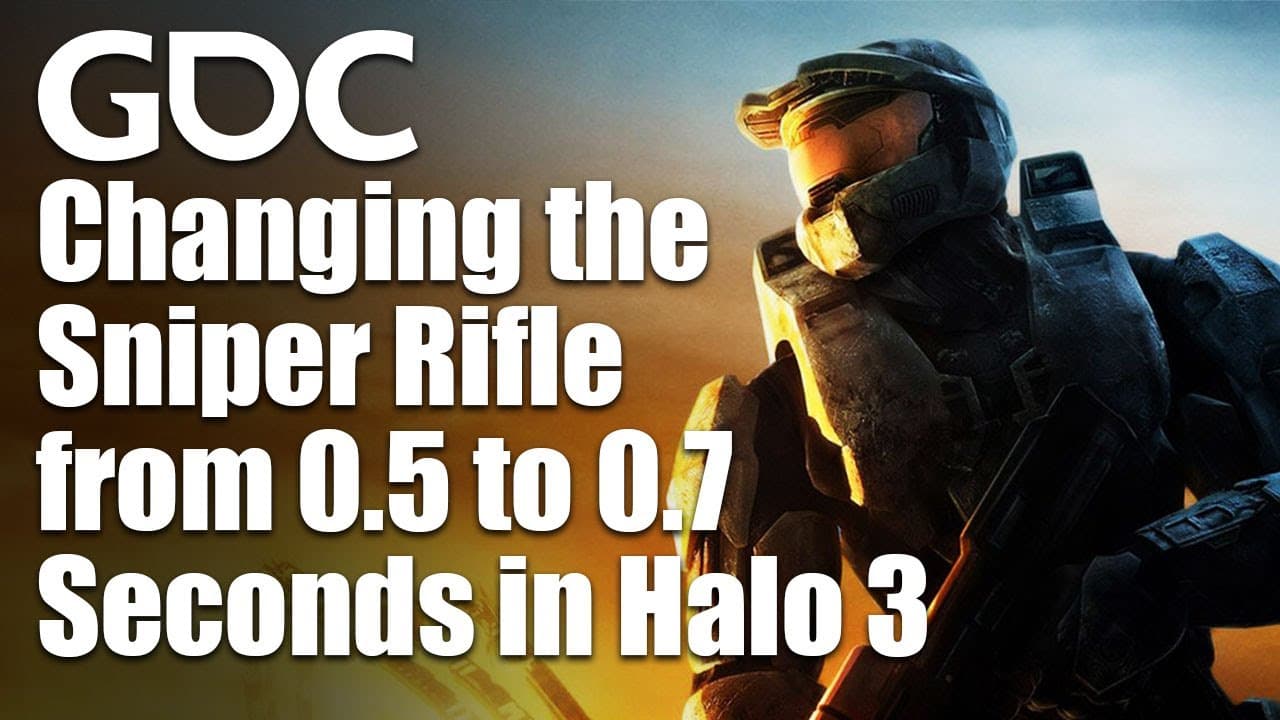
Why Did Halo 3 Change the Sniper Rifle’s Time Between Shots from 0.5 to 0.7 Seconds?
TL;DR
Halo 3’s sniper-rifle firing interval illustrates how designers can balance weapons by repeatedly refining small, manageable details while preserving earlier gains. Bungie used roughly six overlapping balance passes covering flow, strength, limitations, exceptions, and perceptions. The talk also defines balance as longevity and explains how practice builds design intuition, making the full analysis useful for understanding disciplined iteration.
Transcript
all right everybody can I have your attention so you are in room 130 it is 1:30 and I have about 130 slides so we're gonna go really fast welcome to design in detail how to subtitle your talk with an entire paragraph and make sure you don't forget to mention halo 3 before we start is anybody thirsty can I get you anything okay I'm gonna talk very f... Read More
Key Insights
- Balance is longevity, because the only definition presented as practically meaningful is whether a game's balanced state lasts. Balance therefore describes a stable condition of the game rather than an activity that designers simply perform once.
- Balancing in passes resolves a production paradox: meaningful balance comes late, but teams cannot postpone all balancing until development ends. Each pass should produce a stable game, after which designers can refine smaller details without destroying previously achieved balance.
- A developed sense of balance comes from repeatedly playing, testing, predicting, and making mistakes within a narrow field. The Halo 2 team had internalized the game deeply enough to recognize that the version played after release felt different from their expected model.
- Intuition works by building an internal model, anticipating outcomes, and reinforcing successful predictions. Designers can guide this learning process through extensive exposure until the game is sufficiently internalized for unexpected differences to feel immediately wrong.
- Rational reasoning has limited capacity, so designers cannot reliably understand dozens of interacting weapon values simultaneously. The talk argues for reasoning at a very small scale, where fewer factors can be considered carefully and complex balancing problems become manageable.
- Hard choices should be made deliberately rather than postponed, left to chance, or determined indirectly by unrelated constraints. Halo 2's sniper rifle was considered for a patch, but it was not changed because other proposed adjustments had greater impact.
- Paper design belongs in pre-production and should cover every game object. Starting before large production demands accumulate, while avoiding a premature exit from pre-production, is presented as a disciplined investment that saves development time later.
- The sniper rifle's firing interval demonstrates pointillist analysis: a designer can isolate one tiny parameter and examine it exhaustively. Focusing on a narrow detail exposes broader lessons about iteration, perception, production constraints, intuition, and decision-making.
Install to Summarize YouTube Videos and Get Transcripts
Explore YouTube Video Summarizer or Get YouTube Transcript Extractor
Questions & Answers
Q: What Halo 3 sniper-rifle change does the talk examine?
The talk focuses on changing the sniper rifle’s time between shots from 0.5 to 0.7 seconds. Jaime Griesemer uses this single parameter to explore broader lessons about weapon balance, iteration, perception, intuition, and production constraints.
Q: What does balance mean in multiplayer game design?
Griesemer defines balance as longevity: if a balanced state does not last, it was not truly balanced. He describes balance as a state of the game rather than a process that designers complete once.
Q: How did Bungie balance Halo 3 before development ended?
Bungie balanced the game in successive passes, leaving it in a stable state after each pass. Halo 3 had roughly six overlapping passes involving flow, strength, limitations, exceptions, and perceptions, with later work refining details without undoing earlier gains.
Q: What is the balancer’s paradox in game development?
The balancer’s paradox is that balance cannot happen until the end of development, yet it also cannot wait until the end. Balancing in passes resolves this tension by producing a stable game at each stage while allowing progressively finer adjustments.
Q: Why is weapon balancing difficult to reason about?
A weapon contains many interacting values, while rational thought can carefully manage only a small number of factors at once. The talk recommends isolating tiny details, such as the sniper rifle’s firing interval, and examining them exhaustively.
Q: How do game designers develop an intuition for balance?
Designers build intuition through repeated play, testing, prediction, feedback, and mistakes within a focused field. Extensive experience creates an internal model of expected behavior, making unexpected differences feel immediately wrong.
Q: Why did Halo 2 feel unbalanced to its designers after release?
After release, Bungie’s designers played Halo 2 online and found that it felt different from the version they had internalized while playing in the office. Their developed sense of balance suggested that parts of the shipped multiplayer experience would not last as intended.
Q: Why was the Halo 2 sniper rifle not changed in a patch?
The sniper rifle ranked near the top of Bungie’s proposed Halo 2 changes, but it was not patched. Other adjustments were judged to have greater impact, illustrating the need to make difficult balancing choices deliberately.
Summary & Key Takeaways
-
Jaime Griesemer frames game balance as longevity: a balanced game remains viable over time. Halo 2 remained widely played for several years, yet Bungie's designers felt that its shipped multiplayer balance differed from the version they had internalized during development, revealing problems they expected would become more apparent later.
-
Halo 3's balancing process addressed the paradox that balance cannot happen before development ends, but also cannot wait until the end. The team used roughly six overlapping passes covering flow, strength, limitations, exceptions, and perceptions, aiming to leave the game in a stable state after every pass without undoing earlier progress.
-
The talk uses the sniper rifle's time between shots as a tiny detail through which broader design principles can be examined. Its central lessons are to begin with paper designs, cultivate reliable intuition through repeated experience, reduce complex decisions to manageable factors, and deliberately make difficult choices instead of allowing circumstances to decide.
Read in Other Languages (beta)
Share This Summary 📚
Summarize YouTube Videos and Get Video Transcripts with 1-Click
Try YouTube Summary with ChatGPT & Claude or YouTube Transcript Generator
Explore More Summaries from GDC Festival of Gaming 📚


Summarize YouTube Videos and Get Video Transcripts with 1-Click
Try YouTube Summary with ChatGPT & Claude or YouTube Transcript Generator