How to Build an Agentic OS for Claude Models
TL;DR
Build an agentic operating system by organizing four elements: applications, routines, memory, and skills. Start with reusable skills, add a structured memory system, then progress to scheduled routines, application connectors, and custom dashboards that surface important information, launch workflows, and provide access to previously generated artifacts.
Transcript
Claude has evolved with today's generation of Claude 5 models being a lot more powerful than everything that came before. But the way most people set up their agents and their operating systems have not caught up. So today I'll teach you this different framework of setting up your Aentic OS so you can get the full power from these new models to mak... Read More
Key Insights
- The ARMS framework organizes an agentic operating system into applications, routines, memory, and skills. These four elements give the AI agent a structured workspace and help ensure that its available context, recurring work, tools, and procedures support the user’s actual workflow.
- The visual dashboard represents only about 20 to 30% of the operating system’s stated value. The remaining 70% lies beneath the interface, particularly in how context and workspace files are organized so the AI agent can work effectively instead of encountering a confusing environment.
- The recommended learning sequence starts with skills, continues with memory, and then advances to routines and applications. Users can schedule recurring work or build applications and connectors after they have developed confidence in reusable procedures and a dependable system for preserving relevant context.
- A skill is a shortcut to a standard operating procedure. A repeated task becomes a strong candidate for a skill when the user notices that they have prompted Claude to perform the same work twice, because the procedure can then be documented and reused.
- Custom skills are important because individual workflows differ. Prebuilt skills can provide a starting point, while a skill creator can convert useful instructions or external text supplied by the user into a repeatable procedure that can be tested and refined inside the workspace.
- A complex skill can contain more than a single Markdown instruction file. Its SKILL.md can act as a router that directs the agent to supporting reference files, allowing the procedure to use richer context without placing every instruction inside one large document.
- Visual references strengthen design-oriented skills by supplying concrete brand guidance. The example design skill includes information about fonts, color palettes, and a recognizable company style, enabling the agent to create branded assets such as a formatted PDF guide from a relatively simple prompt.
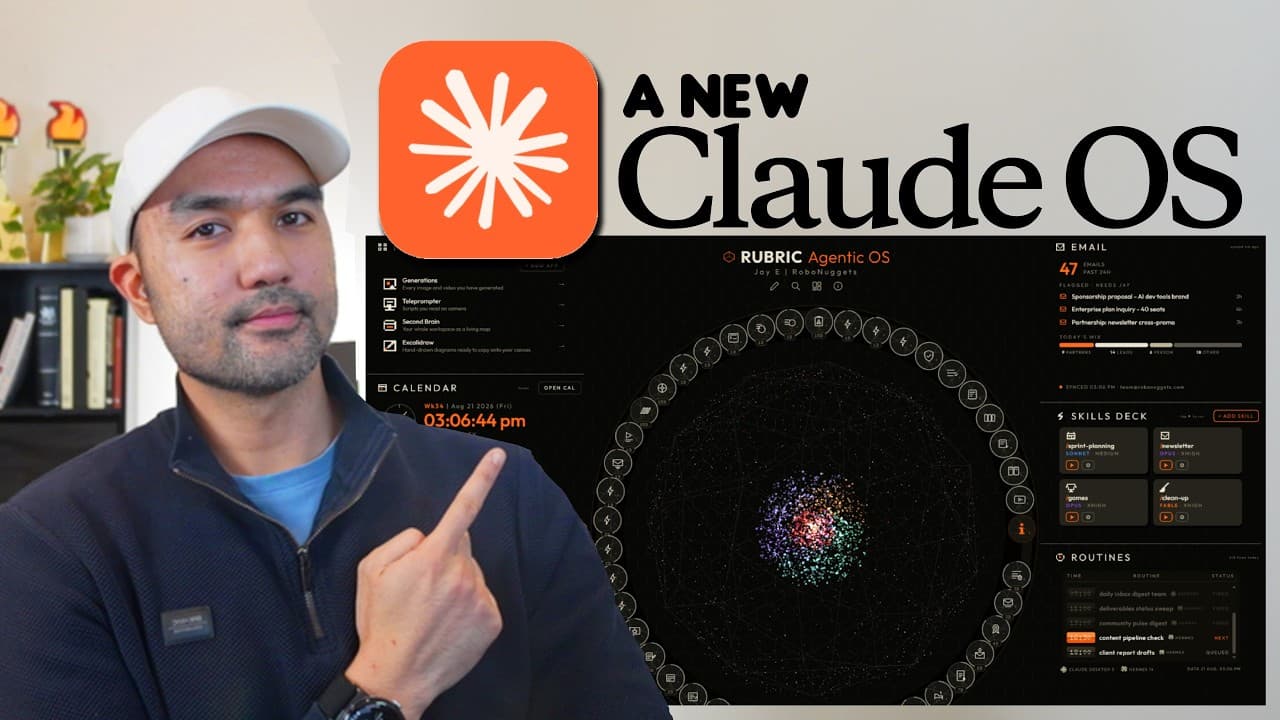
- The command center combines information access and workflow control in one interface. Its widgets can show calendar events, relevant time zones, email summaries, scheduled tasks, model and effort settings, custom applications, searchable artifacts, and access to a visual second-brain system.
Install to Summarize YouTube Videos and Get Transcripts
Explore YouTube Video Summarizer or Get YouTube Transcript Extractor
Questions & Answers
Q: What is the ARMS framework for an agentic OS?
The ARMS framework is a way to organize an agentic operating system around four elements: applications, routines, memory, and skills. Applications provide tools and interfaces, routines cover scheduled or recurring tasks, memory preserves useful context, and skills encode repeatable procedures. Together, these elements create a structured workspace in which an AI agent can support daily work more effectively.
Q: How should beginners build an agentic operating system?
Beginners should build from the bottom up by starting with skills and then establishing a memory system. Once those foundations feel dependable, they can progress to routines, scheduled tasks, custom applications, and connectors for applications they already use. This order reflects the presented learning path and prevents the visible dashboard from becoming the focus before its underlying workflows and context are organized.
Q: When should a repeated task become an AI skill?
A task should become a skill when the user notices that they are prompting Claude to perform the same work more than once. The repeated instructions can be converted into a standard operating procedure that the agent can invoke consistently. This reduces the need to reconstruct the prompt each time and creates a procedure that can be tested, refined, and enriched with references.
Q: What can an agentic OS dashboard display?
An agentic OS dashboard can display calendar events, relevant time zones, email summaries, messages flagged for attention, custom micro applications, YouTube information, routines, and scheduled task times. It can also provide controls for selecting a model and effort level, launch appropriate skills, search previously generated artifacts, open saved HTML files, and provide access to a visual second-brain system.
Q: Why is workspace organization important for AI agents?
Workspace organization is important because the visible interface captures only part of the proposed system’s value. The transcript attributes about 20 to 30% of the value to the dashboard and the remaining 70% to what lies underneath. Well-organized context, skills, memory, and files help the AI agent find relevant guidance and work with the user’s system rather than against it.
Q: How can a skill use multiple reference files?
A sophisticated skill can use its SKILL.md file as a router rather than storing every instruction in one document. The router directs the agent to other files inside the skill folder when particular references are needed. Those files can contain detailed procedures, design guidance, or visual materials, giving the skill richer context while keeping its primary instructions organized and easier to navigate.
Q: How do visual references improve design skills?
Visual references improve a design skill by giving the agent concrete guidance about the intended brand and appearance. In the example, supporting files describe fonts, color palettes, and the company’s visual style. When the design skill is invoked, these references help the agent produce assets, including a formatted PDF guide, that already reflect the established brand from a simple request.
Q: How can an agentic OS be adapted for client work?
An established personal agentic OS can serve as a foundation for client-specific versions. The dashboard, widgets, applications, workflows, and visual presentation can be customized to fit the organization being served. The transcript presents design mockups for a financial services firm in Australia and for Beto Green, and suggests packaging this type of customized command center as an AI consulting service.
Summary & Key Takeaways
-
The proposed agentic operating system uses the ARMS framework: applications, routines, memory, and skills. Its visible command center combines calendars, time zones, email summaries, custom widgets, task schedules, skill controls, artifact search, and a second brain, but the underlying organization of context and workspace provides most of its value.
-
Users are advised to develop the system from the bottom up. They should begin by learning and creating skills, establish a memory system after becoming comfortable with skills, and only then advance to scheduled routines, custom applications, or connectors for existing applications. This progression keeps the operating system grounded in reusable workflows.
-
Skills are reusable versions of standard operating procedures and should be created when the same task is prompted more than once. Simple skills may contain only a SKILL.md instruction file, while complex skills can route to multiple references, including brand guidance, fonts, color palettes, and visual examples for more consistent outputs.
Read in Other Languages (beta)
Share This Summary 📚
Summarize YouTube Videos and Get Video Transcripts with 1-Click
Try YouTube Summary with ChatGPT & Claude or YouTube Transcript Generator
Explore More Summaries from Jay E | RoboNuggets 📚
Summarize YouTube Videos and Get Video Transcripts with 1-Click
Try YouTube Summary with ChatGPT & Claude or YouTube Transcript Generator