When to Use Claude Sonnet 5.5 vs Opus 5.5
TL;DR
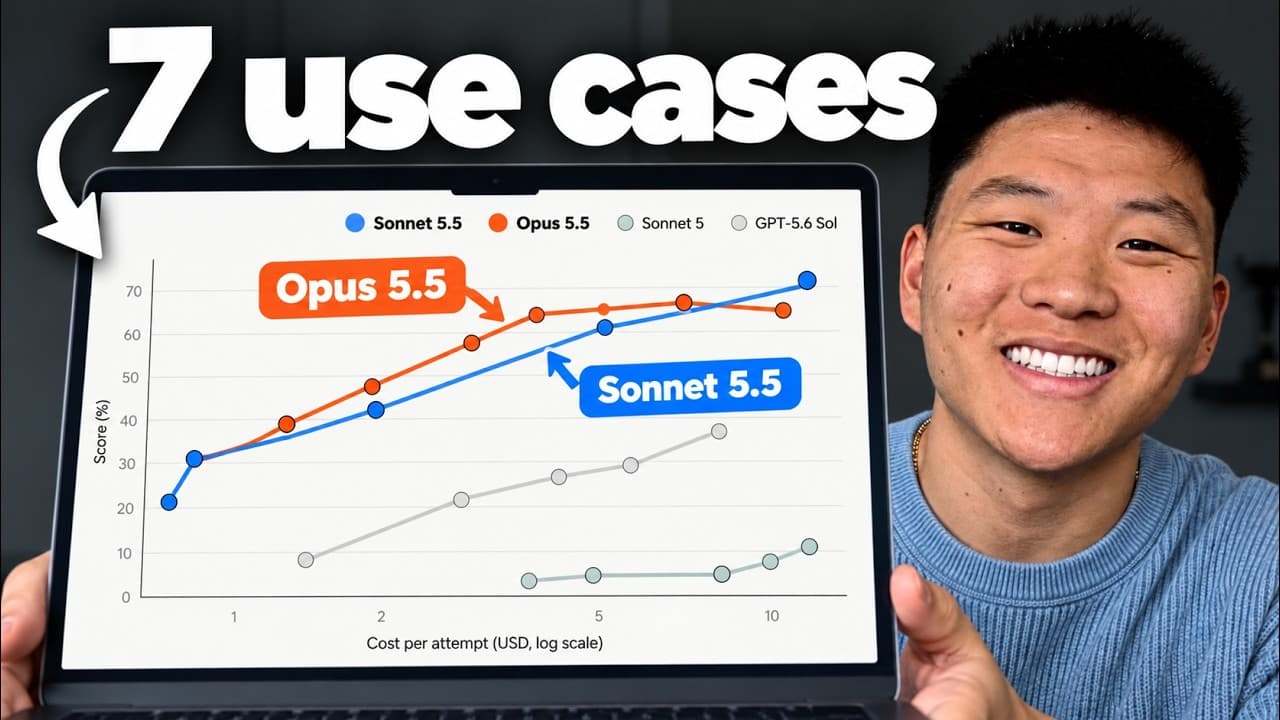
Use Sonnet 5.5 first when a task has a clear specification and an objectively checkable result. It costs roughly half as much as Opus 5.5 and can finish some workflows much faster, while Opus is better suited to subjective, complex work requiring judgment, creativity, or stronger design taste.
Transcript
Cloud Sonnet 5.5 is here and it is a clear upgrade over Claude Sonnet 5. Running 30% faster as well as costing 30% less for most work. So, I've been playing around with it all day on my actual real workflows. Things like building websites, taking a bunch of messy data and turning that into spreadsheets. Also, Excel sheets with different views as we... Read More
Key Insights
- Sonnet 5.5 is priced at $2 per million input tokens and $10 per million output tokens, while Opus 5.5 is priced at $4 and $20. Based on those stated rates, Opus costs roughly twice as much for comparable token usage.
- The clearest model-selection rule is to use Sonnet first when a task has an objective definition of done. Well-scoped coding, bug fixes, routine development, polished documents, slides, spreadsheets, and one-pagers were presented as suitable examples of work with clear specifications and verifiable results.
- Opus 5.5 is positioned for complex work that requires careful judgment, including long-horizon agentic coding and knowledge work. It is also the preferred option when success is subjective or when the model must act as a thought partner and help determine what a good result should be.
- The landing-page comparison showed that a cheaper model can deliver competitive work without winning every qualitative category. Sonnet created the more impressive hero experience, while Opus produced the reviewer’s preferred overall page through better storytelling and use of a real branded product image.
- Sonnet completed the landing-page task in 28 minutes using 20 million input tokens and 134,000 output tokens. Opus required 52 minutes, 37 million input tokens, and 148,000 output tokens, making its run approximately twice as long and roughly twice as expensive.
- The landing-page verdict favored Sonnet because Opus was not judged to be twice as good despite its higher cost. The reviewer believed Sonnet’s main weakness, an invented product can, could likely be corrected by explicitly asking it to replace the fake image with authentic brand imagery.
- Opus delivered the stronger motion-design reel because its background, animations, copy, branding, and sound design felt more consistent with Glido. It also retrieved a quote from the company website, while Sonnet’s version remained creative and stronger than the reviewer had expected.
- The most practical evaluation method is to test reusable skills with both models and record which model performs better for each workflow. This creates a task-specific selection system rather than assuming that the more expensive model is always better or that one model fits every assignment.
- More videos from this channel:
- More from this channel: Nate Herk | AI Automation
Install to Summarize YouTube Videos and Get Transcripts
Explore YouTube Video Summarizer or Get YouTube Transcript Extractor
Questions & Answers
Q: When should I use Sonnet 5.5 instead of Opus 5.5?
Use Sonnet 5.5 first when the assignment has a clear specification, an objective definition of done, and an easy way to verify the result. The examples given include everyday coding, bug fixes, high-volume development, documents, slides, spreadsheets, and one-pagers. If Sonnet falls short, a focused revision may still be more economical than beginning with Opus.
Q: When is Opus 5.5 worth the higher cost?
Opus 5.5 is most appropriate for difficult or subjective work that requires careful judgment, creativity, or help defining what success should look like. The source specifically associates it with long-horizon agentic coding, knowledge work, and the hardest problems requiring the most intelligence. Its motion-design win suggests that stronger taste can justify the extra expense in selected creative workflows.
Q: How much do Sonnet 5.5 and Opus 5.5 cost?
Sonnet 5.5 is stated to cost $2 per million input tokens and $10 per million output tokens. Opus 5.5 costs $4 per million input tokens and $20 per million output tokens. Opus is therefore roughly twice as expensive at the listed token rates, so its additional quality should be evaluated against the requirements of each task.
Q: Which model performed better in the landing-page test?
Sonnet 5.5 received the final win in the landing-page comparison, although Opus produced the reviewer’s preferred overall page. Sonnet created a more striking and interactive hero section, but it invented a product can instead of using an authentic image. Opus used real branded imagery and told a stronger overall story, yet its improvement was not considered worth roughly twice the cost.
Q: Why did Sonnet win despite Opus producing the better overall page?
Sonnet won because its landing page was already competitive, finished much faster, and cost substantially less. The reviewer considered its principal flaw, the generated can image, straightforward enough to address with another prompt requesting real product imagery. Since Opus was not judged to provide twice the quality for roughly twice the expense, Sonnet offered the stronger value in that test.
Q: How did the landing-page runs compare in speed and token use?
Sonnet’s landing-page run took 28 minutes and used 20 million input tokens plus 134,000 output tokens. Opus took 52 minutes and used 37 million input tokens plus 148,000 output tokens. The comparison therefore showed a large difference in runtime and input usage, while the gap in output tokens was comparatively smaller.
Q: Which model produced the better motion-design reel?
Opus 5.5 produced the preferred motion-design reel. Its background, animation choices, copy, sound design, and overall presentation felt more consistent with the Glido brand. It also found and incorporated a quote from the company website. Sonnet still created a respectable reel with creative elements, including pixels forming a G and an AI-generated video sequence.
Q: How should teams choose a model for recurring workflows?
Teams can run the same reusable skill and prompt with both models, compare the outputs, speed, token usage, and monetary cost, then record which model performs better for that specific workflow. Clear, verifiable tasks should begin with Sonnet, while subjective assignments may benefit from Opus. This approach creates evidence-based model choices without assuming one model is universally superior.
Summary & Key Takeaways
-
Sonnet 5.5 costs $2 per million input tokens and $10 per million output tokens, while Opus 5.5 costs $4 and $20 respectively. The practical recommendation is to start with Sonnet for clearly scoped, verifiable work, then consider Opus when the task demands judgment, creativity, or help defining success.
-
In the landing-page test, Sonnet produced the stronger hero section and completed its run in 28 minutes, compared with 52 minutes for Opus. Opus delivered the better overall page and used a real product image, but the reviewer awarded Sonnet the win because a focused revision could potentially correct its invented can image.
-
In the motion-design test, Opus produced the preferred result because its animations, copy, branding, background, and sound design felt more consistent with Glido. Sonnet still performed better than expected and included creative touches, but Opus demonstrated enough additional design taste to justify winning that specific comparison despite costing more.
Read in Other Languages (beta)
Share This Summary 📚
Summarize YouTube Videos and Get Video Transcripts with 1-Click
Try YouTube Summary with ChatGPT & Claude or YouTube Transcript Generator
Explore More Summaries from Nate Herk | AI Automation 📚






Summarize YouTube Videos and Get Video Transcripts with 1-Click
Try YouTube Summary with ChatGPT & Claude or YouTube Transcript Generator