How to Find and Validate a Market Gap in India
TL;DR
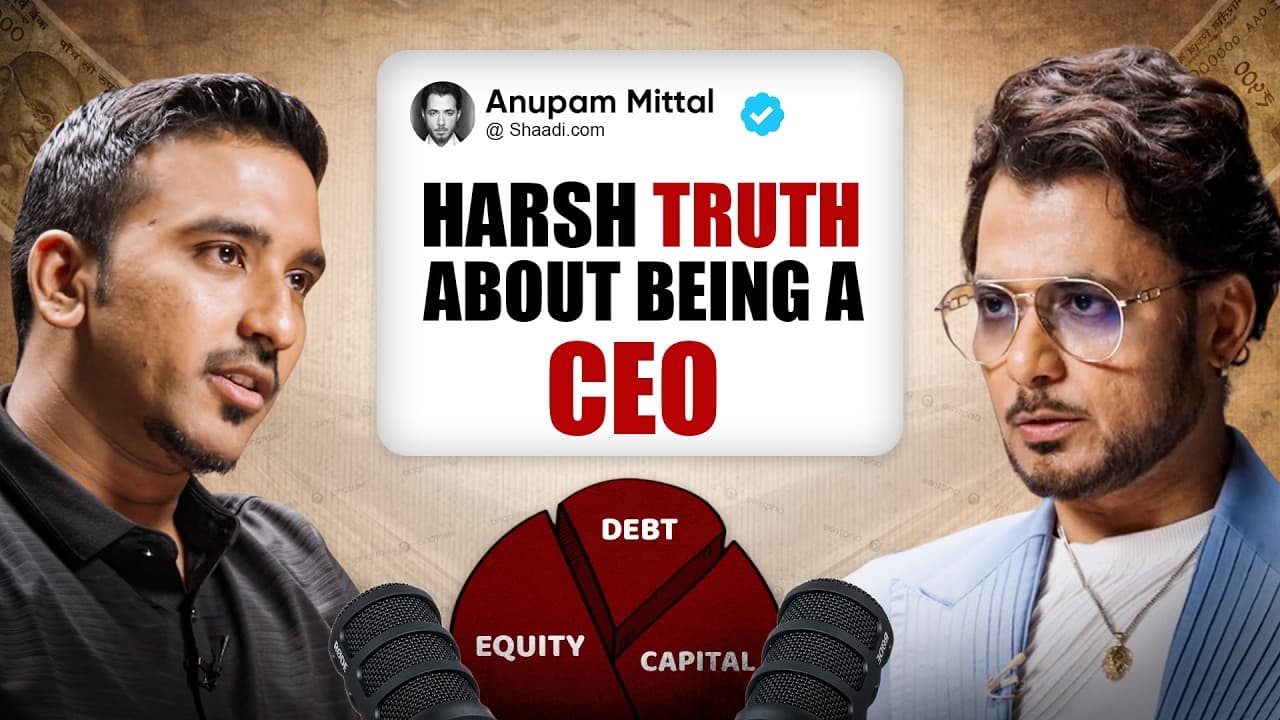
Choose funding according to the business you want to build and the life commitment you are prepared to make. Customer payments offer inexpensive capital and strong validation, while equity funding creates demanding growth and return obligations. Entrepreneurs should also consider friends and family, government schemes, grants, debt, NBFCs, and revenue-based financing before deciding which source fits their industry and ambition.
Transcript
How should an entrepreneur evaluate whether they need funding in the first place or not? When I first built out shadi.com, I built it on capital as well. But you know where my early capital came from? What is the simplest way to validate an idea? People say this is a $10 billion market. Even if I get 1% of it, I'll make 100 million. That's just a w... Read More
Key Insights
- Equity funding is a commitment to generate investor returns, pursue aggressive growth, hire a capable team, establish a scalable go-to-market strategy, and potentially raise additional rounds. A founder should treat that obligation as a major decision about the next phase of life.
- Early-stage investors may expect returns of at least 50% IRR, according to Mittal, while organized investors may expect a minimum of roughly 30% IRR. Meeting such expectations can require years of exceptional growth rather than the steady expansion of a conventional business.
- Customer capital is the cheapest funding source described because it requires neither interest payments nor equity dilution. It also tests whether customers value the offering enough to spend money, which provides more meaningful validation than encouragement from people who want the founder to succeed.
- Paid demand is stronger evidence than verbal approval because customers vote with their wallets. Supportive reactions from friends and family may reflect personal goodwill, while a purchase demonstrates that the product or service addresses a need strongly enough to justify an actual transaction.
- B2B service companies can often begin with customer funding by selling an existing technical or professional capability. Revenue from the first customer can support subsequent development, although the company may later require additional working capital as its operations and commitments expand.
- Friends and family can provide more patient capital than professional investors because their expectations may focus primarily on the founder’s success. This route may suit a business that needs a limited amount to test product-market fit, launch a brand, or develop defensible intellectual property.
- Government support can include grants or debt offered at low interest rates, with specific opportunities available to women entrepreneurs and small businesses. Founders should explore these programs fully because they may provide funding without the growth and return obligations attached to institutional equity.
- Funding choice is determined by ambition, industry structure, competitive intensity, and the kind of company being built. A capital-intensive field such as AI product development may make large fundraising more likely, while service businesses or smaller brands may support customer-funded or patient-capital paths.
Install to Summarize YouTube Videos and Get Transcripts
Explore YouTube Video Summarizer or Get YouTube Transcript Extractor
Questions & Answers
Q: How should a founder decide whether to raise equity funding?
A founder should begin by deciding what kind of business and life commitment they want. Equity funding creates an obligation to deliver substantial investor returns, build a strong team, pursue rapid growth, establish a scalable go-to-market strategy, and possibly complete later fundraising rounds. The decision should reflect the company’s ambition, industry, competitive environment, and expected capital requirements.
Q: Why is equity capital considered expensive for a startup?
Equity capital is expensive because founders exchange ownership while accepting demanding return expectations. Mittal says organized investors may expect at least roughly 30% IRR, while an early-stage investor like him may expect 50%. Attempting to meet those targets can force the company toward aggressive growth, additional hiring, expansion, and subsequent funding rounds over a long period.
Q: What is the cheapest source of startup capital?
Customer payments are presented as the cheapest source of capital because the founder gives away neither interest nor equity. This money also provides commercial validation because a customer has chosen to pay for the offering. Shaadi.com initially used customer capital, and many B2B service companies similarly finance early operations by selling their capabilities before seeking outside investment.
Q: What is the simplest way to validate a business idea?
The clearest validation described is getting customers to pay. Verbal approval can be misleading, especially when it comes from friends or family who personally want the entrepreneur to succeed. Payment represents a stronger signal because customers vote with their wallets. It simultaneously demonstrates demand and supplies capital that can help the founder continue developing the business.
Q: When should founders consider friends and family funding?
Friends and family funding can be suitable when a founder needs a relatively limited amount, is still testing product-market fit, wants to launch a brand, or believes the company is developing intellectual property that others cannot easily replicate. Such investors may be more patient than VCs because their primary expectation is often to see the founder succeed.
Q: How can government programs help entrepreneurs fund a business?
Government programs may provide grants or debt at low interest rates, reducing the need to sell equity. The discussion highlights schemes for women entrepreneurs and small businesses, and notes that Yoga Bar used government grant capital. Founders should investigate available programs carefully because this support can provide both financing and confidence through a detailed documentation and review process.
Q: When are debt and revenue-based financing appropriate?
Debt can be useful when a business can manage repayment obligations without surrendering ownership. Banks may request guarantees, while NBFCs and revenue-based financing companies can provide working-capital support to businesses with operating traction. The appropriate option depends on what the entrepreneur is building, how much capital is required, and whether revenue can reliably support financing costs.
Q: Why might an AI product company need external investment?
An AI product company is presented as an example of a business operating in a hot, highly competitive space where significant capital may be necessary. Mittal argues that building such a company without raising substantial funding is more likely to fail, though exceptions can occur. Choosing that path therefore becomes both a financing decision and a lifestyle commitment.
Summary & Key Takeaways
-
Raising equity capital is a long-term commitment, not a routine milestone. Investors expect substantial returns, which forces founders to pursue rapid growth, recruit a strong team, develop a scalable go-to-market strategy, and often raise subsequent rounds. The decision should therefore reflect the founder’s ambitions and desired way of life.
-
Customer capital can finance early development while validating genuine demand. Shaadi.com initially relied on money from customers, demonstrating that buyers who pay provide stronger evidence than supportive comments from friends or family. This approach avoids interest and dilution, making it especially relevant to service companies and other B2B businesses.
-
Founders should evaluate multiple funding sources before selling equity. Friends and family may provide patient capital, while banks, government programs, grants, NBFCs, working-capital loans, and revenue-based financing serve different needs. The appropriate choice depends on the amount required, business model, competitive environment, industry characteristics, and intended growth rate.
Read in Other Languages (beta)
Share This Summary 📚
Summarize YouTube Videos and Get Video Transcripts with 1-Click
Try YouTube Summary with ChatGPT & Claude or YouTube Transcript Generator
Explore More Summaries from Think School 📚






Summarize YouTube Videos and Get Video Transcripts with 1-Click
Try YouTube Summary with ChatGPT & Claude or YouTube Transcript Generator