How to Articulate Thoughts Clearly and Intelligently
TL;DR
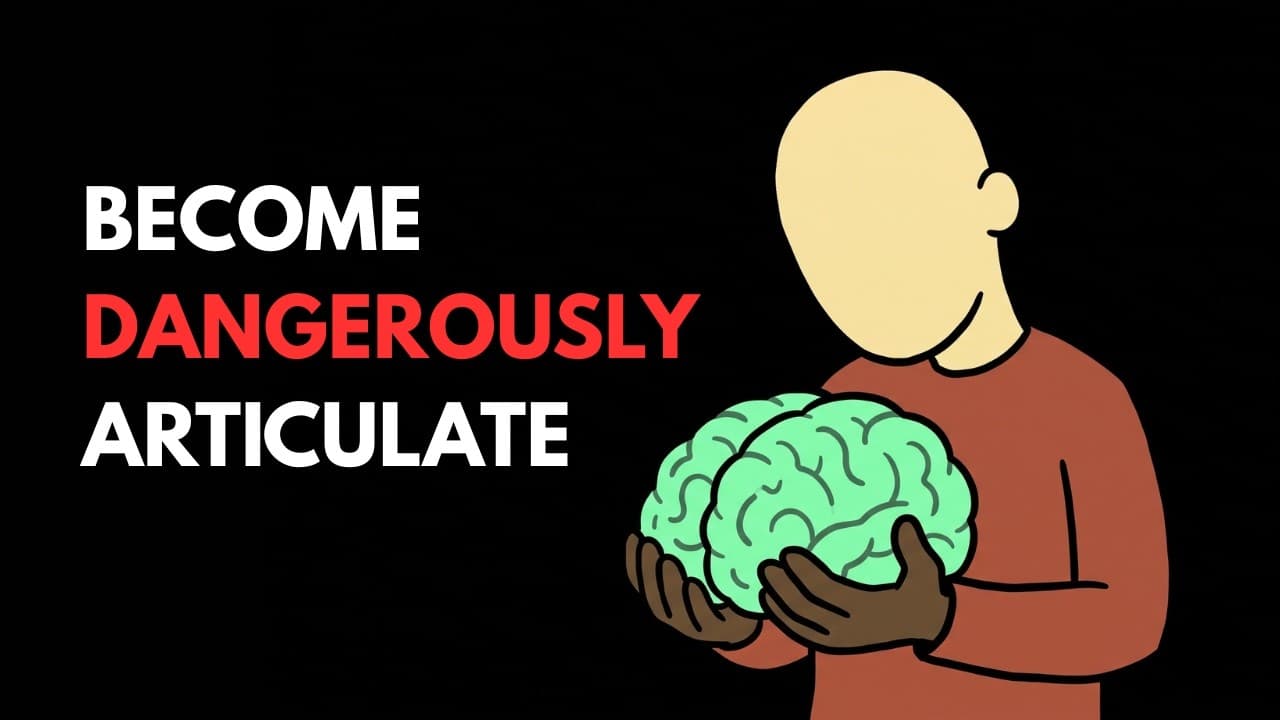
Articulating thoughts clearly isn't about using big words but organizing your ideas. The key lies in understanding the psychology of verbal intelligence, which involves structuring your thoughts before speaking. By practicing concise expression and avoiding complex vocabulary, you can communicate more effectively and be better understood.
Transcript
You can understand something perfectly and still be completely unable to say it. You know exactly what you mean. You can feel the whole idea sitting there clear and complete somewhere behind your eyes. And then someone asks you to explain it and what comes out of your mouth is a mess. Half sentences. A story that starts in the wrong place. A point ... Read More
Key Insights
- Verbal intelligence isn't about having a large vocabulary; it's about organizing ideas before speaking.
- Daniel Oppenheimer's study shows complex language makes people sound less intelligent.
- Willem Levelt's model describes speech production in three stages: conceptualizer, formulator, and articulator.
- Steven Pinker's web/string/tree framework explains why complex minds produce tangled speech.
- Nelson Cowan's research suggests working memory can hold 3-5 chunks of information at once.
- Frieda Goldman-Eisler found that pauses often precede unpredictable, important words.
- Lev Vygotsky argued that thought is completed through language, not just expressed by it.
- Practicing articulation in private can lead to clearer, more structured public speaking.
Install to Summarize YouTube Videos and Get Transcripts
Explore YouTube Video Summarizer or Get YouTube Transcript Extractor
Questions & Answers
Q: How can I articulate my thoughts more clearly?
To articulate thoughts clearly, focus on organizing ideas before speaking. Avoid complex vocabulary as it can make you seem less intelligent. Use simple language and structure your thoughts using the web/string/tree model. Practice speaking privately to improve clarity and confidence in public.
Q: What is the psychology behind verbal intelligence?
Verbal intelligence involves understanding the process of organizing thoughts before speaking. It's not about having a large vocabulary but about structuring your ideas. The psychology behind it includes processing fluency, macro planning, and the conversion of complex mental webs into linear speech.
Q: Why do big words make people sound less intelligent?
Big words can make people sound less intelligent because they increase cognitive load on listeners, leading to lower processing fluency. Listeners perceive the effort required to decode complex language as a reflection of the speaker's lack of clarity or understanding, as shown in Daniel Oppenheimer's study.
Q: What are the stages of speech production?
Willem Levelt's model outlines three stages of speech production: conceptualization, formulation, and articulation. The conceptualizer decides the meaning, the formulator selects words and grammar, and the articulator executes speech. Breakdown often occurs in the conceptualization stage, affecting clarity.
Q: How does Steven Pinker's web/string/tree framework help in communication?
Steven Pinker's web/string/tree framework helps by illustrating how complex ideas (web) must be structured (tree) before being communicated in a linear fashion (string). This model aids in organizing thoughts into a coherent order, making speech clearer and more understandable for listeners.
Q: What is processing fluency in verbal communication?
Processing fluency refers to the ease with which information is processed by listeners. In verbal communication, using simple language enhances processing fluency, making speech easier to understand and more engaging. Complex language reduces fluency and can negatively impact perceived intelligence.
Q: How does practicing articulation privately improve public speaking?
Practicing articulation privately allows you to organize and refine your thoughts without pressure. This preparation helps in delivering clearer and more structured speech in public. Techniques include explaining concepts aloud and using voice memos, which can lead to improved verbal intelligence over time.
Q: Why is it important to state the main point first in communication?
Stating the main point first provides listeners with a clear understanding of the message's purpose. It helps in organizing subsequent information and keeps the listener engaged. This approach prevents the common pitfall of burying the main idea under excessive background details, enhancing overall clarity.
Summary & Key Takeaways
-
Verbal intelligence involves organizing thoughts before speaking, not using complex vocabulary. Daniel Oppenheimer's research shows that simpler language is perceived as more intelligent. Structuring thoughts using Steven Pinker's web/string/tree model helps in clear communication.
-
Willem Levelt's model outlines three stages of speech: conceptualization, formulation, and articulation. Most articulation issues stem from poor macro planning, where thoughts aren't organized effectively before speaking.
-
Practicing articulation privately can improve public speaking. Techniques include stating the main point first, limiting information chunks, and allowing pauses for thought selection. These strategies enhance clarity and listener engagement.
Read in Other Languages (beta)
Share This Summary 📚
Summarize YouTube Videos and Get Video Transcripts with 1-Click
Try YouTube Summary with ChatGPT & Claude or YouTube Transcript Generator
Explore More Summaries from PsychToons 📚





Summarize YouTube Videos and Get Video Transcripts with 1-Click
Try YouTube Summary with ChatGPT & Claude or YouTube Transcript Generator