How to use Python comparison operators effectively
TL;DR
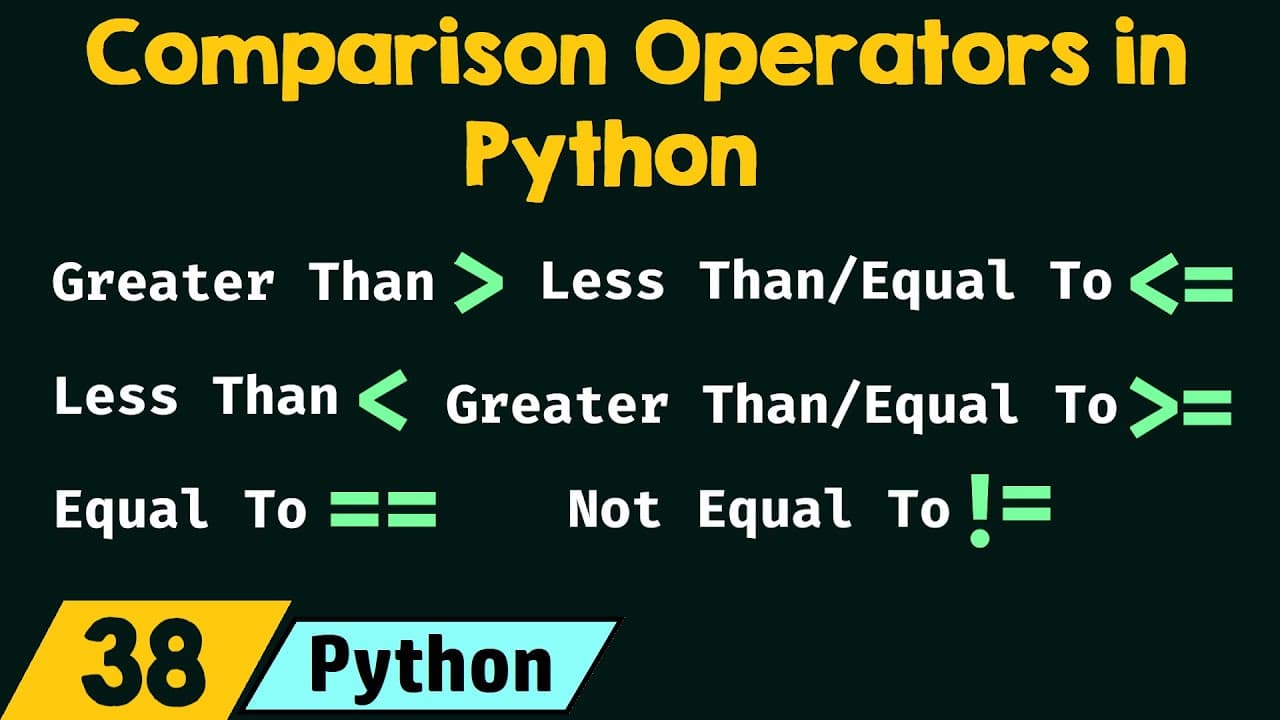
Comparison operators compare two operands and return true or false. The six basic operators are greater than, less than, equal to, less than or equal to, greater than or equal to, and not equal to. They are binary, relational operators, and are used to evaluate relationships between two values in Python code.
Transcript
foreign comparison operators in detail so without any further delay let's get started let's see the topics of this presentation the first topic is Introduction to comparison operators the second topic is various comparison operators after understanding the above two topics we will then move on to the homework problem of this presentation now let's ... Read More
Key Insights
- Comparison operators are binary, meaning they operate on two operands at a time.
- The six operators covered are greater than, less than, equal to, less than or equal to, greater than or equal to, and not equal to.
- The operators return true or false based on the relationship between the left and right operands.
- The equal to operator uses double equals sign, while a single equals sign is used for assignment.
- Not equal to operator checks inequality and returns true when operands differ.
- Less than or equal to and greater than or equal to combine comparison and equality in one test.
- Understanding each operator involves looking at the condition that must be satisfied for a true result.
Install to Summarize YouTube Videos and Get Transcripts
Explore YouTube Video Summarizer or Get YouTube Transcript Extractor
Questions & Answers
Q: A real search query question about the video (e.g. 'How to...', 'What is...', 'Why does...', 'When should...'). Question 1
What are the main comparison operators in Python and why are they considered binary relational operators? They are six operators: greater than, less than, equal to, less than or equal to, greater than or equal to, and not equal to. Each operator compares two operands, returning a boolean result true or false. They are called relational operators because they express a relationship between two values, which is evaluated as true or false within Python expressions.
Q: Question 2
How does the equal to operator differ from the assignment operator in Python? The equal to operator is denoted by double equals and is used to test whether two operands are equal, returning true if they are the same value. The single equals sign denotes assignment, which stores a value in a variable rather than comparing two values. This distinction is essential to avoid syntax errors and logical mistakes in conditional statements.
Q: Question 3
What does the not equal to operator do in Python? The not equal to operator returns true when the two operands are not equal and false when they are equal. It serves as a negation of the equal to operator, allowing code to branch based on inequality. This operator is useful in loops and conditionals to handle cases where values should differ. It is written as a exclamation mark followed by equal sign.
Q: Question 4
What does the less than operator evaluate? The less than operator returns true if the left operand is smaller than the right operand. If the left is greater than or equal to the right, the result is false. This operator is foundational for sorting, filtering, and conditional logic where order matters. It is often demonstrated with simple numeric comparisons.
Q: Question 5
What is the behavior of the greater than operator? The greater than operator yields true when the left operand is greater than the right operand, and false otherwise. This makes it suitable for comparing magnitudes, implementing thresholds, and validating inputs where a value must exceed a minimum. It is a basic relational operator covered early in Python lessons.
Q: Question 6
How do the less than or equal to and greater than or equal to operators work? Less than or equal to returns true when the left operand is either smaller than or equal to the right operand. Greater than or equal to returns true when the left operand is greater than or equal to the right operand. Both allow combining inequality and equality checks in a single comparison, simplifying conditional logic.
Q: Question 7
Why are comparison operators important in Python programming? They enable conditional execution, branching, and decision making by evaluating relationships between values. Since they always yield boolean results, they form the basis of if statements, while loops, and problem-solving tasks demonstrated in homework sections, providing foundational control flow knowledge for learners.
Q: Question 8
What is the significance of understanding relational operators for debugging? Understanding these operators helps predict outcomes of expressions, diagnose logic errors, and write correct conditions for edge cases. By analyzing how each operator responds to true and false relationships, a programmer can trace program behavior and ensure conditions reflect intended logic.
Summary & Key Takeaways
-
A concise overview of comparison operators in Python including what they are, how they differ, and when to use them in simple terms.
-
The document lists the six primary operators and explains the exact meaning of each, with examples illustrating true and false results.
-
The material emphasizes that these operators return boolean results and are used to form conditional statements and homework problems for practice.
Read in Other Languages (beta)
Share This Summary 📚
Summarize YouTube Videos and Get Video Transcripts with 1-Click
Try YouTube Summary with ChatGPT & Claude or YouTube Transcript Generator
Explore More Summaries from Neso Academy 📚






Summarize YouTube Videos and Get Video Transcripts with 1-Click
Try YouTube Summary with ChatGPT & Claude or YouTube Transcript Generator