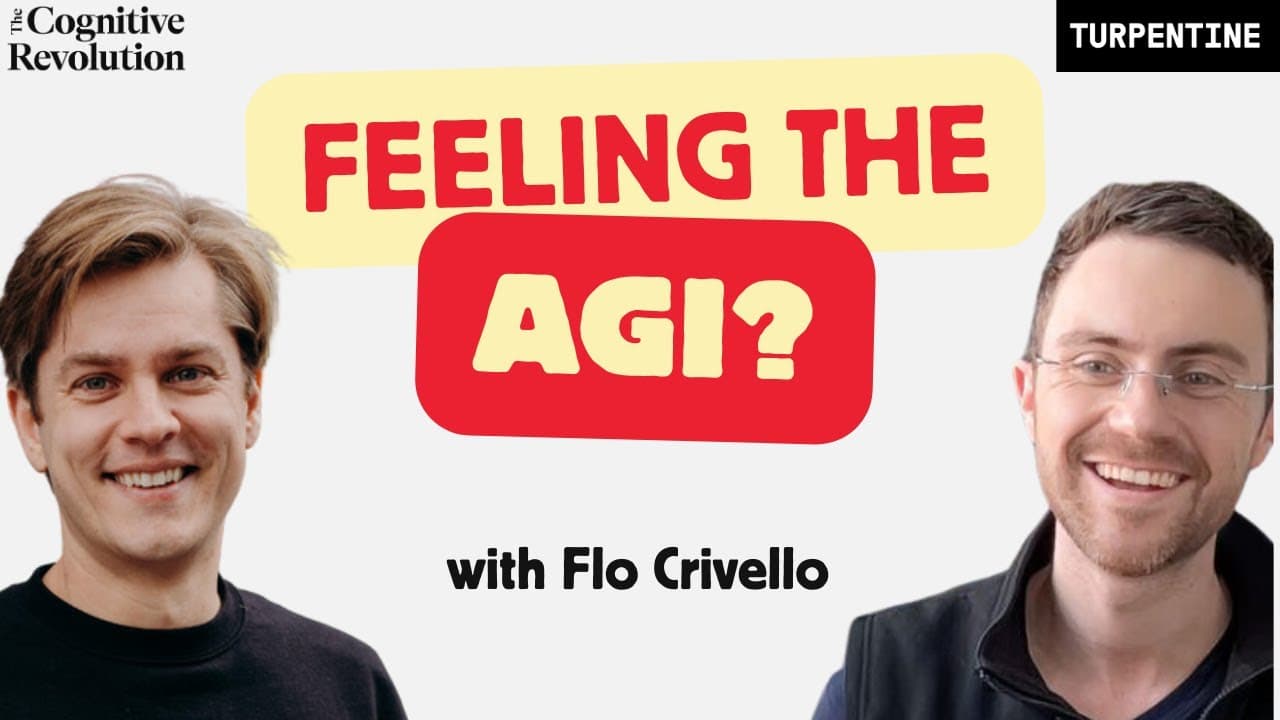
How Close Is AGI? Feeling the AGI with Flo Crivello
TL;DR
AGI may be only 2 to 5 years away, according to timelines discussed by frontier lab leaders, with superintelligence potentially following soon afterward. Nathan Labenz and Flo Crivello examine Leopold Aschenbrenner’s “Situational Awareness” argument, the danger of a US-China AI arms race, whether GPT-5-class models will be safe to deploy, and the case for regulation or a pause in scaling. Read on for their candid assessment of an increasingly unstable race.
Transcript
hello and welcome to the cognitive Revolution where we interview Visionary researchers entrepreneurs and Builders working on the frontier of artificial intelligence each week we'll explore their revolutionary ideas and together we'll build a picture of how AI technology will transform work life and Society in the coming years I'm Nathan lens joined... Read More
Key Insights
- The development of AGI is perceived as imminent, with predictions ranging from a few years to a decade, driven by rapid advancements in AI models and infrastructure.
- The potential for a US-China AI arms race is a significant concern, with geopolitical tensions likely to accelerate the race for AI supremacy.
- AI safety and alignment remain critical challenges, with calls for a 'Manhattan Project' level of investment in AI safety research to prevent catastrophic outcomes.
- Open sourcing AI models poses significant risks, as it could lead to misuse or unintended consequences, highlighting the need for regulated access and control.
- The economic incentives for companies to pursue AI advancements are strong, potentially leading to rapid automation of knowledge work and significant societal impacts.
- The role of governments in regulating AI development is crucial, yet the slow pace of policy-making is a concern given the rapid advancements in the field.
- OpenAI's leadership is viewed as capable but under immense pressure, with internal challenges and the need for external regulation to ensure safe AI development.
- The future landscape of AI is likely to be dominated by a few major players, with smaller companies struggling to compete in the high-cost environment of AI development.
Install to Summarize YouTube Videos and Get Transcripts
Explore YouTube Video Summarizer or Get YouTube Transcript Extractor
Questions & Answers
Q: How close is AGI, according to Flo Crivello and Nathan Labenz?
The discussion treats AGI as near rather than distant. Labenz says frontier lab leaders are talking about timelines of 2 to 5 years, while acknowledging substantial uncertainty about what happens next.
Q: What is the central argument of Leopold Aschenbrenner’s “Situational Awareness” manuscript?
The manuscript argues that AGI is near and superintelligence may follow soon afterward. In the current geopolitical environment, it predicts that the US and Chinese governments will probably compete for AI supremacy, creating a dangerous arms race.
Q: Why could a US-China AI arms race be dangerous?
An AI arms race could force developers to solve critical safety problems under intense, potentially winner-take-all international pressure. Labenz considers that prospect frightening and explores cooperation with China as an alternative, despite the severe difficulty of establishing trust.
Q: What strategy does Aschenbrenner propose for managing competition with China?
His hope is that the US can preserve a sufficient AI capability lead to give researchers time to solve critical safety problems before deploying highly powerful systems. After securing a decisive strategic advantage, the US could offer China a benefit-sharing deal that it could not afford to reject.
Q: Do the speakers expect GPT-5-class models to pose major risks?
Labenz’s best guess is no. He expects GPT-5-class models to remain in a sweet spot where they are highly useful and safe enough to deploy, although perhaps not safe enough to open source.
Q: Do Nathan Labenz and Flo Crivello support AI regulation?
Both describe themselves as longtime libertarians and recognize that regulation can produce unintended and unexpected harms. Even so, the apparent inability of frontier labs to regulate themselves makes them inclined to support regulation as a starting point.
Q: Could further scaling of frontier AI models be paused?
Labenz says he could imagine advocating for an outright pause in further scaling in the not-too-distant future. He also acknowledges a counterargument: faster adoption may expose the limits of current models and thereby encourage additional scaling.
Q: Why does the conversation suggest Chinese AI research may be close behind the US?
Labenz points to a Chinese firm’s release of a Sora-like video-generation model as evidence that Chinese AI research may not be far behind. That possibility makes maintaining a decisive US capability lead less certain and intensifies concern about competitive development.
Summary & Key Takeaways
-
In this episode, the discussion centers on the impending arrival of AGI and the associated risks, particularly the potential for a US-China AI arms race. The conversation explores regulatory challenges and the need for significant investment in AI safety research to mitigate potential dangers.
-
The dialogue delves into the complexities of open sourcing AI models, the economic drivers behind AI advancements, and the role of governments in regulating AI development. The challenges faced by OpenAI and the broader AI community in navigating these issues are also highlighted.
-
The future of AI is examined, with a focus on the dominance of major tech companies and the potential societal impacts of widespread AI adoption. The conversation underscores the urgency of addressing AI safety and alignment to ensure beneficial outcomes.
Read in Other Languages (beta)
Share This Summary 📚
Summarize YouTube Videos and Get Video Transcripts with 1-Click
Try YouTube Summary with ChatGPT & Claude or YouTube Transcript Generator
Explore More Summaries from Cognitive Revolution "How AI Changes Everything" 📚
Summarize YouTube Videos and Get Video Transcripts with 1-Click
Try YouTube Summary with ChatGPT & Claude or YouTube Transcript Generator