How to boost Shopify sales with CRO strategies
TL;DR
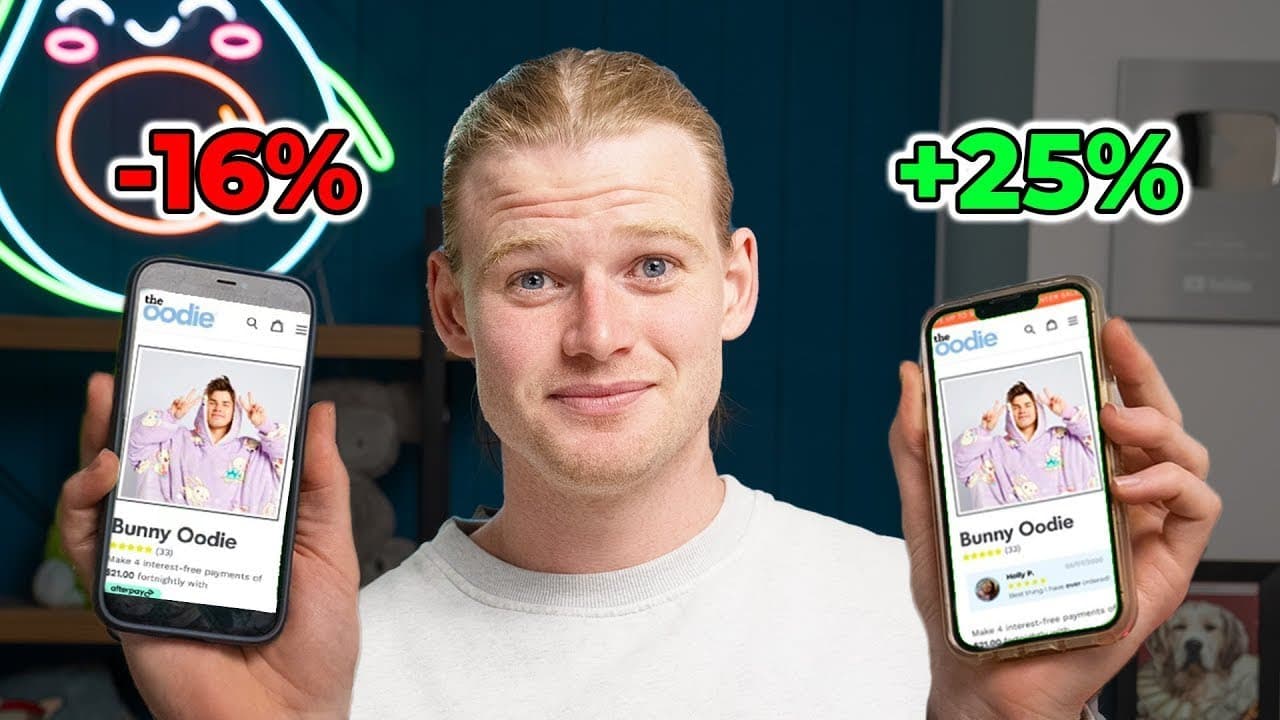
CRO uses controlled experiments to measure which page variants perform better, then implements winning changes. Start with user feedback through a post-purchase survey and gradually run A/B tests using a simple toolset or a CRO team as your store scales. Focus on one variable at a time to build a strong conversion baseline.
Transcript
- CRO is one of the most underestimated levers that you have to optimize your business. Everyone always talks about optimizing your Facebook ad structure, but nobody talks about optimizing your landing page. Even on YouTube, the search volume for CRO is so low. This needs to change. Conversion rate optimization is one of the only things that can do... Read More
Key Insights
- CRO is defined as creating alternative versions of a website to test which version converts better.
- A/B testing is the core method used to compare a control against a variant and measure impact on behavior.
- Post purchase attribution surveys can reveal why customers buy, guiding subsequent tests and email experiments.
- Using page builders or CRO tools can simplify running split tests, but consider the trade offs with performance and speed.
- The ICE framework helps prioritize tests by measuring impact, confidence, and ease of implementation.
- Testing should change only one variable at a time to isolate effects and learn what actually drives conversions.
- Large macro changes early on can have bigger effects, but should be weighed against risk and speed.
- Social proof placement, such as customer reviews near product titles, can influence add to cart behavior.
- More videos from this channel:
- More from this channel: Davie Fogarty
Install to Summarize YouTube Videos and Get Transcripts
Explore YouTube Video Summarizer or Get YouTube Transcript Extractor
Questions & Answers
Q: What is CRO and why is it important for Shopify stores?
CRO stands for conversion rate optimization and it is the process of creating an alternative version of a website to run against the original, measuring how traffic responds to the change. It helps determine which elements improve conversions and sales, enabling data driven decisions rather than guesswork. For Shopify stores, CRO can improve funnel efficiency and return on ad spend by making landing pages, product pages, and checkout experiences more persuasive.
Q: How should a beginner start with CRO according to the video?
Begin with a low friction, high potential test like a post purchase attribution survey to gather customer insights, then use those insights to inform simple split tests. Use a basic page builder or CRO tool, and if needed hire a designer to implement the changes. Start with one competitive variable at a time and build a baseline before expanding tests.
Q: What roles are recommended for a CRO team at scale?
As revenue grows, consider forming a CRO team including a head of CRO who leads testing and projects, a UX designer to shape user experiences, a front end developer to implement tests, a data analyst to interpret results, and a direct response copywriter to improve messaging. This structure helps run frequent, well designed tests with clear ownership.
Q: What is the ICE framework and how is it used in CRO?
The ICE framework evaluates tests by three criteria: Impact, which measures potential conversion lift; Confidence, which reflects belief in the test’s likelihood of success; and Ease, which gauges how difficult it is to implement the test. This framework helps prioritize experiments that will yield meaningful results with reasonable effort and reliability.
Q: What are some example CRO tests mentioned for improving revenue?
Examples include adding a floating add to cart feature to keep the CTA visible, and applying a New badge to new products to generate excitement and potential uplift. These tests are designed to be simple to implement, often doable without a designer, and can be rolled out across desktop and mobile to assess impact on revenue and conversion.
Q: Why should testing be limited to one variable at a time?
Testing one variable at a time isolates the cause of any observed improvement, making it possible to attribute changes accurately. Running multiple changes in a single test obscures which element drove performance, slows learning, and can mislead decision making. A disciplined approach builds a reliable baseline for future experiments.
Q: What are potential downsides of CRO tools and fast paced testing?
CRO tools can slow down a site if overused or poorly integrated, reducing user experience and harming performance. It is important to weigh the benefits of a test against its impact on speed, and sometimes hard coding or simpler implementations can be more cost effective than adding heavy CRO tooling.
Q: How should success be measured in CRO according to the video?
Success is measured using revenue per visitor and earnings per visitor, which incorporate metrics like average order value, conversion rate, and related costs. A complete view includes how testing affects profits after considering fulfillment and operational expenses, ensuring that improvements translate into real profitability.
Summary & Key Takeaways
-
CRO is a process of creating alternative versions of a website and testing them against the original to measure performance. It emphasizes data driven decisions and careful implementation to avoid slowing the site. Early wins can come from simple, well tested page changes.
-
A practical CRO plan starts with gathering customer insights via a post purchase survey, then translates those insights into split tests and email experiments. Tools and skills vary by store size, so choose a setup that matches resources and goals.
-
As stores grow, a dedicated CRO team can improve efficiency, including a head of CRO, a UX designer, a front end developer, a data analyst, and a copywriter. Prioritize tests using a clear framework like ICE to balance impact, confidence, and ease.
Read in Other Languages (beta)
Share This Summary 📚
Summarize YouTube Videos and Get Video Transcripts with 1-Click
Try YouTube Summary with ChatGPT & Claude or YouTube Transcript Generator
Explore More Summaries from Davie Fogarty 📚



Summarize YouTube Videos and Get Video Transcripts with 1-Click
Try YouTube Summary with ChatGPT & Claude or YouTube Transcript Generator