How to Run AI Locally on Sensitive Files You Can't Upload
TL;DR
Running a downloaded AI model offline lets you analyze confidential documents without sending data to cloud services. The method uses air gapping, a local model, and a sensitivity preset to identify and mask private information while keeping the process completely offline and controllable by you.
Transcript
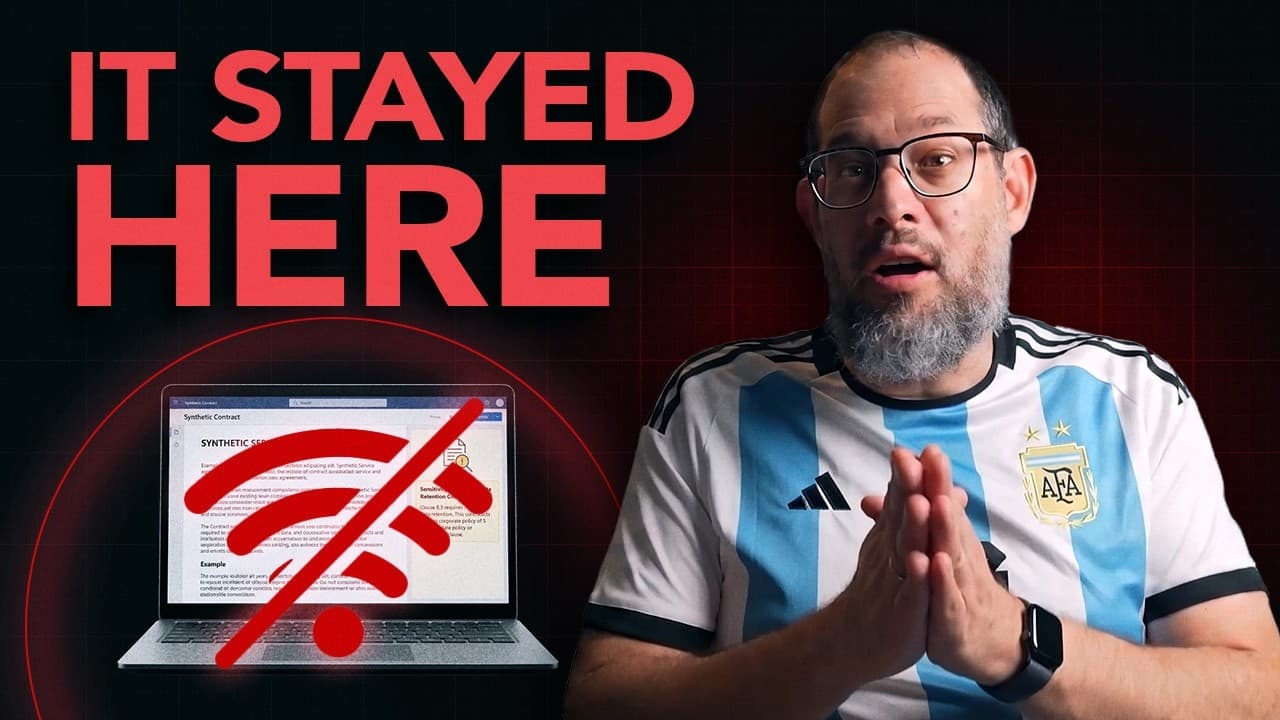
The laptop I'm about to show you has no internet connection, but it still has AI. A downloaded model just read a contract. It found private material inside that should not go to any kind of cloud AI. It masked all of that private information, and it refused to call anything that was unreadable safe. In a few minutes, I'm going to show you the entir... Read More
Key Insights
- Offline AI is feasible on consumer hardware using downloaded models with network isolation. The approach hinges on air gapping and local execution to prevent data from leaving the device.
- A sensitivity preset or skill directs the model to find private identity, financial, legal, and personal information and to mask it without falsely confirming unreadable sections as safe.
- Large organizations currently use on premise or secure cloud boundaries with specialized tuning like LoRA to tailor models to confidential workflows.
- Observation of the Grok Build incident underscores that model privacy claims can be misleading if not audited, as data can be exposed despite claims of no data transfer.
- LM Studio enables running open weight models locally, offering a practical path for SMBs to implement private AI without third-party data leakage.
- Microsoft’s strategy involves boundary controls and specialist models that perform specific tasks within a company’s governed boundary rather than a single all-knowing chatbot.
- LoRA tuning is a lightweight method to customize pre-trained models for particular tasks, keeping data in a controlled environment.
- The video argues that open weight AI can operate offline today, expanding access to secure AI use while highlighting the ongoing dependency on platform providers for governance and tooling.
- More videos from this channel:
- More from this channel: AI News & Strategy Daily | Nate B Jones
Install to Summarize YouTube Videos and Get Transcripts
Explore YouTube Video Summarizer or Get YouTube Transcript Extractor
Questions & Answers
Q: How can I run AI locally on my computer without internet access?
You can download a compatible open weight model and run it entirely offline with a tool like LM Studio. After disconnecting the network, you configure a sensitivity preset that instructs the model to locate and mask private, financial, and legal information within documents. The setup keeps all processing on-device and avoids cloud transmission.
Q: What is a sensitivity preset and why is it important?
A sensitivity preset is a saved instruction that directs the local model to identify specific categories of sensitive data, such as personal identifiers, financial details, or confidential company information, and to mask or redact those elements. This helps ensure consistent handling of sensitive material and reduces risk of data leakage during processing.
Q: Why is air gapping emphasized in local AI workflows?
Air gapping means isolating the computer from any network connection, reducing the chance that data could be sent to external servers. In the video, turning off Wi-Fi ensures the model cannot reach cloud providers, reinforcing data sovereignty and enabling compliant processing of confidential documents.
Q: What is LoRA and how does it relate to private AI deployment?
LoRA is a lightweight fine-tuning method that updates only a subset of a model’s parameters. It allows organizations to tailor models to specific tasks while keeping the data inside a secure boundary. This makes localized, task-specific AI more practical and performant without broad model modification.
Q: What examples does the video give for private AI in use?
The video cites Discovery Bank and Bayer as examples where private AI was used to process company-specific data, improve speed, and keep information within controlled boundaries. It also references Microsoft infrastructure that supports on-premises or boundary-constrained models for sensitive workflows.
Q: How does the Grok Build incident relate to data privacy?
The Grok Build incident demonstrates that a model can appear to follow instructions while still exfiltrating data. Logs indicated that files or repos were uploaded despite a claim of non-access, highlighting the need for verifiable safeguards and robust auditing in AI tooling.
Q: What is the main trade-off between cloud AI and local AI according to the video?
Cloud AI offers broader capabilities and convenience but risks data leaving your environment. Local AI provides stronger data control and privacy, at the potential cost of reduced scale or convenience, though the video argues that local solutions are now accessible and practical for many use cases.
Q: Who should consider the SMB path to private AI as described?
SMBs with moderate data volumes can use secure Azure deployments of open weight models or lightweight fine-tuning to meet privacy needs without engaging in large-scale enterprise setups. This middle-ground approach balances cost, control, and capability for smaller organizations.
Summary & Key Takeaways
-
A local offline setup shows that AI can handle confidential documents entirely on your machine, avoiding cloud exposure and preserving privacy. The approach relies on an air gapped environment and a ready-to-use model with a reusable preset called a skill to detect sensitive data.
-
The video demonstrates a practical workflow: download a model, disable network connections, apply a sensitivity preset, and verify that the output masks private content while not labeling unreadable sections as safe.
-
The broader takeaway is that enterprises and individuals can tighten data governance by running open weight models locally, enabling secure processing and on-device evaluation without compromising data sovereignty.
Read in Other Languages (beta)
Share This Summary 📚
Summarize YouTube Videos and Get Video Transcripts with 1-Click
Try YouTube Summary with ChatGPT & Claude or YouTube Transcript Generator
Explore More Summaries from AI News & Strategy Daily | Nate B Jones 📚






Summarize YouTube Videos and Get Video Transcripts with 1-Click
Try YouTube Summary with ChatGPT & Claude or YouTube Transcript Generator