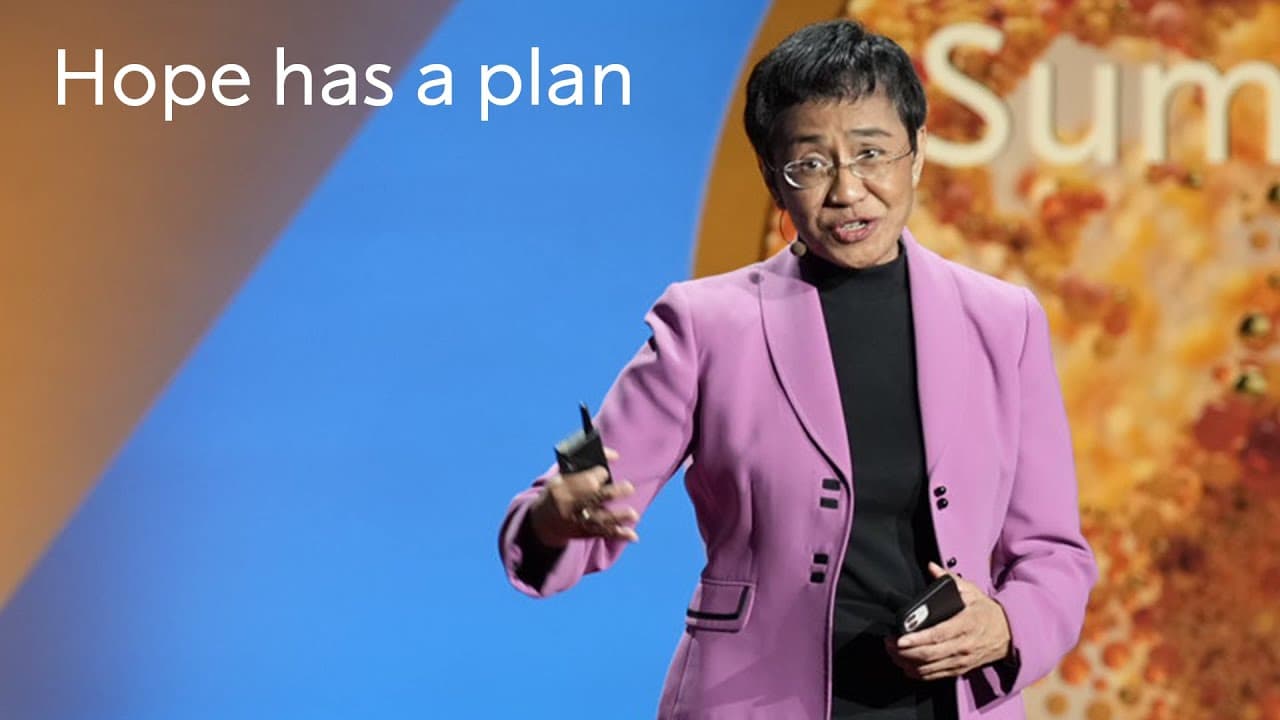
Hope has a plan | Maria Ressa | Nobel Prize Summit 2023
Transcript
all right please don't make me cry before I have to speak for 20 minutes oh my god um thank you thank you so much that was actually the very first thing I wanted to say there are so many people in this audience who have helped us stay alive stay out of jail thank you thank you the only weapon a journalist has to fight back is To Shine the Light wit... Read More
Install to Summarize YouTube Videos and Get Transcripts
Explore YouTube Video Summarizer or Get YouTube Transcript Extractor
Summary
In this video, Maria Ressa, a prominent journalist, discusses the issues of disinformation and information warfare in today's society. She emphasizes the exponential growth of technology and the need for action to combat these problems. She shares personal experiences of being targeted by disinformation campaigns and emphasizes the importance of rebuilding trust in journalism and holding tech companies accountable. Ressa offers a 10-point action plan and highlights the need for education, legislation, and collaboration to protect democracy and the integrity of information.
Questions & Answers
Q: How does Maria Ressa differentiate between misinformation and disinformation?
Maria Ressa explains that misinformation is like a game of telephone where information gets distorted and mistakes are made. On the other hand, disinformation is when power and money manipulate the information ecosystem to manipulate democracy and society at a cellular level. Disinformation involves intentional manipulation and is often driven by a powerful tech lobby that uses the term "misinformation" to downplay its impact.
Q: How has disinformation been used in the Philippines and Southeast Asia?
According to Maria Ressa, disinformation has been used extensively in the Philippines and Southeast Asia to manipulate public opinion and destabilize democracy. She explains that it is part of the business plan of those in power to spread disinformation for their own benefit. Ressa cites examples of disinformation campaigns during elections and how they have affected the political landscape in these regions.
Q: How has Ressa's book, "A Thousand Cuts," been received worldwide?
Ressa states that her book, "A Thousand Cuts," has been widely translated and published in many languages, including French, Japanese, Korean, Mandarin, and Ukrainian. The book highlights the challenges faced by journalists and the importance of taking action against disinformation and information warfare. It sheds light on the experiences of Ressa and others who have been targeted by disinformation campaigns.
Q: How does Ressa propose to move journalists to take action against disinformation?
Ressa believes that moving journalists to take action against disinformation is a matter of individual courage and standing up for what they believe in. She encourages journalists to look at the complexities of the world and make a stand against disinformation. Ressa emphasizes that silence is complicity and reminds journalists of their role as defenders of democracy and truth.
Q: How does Ressa compare the war in Russia invading Ukraine with the war on information?
Ressa draws a parallel between the war in Russia invading Ukraine and the war on information. She explains that the war on information is a defense of values and democracy at a personal level. Ressa believes that the principles used to combat terrorism, such as asymmetrical warfare, are now being used against individuals through the spread of disinformation. She highlights the importance of each person winning the war on information for the sake of democracy.
Q: How does Ressa describe the current state of our information ecosystem?
Ressa describes the current information ecosystem as being in a state of crisis. She highlights the addictive nature of social media and its negative impact on attention spans and mental health. Ressa expresses concern for the younger generation and the harmful effects of social media on children. She stresses the urgent need for action to address these issues.
Q: What are the three buckets of action in Ressa's 10-point action plan?
Ressa outlines three main buckets of action in her 10-point plan. The first is to stop surveillance for profit, which involves regulating the collection and use of personal data by tech companies without consent. The second is to stop coded bias, which aims to address the marginalization and discrimination faced by certain groups, especially in the field of artificial intelligence. The third is to strengthen journalism as an antidote to tyranny and protect journalists who are increasingly under attack.
Q: How does Ressa propose to rebuild trust in journalism?
Ressa proposes rebuilding trust in journalism through a multi-faceted approach. This includes supporting journalism financially by establishing international funds for public interest media. It also involves holding tech companies accountable for their role in spreading disinformation and promoting legislation that protects the integrity of facts. Ressa emphasizes the need for collaboration among journalists, organizations, and governments to address the challenges and restore trust in journalism.
Q: What is the Institute of Global Politics and what is its purpose?
Ressa introduces the Institute of Global Politics, set to be launched at Columbia University's School of International and Public Affairs. The institute aims to bring together various professionals, including engineers, lawyers, policymakers, and scientists, to collectively address the challenges posed by disinformation. It will focus on research, education, and collaboration to find innovative solutions to protect the public sphere and democratic values.
Q: What is Project Algo and how does it aim to combat disinformation?
Project Algo is a project initiated by Ressa and her team to address disinformation in the Philippines. It involves employing an influencer marketing campaign for facts to counter disinformation. The project identified influential individuals and groups who would share fact-checked information with their networks, adding emotion to make it more engaging. By leveraging influencers and expanding the reach of verified information, the project aimed to combat disinformation and promote fact-based content.
Q: What is the ultimate goal of Maria Ressa's efforts?
Maria Ressa's ultimate goal is to protect democracy and the integrity of information. She emphasizes the urgency of the situation, highlighting that 2024 is a tipping point for many countries' elections. Ressa's efforts aim to encourage education, legislation, and collaboration to combat disinformation and rebuild trust in journalism. She believes that by taking action collectively, it is possible to safeguard democracy and ensure the free flow of accurate information.
Takeaways
Maria Ressa's talk highlights the growing threat of disinformation and information warfare in today's society. She emphasizes the need for urgent action to combat this issue and rebuild trust in journalism. Ressa's 10-point action plan includes stopping surveillance for profit, addressing coded bias, and strengthening journalism as an antidote to tyranny. She proposes education, legislation, and collaboration as key components to protect democracy and the integrity of information. Ressa's efforts and initiatives like Project Algo demonstrate the importance of using technology and influencers to counter disinformation and promote fact-based content. The ultimate goal is to safeguard democracy and ensure the free flow of accurate information in an increasingly complex information ecosystem.
Read in Other Languages (beta)
Share This Summary 📚
Summarize YouTube Videos and Get Video Transcripts with 1-Click
Try YouTube Summary with ChatGPT & Claude or YouTube Transcript Generator
Explore More Summaries from Nobel Prize 📚


Summarize YouTube Videos and Get Video Transcripts with 1-Click
Try YouTube Summary with ChatGPT & Claude or YouTube Transcript Generator