How Do You Build a Scalable RAG System for AI Apps? (Full Architecture)
TL;DR
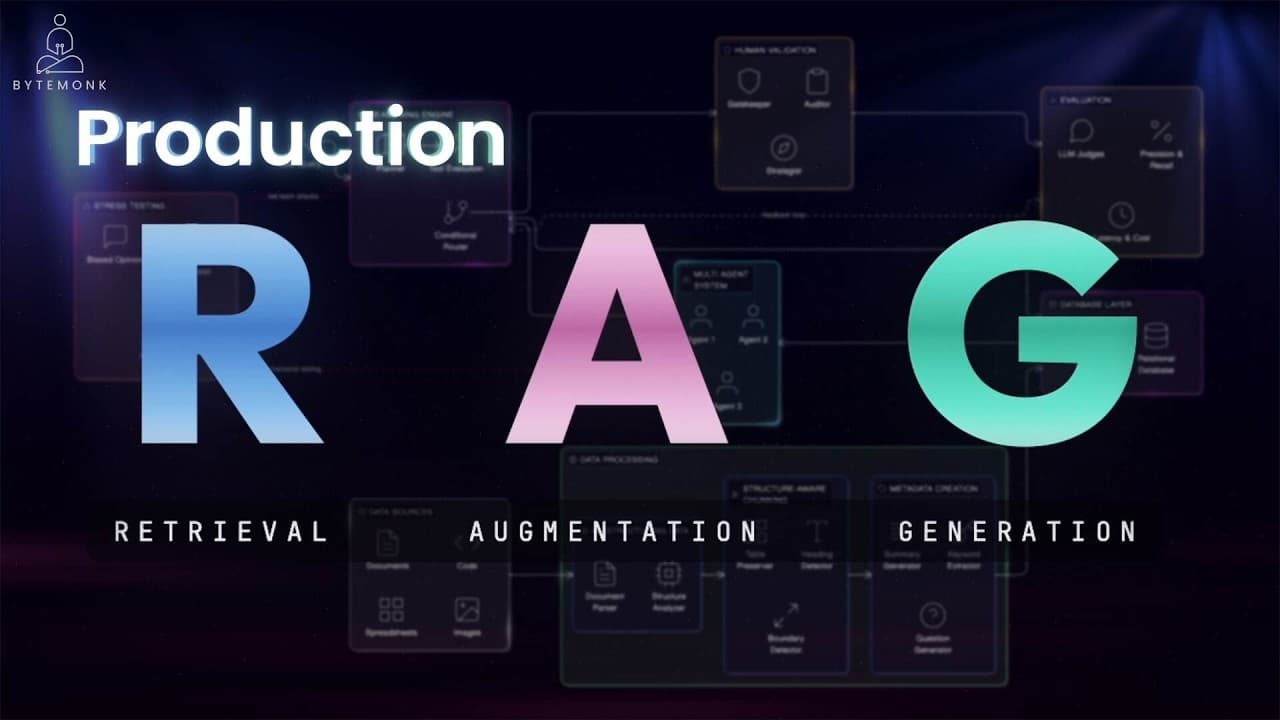
Build a scalable RAG system for AI apps by restructuring source data, using structure-aware chunking, creating metadata, combining vector and relational retrieval, and validating generated answers. The production architecture also uses a reasoning engine, multiple agents, evaluation metrics, and stress testing because poor retrieval can make an LLM hallucinate more than receiving no context. Read on for the complete flow from document processing to answer validation.
Transcript
Large language models don't know anything about your private data. They were trained on the public internet, not your internal wiki. RAD or retrieval augmented generation solves this. The idea is simple. When a user asks a question, you first retrieve relevant pieces of information from your own documents. Then you argument the user's question with... Read More
Key Insights
- RAG systems enhance AI by retrieving and augmenting context from private data, bypassing the need for model retraining.
- Bad data retrieval can lead to AI hallucinations, making accurate retrieval crucial for reliable outputs.
- Production RAG systems require restructuring of data to maintain document integrity and context.
- Combining vector and relational databases allows for semantic search and precise filtering of relevant information.
- Hybrid search techniques, using both vector and keyword search, improve query accuracy by matching both meaning and specific terms.
- A reasoning engine and multi-agent system are essential for handling complex queries that require multiple data sources.
- Validation nodes in a RAG system ensure that generated responses are accurate, relevant, and grounded in retrieved data.
- Evaluation and stress testing are critical to measure system performance and identify potential failure points before deployment.
Install to Summarize YouTube Videos and Get Transcripts
Explore YouTube Video Summarizer or Get YouTube Transcript Extractor
Questions & Answers
Q: How do you build a scalable RAG system for AI apps?
Start with a restructuring layer that identifies headings, paragraphs, and tables, then apply structure-aware chunking so related content stays together. Create metadata for each chunk, store embeddings alongside relational data, and route queries through a reasoning engine. Before returning an answer, use validation nodes, evaluation metrics, and stress testing to identify errors and weaknesses.
Q: How does a RAG system work?
A RAG system first retrieves relevant information from private documents, combines that context with the user's query, and then asks an LLM to generate an answer from the supplied context. In the basic flow, the query becomes an embedding that is matched against similar chunks in a vector database. This provides access to private data without retraining the model.
Q: Why can bad retrieval be worse than no retrieval in a RAG system?
Bad retrieval can supply incomplete, outdated, or incorrect context, such as an old policy or a chunk missing its eligibility criteria. The LLM may become more confident when context is present and fill any gaps with plausible but invented information. The result can be a confidently wrong answer rather than an admission that the system does not know.
Q: What is structure-aware chunking in a production RAG architecture?
Structure-aware chunking divides documents according to natural boundaries instead of blindly splitting them every 500 tokens. It keeps tables intact and headings with their related content. This helps prevent essential context from being cut off or turned into unusable text.
Q: Why should a production RAG system use both vector and relational data?
Vector data supports similarity-based retrieval through embeddings, while relational data supports structured metadata and precise filtering. The architecture uses both because production retrieval needs more than a vector store alone. Together, they help the system find semantically relevant chunks while accounting for attributes such as a document's date or type.
Q: What does the reasoning engine do in a RAG system?
The reasoning engine includes a planner that determines what a user's query actually requires. It then selects and executes the appropriate tools to gather the needed information. For complex problems, multiple agents can work on different parts of the query.
Q: How do validation nodes improve RAG answers?
Validation nodes verify the retrieval and generation process before an answer reaches the user. The architecture describes a gatekeeper, an auditor, and a strategist that can catch problems and assess whether the result is accurate, relevant, and grounded in the retrieved context. This adds protection against confidently incorrect outputs.
Q: How should a production RAG system be evaluated and stress-tested?
Evaluation should include qualitative assessment with LLM judges, quantitative measures such as precision and recall, and performance tracking for latency and cost. Stress testing can use red teaming and checks involving biased opinions or information evasion. These tests expose failure points before the system is relied on in production.
Summary & Key Takeaways
-
RAG systems use retrieval, argumentation, and generation to provide AI with context from private data, enabling accurate responses without model retraining. Accurate retrieval is crucial as poor retrieval can lead to AI hallucinations.
-
Production-ready RAG systems involve restructuring data to preserve document integrity, using both vector and relational databases for efficient retrieval, and implementing validation nodes to ensure response accuracy.
-
A reasoning engine and multi-agent system handle complex queries by breaking them into actionable steps, while evaluation and stress testing ensure system reliability and performance in real-world applications.
Read in Other Languages (beta)
Share This Summary 📚
Summarize YouTube Videos and Get Video Transcripts with 1-Click
Try YouTube Summary with ChatGPT & Claude or YouTube Transcript Generator
Explore More Summaries from ByteMonk 📚

Summarize YouTube Videos and Get Video Transcripts with 1-Click
Try YouTube Summary with ChatGPT & Claude or YouTube Transcript Generator