How Is Goodfire Advancing Mechanistic Interpretability for AI Safety? | The Cognitive Revolution
TL;DR
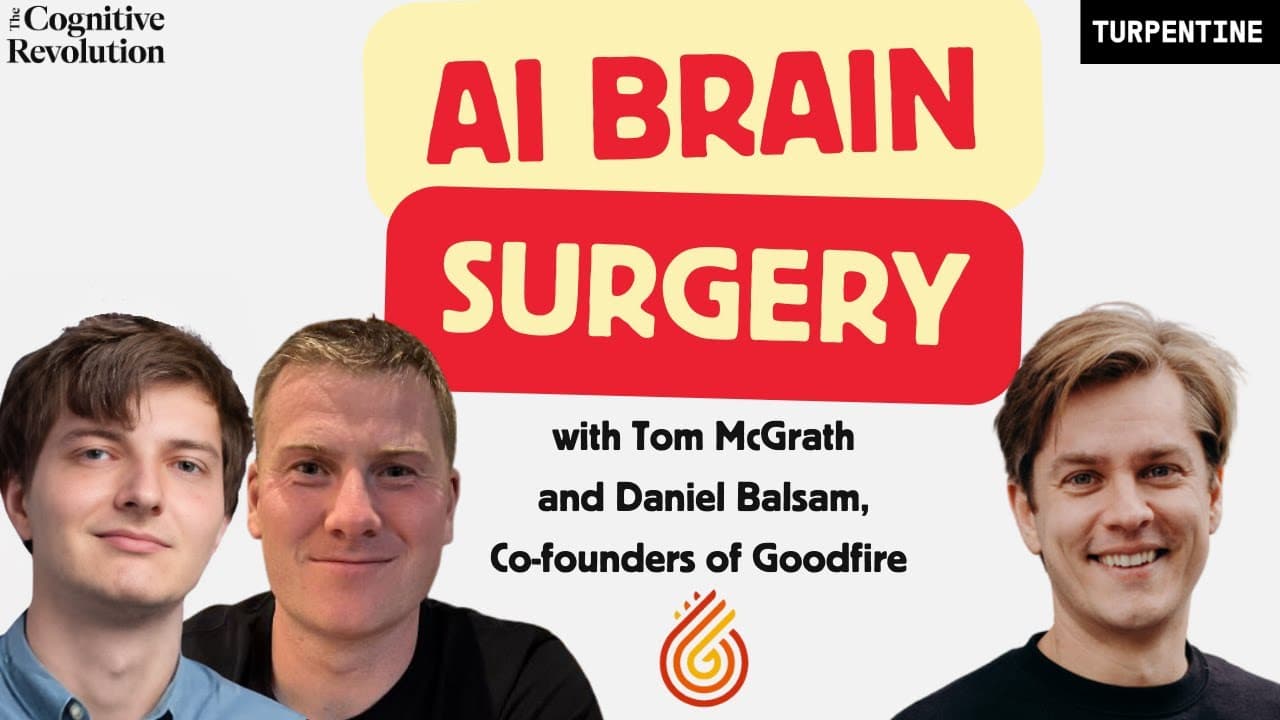
Mechanistic interpretability can improve AI safety by revealing why models behave as they do, helping people diagnose issues, monitor internal states, and intervene to improve performance and reliability. The Cognitive Revolution’s Nathan Labenz speaks with Goodfire co-founders Dan Balsam and Tom McGrath about sparse autoencoders, feature editing, auto-interpretability, and the company’s $7 million seed round. Read on to understand the tools and challenges behind opening AI’s black box.
Transcript
hello and welcome to the cognitive Revolution where we interview Visionary researchers entrepreneurs and Builders working on the frontier of artificial intelligence each week we'll explore their revolutionary ideas and together we'll build a picture of how AI technology will transform work life and Society in the coming years I'm Nathan lens joined... Read More
Key Insights
- Mechanistic interpretability seeks to understand the inner workings of AI models.
- Sparse autoencoders are a breakthrough tool for unpacking model behaviors.
- Polysemanticity in neural networks poses challenges for interpretability.
- Understanding AI models can lead to safer and more reliable AI systems.
- AI models often learn representations that are not easily interpretable.
- Goodfire aims to make interpretability accessible and practical for real-world use.
- Interpretable AI can help reduce unintended consequences from AI deployment.
- New architectures in AI may impact future interpretability research.
Install to Summarize YouTube Videos and Get Transcripts
Explore YouTube Video Summarizer or Get YouTube Transcript Extractor
Questions & Answers
Q: How does mechanistic interpretability improve AI safety?
Mechanistic interpretability seeks to explain why AI models do what they do by examining their inner workings. That understanding may support engineering solutions for AI control and safety while helping users diagnose issues and intervene to improve model performance and reliability.
Q: What is Goodfire’s role in mechanistic interpretability?
Goodfire is a company focused on scaling and productizing mechanistic interpretability research for open-source models. Its goal is to let developers and everyday users inspect models, diagnose problems, and intervene to improve performance and reliability.
Q: Who are Goodfire’s co-founders?
Goodfire was co-founded by Dan Balsam and Tom McGrath. Balsam serves as CTO and brings experience as a serial startup engineer, while chief scientist McGrath has a background in AI safety research at DeepMind.
Q: How do sparse autoencoders help researchers understand AI models?
Sparse autoencoders isolate concepts, also called features, that large language models learn. Researchers are beginning to use those features to monitor models’ internal states and steer their behavior.
Q: What did Anthropic’s Golden Gate Claude demonstrate?
Anthropic intervened by setting the model’s Golden Gate Bridge feature to an artificially high level. The experiment provided an intuitive demonstration of how features discovered with sparse autoencoders can affect model behavior.
Q: Which mechanistic interpretability techniques does the discussion cover?
The conversation covers activation patching, causal tracing, and feature editing as techniques for large-scale interpretability studies. It also examines sparse autoencoder architecture, training processes, and outputs.
Q: What is auto-interpretability?
Auto-interpretability uses language models to label features isolated by sparse autoencoders. The discussion describes this as an area showing early progress within interpretability research.
Q: What is Goodfire’s long-term vision for interpretable AI?
Goodfire wants to develop and productize interpretability research so people can look inside models and improve them. Its ultimate vision is a world in which companies do not deploy AI models they do not understand; the company raised $7 million in seed funding led by Lightspeed Ventures toward this work.
Summary & Key Takeaways
-
Mechanistic interpretability focuses on understanding AI models' internal processes to enhance safety and control. Recent advances, such as sparse autoencoders, have made it possible to dissect complex model behaviors, providing insights into AI decision-making. This understanding is crucial for developing AI systems that are transparent, reliable, and aligned with human values.
-
Goodfire, a company founded by Dan Balsam and Tom McGrath, aims to scale interpretability research and make it practical for real-world applications. By leveraging tools like sparse autoencoders, Goodfire seeks to empower developers and users to diagnose and improve AI models, ultimately creating a world where AI systems are not deployed without understanding their inner workings.
-
The future of interpretability research holds promise for unlocking scientific knowledge from AI models trained on domain-specific data, such as protein folding and weather prediction. As AI architectures evolve, interpretability techniques must adapt to ensure that AI remains a beneficial tool for society, reducing risks and enhancing performance.
Read in Other Languages (beta)
Share This Summary 📚
Summarize YouTube Videos and Get Video Transcripts with 1-Click
Try YouTube Summary with ChatGPT & Claude or YouTube Transcript Generator
Explore More Summaries from Cognitive Revolution "How AI Changes Everything" 📚




Summarize YouTube Videos and Get Video Transcripts with 1-Click
Try YouTube Summary with ChatGPT & Claude or YouTube Transcript Generator