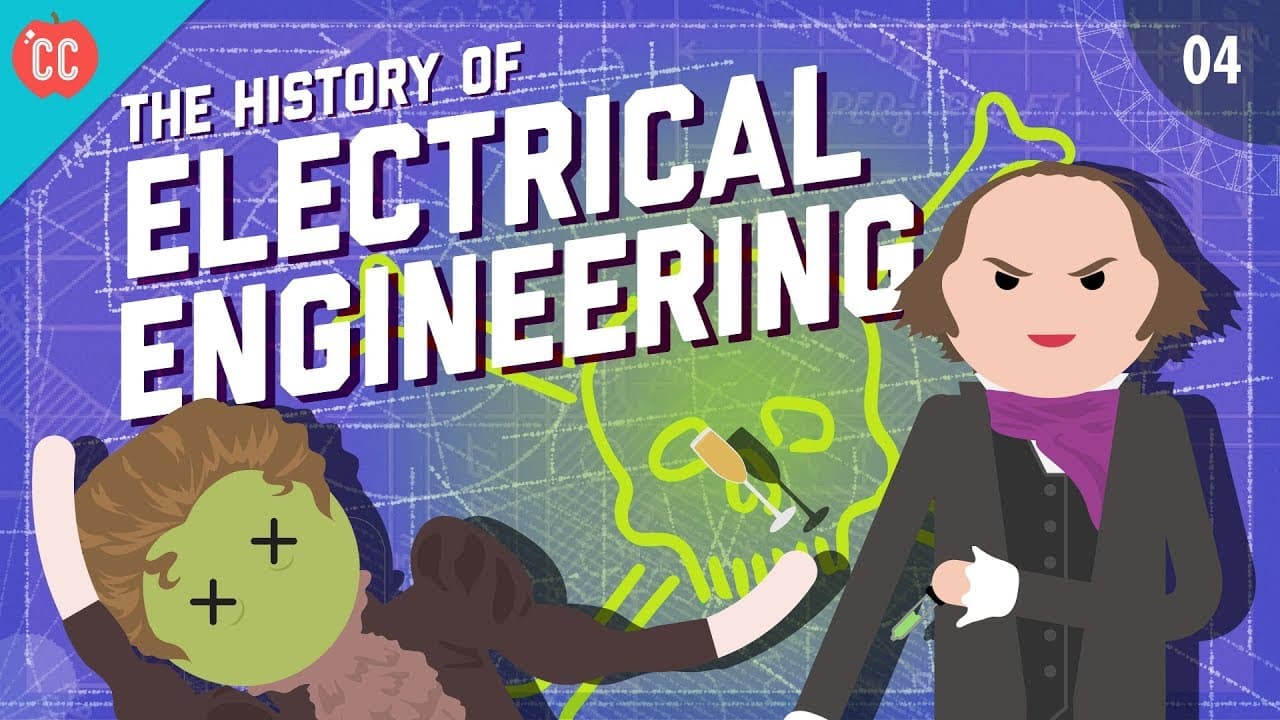
The History of Electrical Engineering: Crash Course Engineering #4
TL;DR
Explores the evolution of electrical engineering fields.
Transcript
Electricity powers our world. And we harness it through electrical engineering, the field that focuses on the application of electricity and electromagnetism in our everyday lives. Just as you have blood pumping through your veins, machines and systems often need electrical power flowing through their wires to work. It’s the lifeblood of our societ... Read More
Key Insights
- Electrical engineering is essential for modern society, powering telecommunications, lighting, and computers, with roots in electromagnetism and electrical conduction.
- William Gilbert is credited as the father of electrical studies, discovering Earth's magnetic properties in 1600, laying the groundwork for understanding electromagnetism.
- Telecommunication began with the electric telegraph in 1837, evolving from semaphore systems, with Samuel Morse's Morse code revolutionizing long-distance communication.
- The telephone, patented by Alexander Graham Bell in 1876, allowed sound transmission over telegraph lines, marking a significant milestone in telecommunication.
- The discovery of electromagnetic waves by Heinrich Hertz in 1887 led to the development of radio and television, transforming media and communication.
- Arc lighting, discovered by Sir Humphry Davy in 1801, became commercially viable in the 1870s, leading to widespread electric lighting, with Thomas Edison pioneering incandescent lamps.
- The War of Currents saw AC current, championed by Westinghouse and Tesla, prevail over Edison's DC current, shaping the modern power industry.
- The invention of microprocessors in 1968 by Marcian Hoff revolutionized computing, enabling smaller, more powerful computers and advancing the field of computer engineering.
Install to Summarize YouTube Videos and Get Transcripts
Explore YouTube Video Summarizer or Get YouTube Transcript Extractor
Questions & Answers
Q: Who is considered the father of electrical studies?
William Gilbert is regarded as the father of electrical studies. In 1600, he released his principal work, 'De Magnete,' which explored Earth's magnetic properties. His findings laid the foundation for understanding electromagnetism, crucial for the development of electrical engineering and its applications in modern society.
Q: How did the electric telegraph impact communication?
The electric telegraph, patented in 1837 by William Fothergill Cooke and Charles Wheatstone, revolutionized long-distance communication. It enabled messages to be sent quickly over vast distances, paving the way for global communication networks. Samuel Morse's development of Morse code further enhanced its efficiency and accessibility.
Q: What role did Alexander Graham Bell play in telecommunications?
Alexander Graham Bell played a significant role in telecommunications by inventing the telephone in 1876. He patented the device, which allowed sound transmission over telegraph lines. This innovation marked a major milestone, enabling real-time voice communication over long distances and transforming how people connected.
Q: What was the War of Currents?
The War of Currents was a late 19th-century conflict between proponents of alternating current (AC) and direct current (DC) for electric power distribution. Thomas Edison championed DC, while George Westinghouse and Nikola Tesla advocated for AC. AC ultimately prevailed due to its efficiency in transmitting power over long distances.
Q: How did the discovery of electromagnetic waves influence technology?
Heinrich Hertz's discovery of electromagnetic waves in 1887 had a profound impact on technology, leading to the development of radio and television. These waves enabled the wireless transmission of signals, transforming media and communication by allowing audio and visual content to be broadcast over long distances without physical connections.
Q: What advancements in lighting were made by electrical engineers?
Electrical engineers made significant advancements in lighting, starting with Sir Humphry Davy's discovery of arc lighting in 1801. Thomas Edison later developed the incandescent lamp, making electric lighting more suitable for homes. These innovations led to widespread adoption of electric lighting, enhancing safety and productivity in urban environments.
Q: How did microprocessors revolutionize computing?
Microprocessors, first developed in 1968 by Marcian Hoff, revolutionized computing by enabling the creation of smaller, more powerful computers. These integrated circuits could perform multiple functions, replacing bulky vacuum tubes and allowing for more compact and efficient designs. This advancement was crucial for the growth of the computer industry.
Q: What are the main fields of electrical engineering discussed in the video?
The video discusses three main fields of electrical engineering: telecommunications, electric power and lighting, and computer engineering. Each field has significantly contributed to modern society, from enabling global communication networks and efficient power distribution to advancing computing technologies, shaping the way we live and interact today.
Summary & Key Takeaways
-
The video explores the history of electrical engineering, focusing on major developments in telecommunications, power, and computer engineering. It highlights key figures and inventions, such as William Gilbert's studies on magnetism, Samuel Morse's telegraph, and the War of Currents between AC and DC power.
-
Telecommunication advancements began with the electric telegraph, evolving into the telephone and radio, thanks to pioneers like Samuel Morse and Alexander Graham Bell. The discovery of electromagnetic waves further enabled the development of radio and television, transforming global communication.
-
Electrical engineering's impact on computing began with the invention of transistors and microprocessors, leading to the development of smaller, more efficient computers. This evolution was crucial for the advancement of various technologies, including radar, radio, and early television, shaping the modern digital age.
Read in Other Languages (beta)
Share This Summary 📚
Summarize YouTube Videos and Get Video Transcripts with 1-Click
Try YouTube Summary with ChatGPT & Claude or YouTube Transcript Generator
Explore More Summaries from CrashCourse 📚

Summarize YouTube Videos and Get Video Transcripts with 1-Click
Try YouTube Summary with ChatGPT & Claude or YouTube Transcript Generator