How to Run E-commerce Operations at Scale
TL;DR
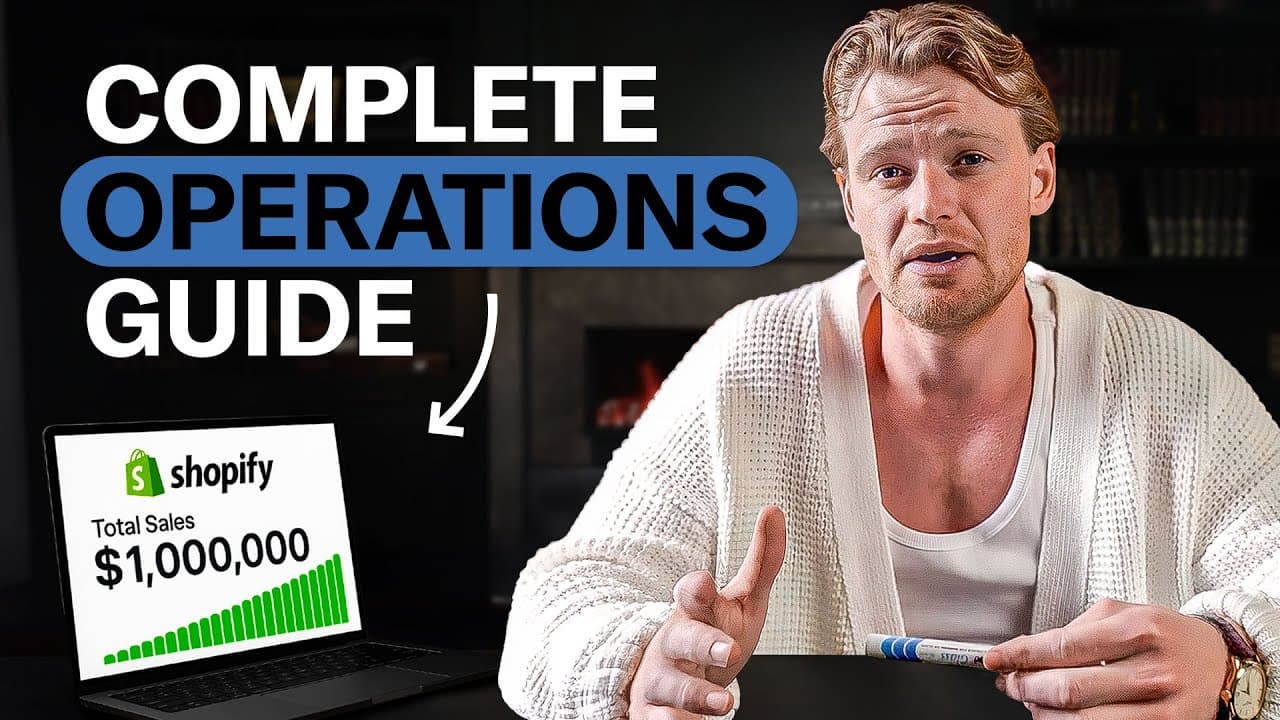
Run e-commerce operations at scale by improving customer outcomes while reducing unnecessary inputs, process load, and costs through efficiency and automation. Founders need working knowledge of product, supply chain, forecasting, fulfillment, and customer service before specialists take over. The Oodie’s stockout and 3PL failures show how operational gaps can erase major growth opportunities, so read on for the functions, risks, and priorities to manage.
Transcript
in today's video I'm going to cover absolutely everything that you need to know about e-commerce operations I really wish I had this video when I was creating the OD we did over $650 million in sales and it has been the most challenging part of my business marketing it's always been my specialty but operations simply because generally how e-commerc... Read More
Key Insights
- Operations is the discipline of transforming inputs through processes into outputs while maximizing the result experienced by customers. Efficiency comes from reducing unnecessary inputs, simplifying process requirements, and using automation to lower operational workload and costs without losing sight of the customer outcome.
- E-commerce operations includes product, supply chain, forecasting or planning, fulfillment, and customer service. The sequence begins with creating and ordering products, continues through inventory planning and warehouse fulfillment, and ends with delivery support and service for the customer.
- Forecasting is essential because rapid sales growth does not automatically produce operational readiness. When demand changed during COVID, The Oodie increased advertising spend without promptly revising inventory orders, sold out entirely, and missed an opportunity the founder believes could have made the business 30–40% bigger.
- Third-party logistics is a critical operational dependency because an external warehouse may be responsible for shipping every customer order. The wrong provider can fail to dispatch orders, send incorrect products, disrupt promotions, generate negative customer experiences, and leave the brand with limited ability to intervene quickly.
- Logistics failures can erase substantial growth opportunities even when demand is strong. The Oodie expected approximately $45–50 million in October and November sales, but a provider could not reliably ship orders, promotions were stopped, and the founder estimated the resulting lost revenue at more than $20 million.
- Operational work is comparable to regularly weeding a garden because neglected problems eventually restrict productive growth. Products and marketing may create visible revenue opportunities, but recurring operational maintenance is required so inventory, fulfillment, and customer service failures do not overwhelm those opportunities.
- Early-stage founders are operational generalists because they commonly occupy every major role until the business exceeds $1 million in revenue. They can learn the required functions themselves or hire assistance, but they still need broad competence before the company can support dedicated specialists.
- A chief operating officer generally oversees product, supply chain, planning, fulfillment, and customer service within the organizational structure described. Some companies separate product or customer service, but placing these connected functions under operational leadership can give the fulfillment sequence clear responsibility.
Install to Summarize YouTube Videos and Get Transcripts
Explore YouTube Video Summarizer or Get YouTube Transcript Extractor
Questions & Answers
Q: How do you run e-commerce operations at scale?
Manage product, supply chain, forecasting or planning, fulfillment, and customer service as one connected operational sequence. Improve that sequence by maximizing the output customers experience while reducing unnecessary inputs, process requirements, workload, and costs. Use automation where it can make processes more efficient without losing sight of the customer outcome.
Q: What is e-commerce operations management?
E-commerce operations management turns business inputs into customer-facing outputs through repeatable processes. Its purpose is to maximize the result for customers while decreasing unnecessary inputs and process load. The framework presented covers product, supply chain, forecasting or planning, fulfillment, and customer service.
Q: Which departments are part of e-commerce operations?
The core departments are product, supply chain, forecasting or planning, fulfillment, and customer service. The sequence moves from creating and ordering products through inventory planning, warehouse fulfillment, and post-purchase customer support. These functions commonly sit under a chief operating officer, although some companies separate product or customer service.
Q: Why is inventory forecasting important for e-commerce brands?
Forecasting helps a brand align inventory orders with expected demand before products sell out. When demand changed during COVID, The Oodie increased advertising without promptly revising its inventory orders and eventually sold out entirely. The founder believes the missed opportunity could have made the business 30–40% bigger.
Q: What can happen when an e-commerce brand chooses the wrong 3PL?
An unreliable third-party logistics provider can fail to dispatch orders, send incorrect products, and leave the brand unable to fix fulfillment problems quickly. The Oodie had to stop promotions when its provider could not reliably ship orders. The founder estimated that the failure caused more than $20 million in lost revenue and led to negative customer experiences.
Q: Why can strong marketing fail without strong operations?
Marketing can create demand, but operations determines whether the business can stock, ship, and support the resulting orders. The Oodie forecast approximately $45–50 million in sales during October and November, yet fulfillment failures forced the company to turn off promotions. Rapid demand during COVID also produced a complete stockout because inventory ordering did not adjust quickly enough.
Q: How should e-commerce companies measure operational success?
Operational success should remain tied to the output experienced by the customer rather than internal activity alone. The goal is to improve that output while reducing the inputs and process effort required to deliver it. Automation can lower workload, and fewer inputs can reduce costs, but neither matters if the customer outcome suffers.
Q: When should an e-commerce founder hire operations specialists?
Early-stage founders commonly handle every major operational role themselves and may use freelancers for selected tasks. The framework says founders often remain operational generalists until the business exceeds $1 million in revenue. As revenue and complexity grow, specialized employees can take responsibility for individual functions.
Summary & Key Takeaways
-
E-commerce operations can be viewed as inputs moving through processes to create outputs for customers. The operational goal is to improve those customer outcomes while using fewer inputs, simplifying processes, controlling costs, and applying automation where appropriate. Measurements should remain connected to what customers actually experience rather than focusing only on internal activity.
-
The core operational sequence covers creating a product, ordering and forecasting inventory, moving goods through the supply chain, fulfilling customer orders, and providing customer service. These functions commonly sit under a chief operating officer, although product or customer service may be separated in some organizations as the company develops.
-
Early-stage founders often perform every operational role themselves and may use freelancers for selected tasks. They therefore need working knowledge of product, customer service, supply chain, fulfillment, and planning. As revenue and complexity grow, the business can hire specialized people, but generalists remain necessary during the earlier stages of development.
Read in Other Languages (beta)
Share This Summary 📚
Summarize YouTube Videos and Get Video Transcripts with 1-Click
Try YouTube Summary with ChatGPT & Claude or YouTube Transcript Generator
Explore More Summaries from Davie Fogarty 📚




Summarize YouTube Videos and Get Video Transcripts with 1-Click
Try YouTube Summary with ChatGPT & Claude or YouTube Transcript Generator