How to Launch an E-commerce Brand for Under $500
TL;DR
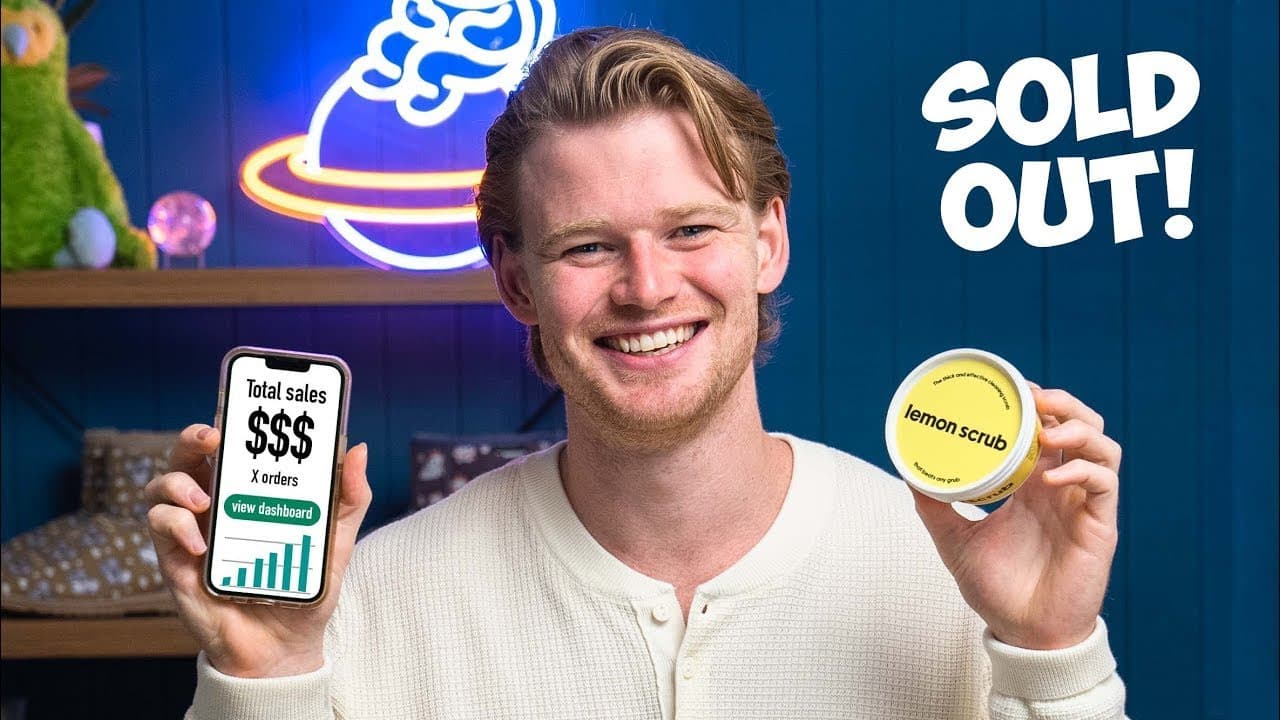
You can launch an e-commerce brand for under $500 by using an ads-buy tool to find a winning product, sourcing it on Alibaba with a negotiated sample run instead of a full MOQ, and driving sales through organic TikTok. Lemon Scrub, a cleaning paste, hit a viral 3.7M-view TikTok and made about $958 in launch-week sales before selling out.
Transcript
- Six months ago, we set ourselves the challenge to launch a brand under $500. We wanted to give you every single step of the way so you could do it yourself. We wanted to teach entrepreneurs how to create a million dollar brand. In this episode, we're just gonna recap all of the lessons that we learned along the way. For those that watch along, th... Read More
Key Insights
- Ads-buy tools are the starting point for product research because they scrape Facebook and surface many product ideas, which can then be cross-referenced against TikTok to spot products already scaling with proven demand.
- Product-market fit validation comes from seeing competitors already scaling. The team chose cleaning paste specifically because a couple of brands were scaling incredibly well on TikTok, signaling a real opportunity.
- Minimum order quantities can be bypassed by negotiating a sample run. Instead of the standard 5,000-piece MOQ on Alibaba, the team convinced the supplier to produce about 40 pieces for their customized yellow, lemon-scented paste.
- Advertorials are becoming essential in Facebook marketing because they increase conversion rate and AOV. Products with health benefits or cleaning uses lend themselves especially well to the advertorial format.
- Launching fast beats perfecting the store. Some brands convert well after four years with very basic websites, so the priority should be testing product-market fit rather than over-investing time and money in store design.
- Organic TikTok is a near-free acquisition method requiring only a product and a camera. This drove the majority of Lemon Scrub's sales and let the team sell out without spending heavily on ads.
- Attribution is a nightmare, so a free post-purchase survey app was used to identify true sources. Of 8 responses from 23 orders, TikTok was the majority driver, with some YouTube and about two sales from Facebook/Instagram.
- A viral video does not mean instant sales. Despite 3.7 million TikTok views, only 23 sales resulted, due to a terrible website conversion rate, inability to add a link in a new TikTok bio, and low brand credibility.
Install to Summarize YouTube Videos and Get Transcripts
Explore YouTube Video Summarizer or Get YouTube Transcript Extractor
Questions & Answers
Q: How do you find a winning product to sell online?
Start with an ads-buy tool, which scrapes Facebook and gives you a ton of product ideas. Then go down the rabbit hole by checking TikTok for similar products you saw on the ads-buy tool. This approach led the team to a cleaning paste that cleaned stoves and surfaces well. The key signal was that a couple of brands were already scaling incredibly well on TikTok, which they viewed as a great opportunity and proof of product-market fit.
Q: How can you avoid a large minimum order quantity when sourcing from Alibaba?
Convince the supplier to do a sample run instead of a full production order. When customizing a product, suppliers often cannot drop ship and require a minimum order quantity. The team wanted a customized yellow, lemon-scented cleaning paste, so rather than ordering the standard 5,000 pieces, they negotiated the supplier down to about 40 pieces. This kept costs low enough to stay under the $500 budget while still allowing product customization for their minimum viable brand.
Q: Why are advertorials important in Facebook marketing?
Advertorials are becoming essential in Facebook marketing because they help really increase conversion rate and AOV, and make your Facebook rates grow higher. Certain products lend themselves amazingly to advertorials, such as ones with health benefits or cleaning products. The team created an advertorial for their cleaning paste and targeted it to mums, the same audience as most of their marketing. They initially expected the advertorial to convert better than their Shopify store.
Q: Should you perfect your website before launching a brand?
No. People often get stuck on this step and invest a lot of time, effort, and money getting it right, but you should just launch and understand if you have product-market fit first. Even after four years, some of the team's brands still have really basic websites but convert really well. The team's own Shopify store ended up looking pretty bad and did not convert well, which became a lesson to improve later rather than a reason to delay launching.
Q: What acquisition method did the brand use and why?
The team used organic TikTok because they did not need to spend money on ads. All you need is a product and a camera to start selling. This proved true, as they hit a viral TikTok video and sold out of all their products. TikTok was chosen because there was already product-market fit, with other brands scaling on the platform. A post-purchase survey later confirmed TikTok was the main driver of sales over YouTube, Facebook, and Instagram.
Q: Why did a viral TikTok with millions of views produce so few sales?
Despite 3.7 million views, the brand only got 23 sales for several reasons. First, the website conversion rate was terrible. Second, because it was a new TikTok account, they could not put the link in the bio. Third, people do a lot of research before buying products online and the brand had no credibility, making for a slow start. The owner expected momentum to build quickly by continuing to post and adding UGC and influencer content.
Q: How can you tell where your sales are actually coming from?
Because attribution is a nightmare, the team set up a free post-purchase survey app to ask customers where they came from. Out of 23 orders they got about eight responses, since not everyone completes the survey. Even with this small dataset, TikTok was the majority of purchasers, with some YouTube involvement and Facebook and Instagram claiming about two sales. This confirmed their hypothesis that TikTok was the main sales driver and validated the brand's viability beyond just the owner's YouTube influence.
Q: What are the options for scaling a Facebook ad account?
There are two main structures. Interest-based targeting means taking one ad set targeting a single interest and duplicating it across five or six interests at small budgets, then using an early metric like cost per add-to-cart to kill underperformers, ending with a few ad sets of two to three creatives each. The alternative is broad audiences with no retargeting and no stacked interests, running one broad campaign plus one testing campaign, feeding winning ads into the broad targeting on the premise that Facebook knows more than you about when to target.
Summary & Key Takeaways
-
The team set a six-month challenge to launch a brand for under $500, documenting every step. They found a cleaning paste product using an ads-buy tool that scrapes Facebook, then confirmed the idea on TikTok where competitor brands were already scaling successfully, indicating product-market fit.
-
To source, they searched cleaning paste on Alibaba and negotiated a sample run of about 40 pieces instead of the standard 5,000-piece MOQ, customizing it as a yellow, lemon-scented paste. They wrote direct-response copy for Shopify, Facebook, email, and Google, plus an advertorial targeting mums.
-
Launch week produced about $958 in sales and a viral 3.7M-view TikTok before selling out. A post-purchase survey confirmed TikTok drove most orders. Future scaling options include interest-based Facebook targeting versus broad no-retargeting structures, plus adding secondary products and wholesale retail.
Read in Other Languages (beta)
Share This Summary 📚
Summarize YouTube Videos and Get Video Transcripts with 1-Click
Try YouTube Summary with ChatGPT & Claude or YouTube Transcript Generator
Explore More Summaries from Davie Fogarty 📚



Summarize YouTube Videos and Get Video Transcripts with 1-Click
Try YouTube Summary with ChatGPT & Claude or YouTube Transcript Generator