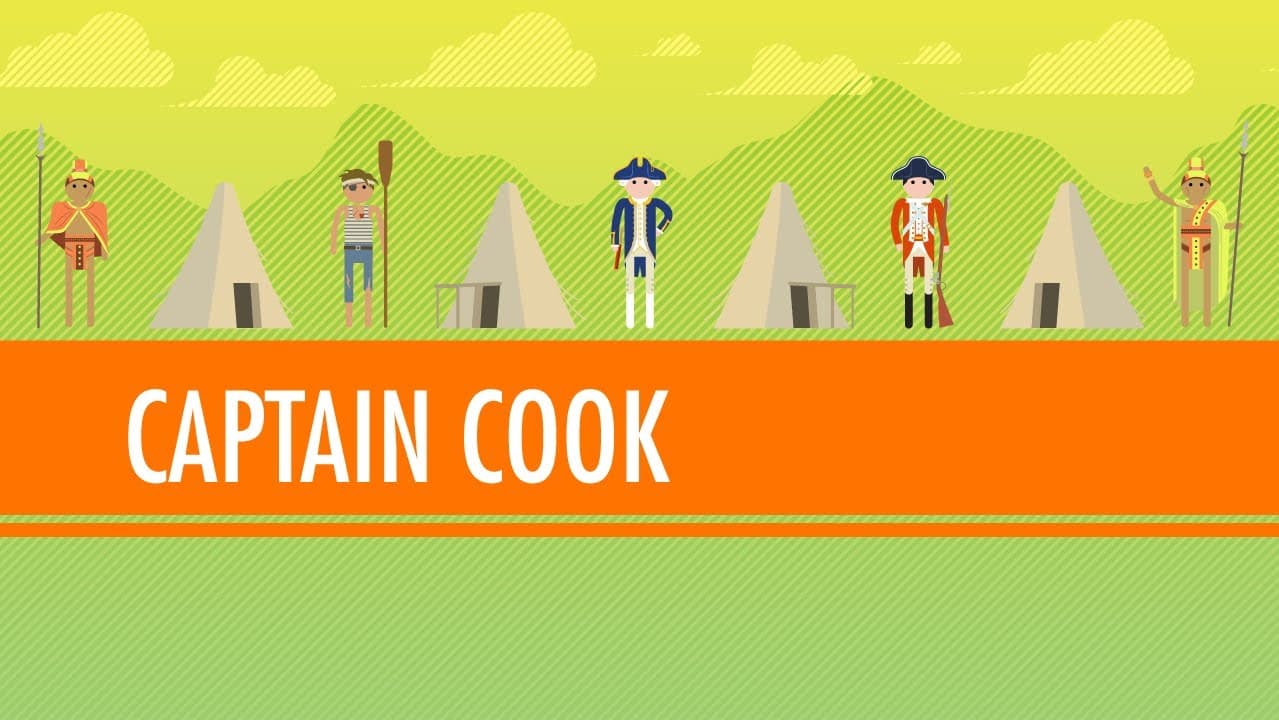
The Amazing Life and Strange Death of Captain Cook: Crash Course World History #27
TL;DR
Captain Cook’s 1779 death in Hawaii remains controversial because historians disagree over whether it was a ritual killing or the result of conflict and misunderstanding. Marshall Sahlins argued that Hawaiians perceived Cook as the fertility god Lono and killed him at the end of Makahiki, while Gananath Obeyesekere disputed that interpretation. Read on to compare these accounts and see how limited, biased sources complicate historical interpretation.
Transcript
Hi, I'm John Green, this is Crash Course World History and today we're going to talk about the life and astonishing death of Captain James Hook. Who's death by a crocodile ch- what? James Cook? There's no crocodiles? HGGG! Stupid history, always disappointing me. Well, Captain Cook is pretty interesting too and his death is a nice entree into one o... Read More
Key Insights
- Captain James Cook was a prominent British Naval Officer known for his three significant voyages of exploration and scientific discovery in the Pacific Ocean, which laid the groundwork for colonization.
- Cook's voyages contributed to the biological transformation of Australia, introducing new species like sheep and leading to the near destruction of indigenous cultures.
- Cook's exploration debunked myths like the existence of Terra Australis and the North-West Passage, reshaping European understanding of the Pacific region.
- Cook's death in Hawaii in 1779 is surrounded by controversy, with interpretations ranging from ritual murder to a melee during a tense encounter.
- Marshall Sahlins proposed that Cook was killed as part of a Hawaiian ritual, perceiving him as the fertility god Lono, a theory criticized for lack of evidence.
- Gananath Obeyesekere argued against the ritual theory, suggesting that Cook's death was a result of misunderstanding and conflict, not religious ritual.
- The narrative of Cook being viewed as a god by Hawaiians fits a broader pattern of European explorers being mythologized in history, often overshadowing indigenous perspectives.
- The story of Cook's death highlights the challenges of interpreting historical events from limited and biased sources, emphasizing the importance of considering multiple viewpoints.
Install to Summarize YouTube Videos and Get Transcripts
Explore YouTube Video Summarizer or Get YouTube Transcript Extractor
Questions & Answers
Q: Why was Captain Cook killed in Hawaii?
Captain Cook was killed during a fracas after returning to Kealakekua Bay for ship repairs in early 1779. Marshall Sahlins interpreted his death as a ritual killing connected to Lono and Makahiki, while Gananath Obeyesekere argued that it resulted from conflict and misunderstanding.
Q: Who was Captain James Cook?
Captain James Cook was a sailor and British Naval Officer born in 1728 who saw action in the Seven Years War. He is best known for three voyages of exploration and scientific discovery in the Pacific Ocean.
Q: What were Captain Cook’s three Pacific voyages?
Cook’s first voyage lasted from 1768 to 1771, and his second from 1772 to 1775. His third began in 1776 and continued until 1780, although Cook’s own journey ended with his death in 1779.
Q: What did Captain Cook accomplish during his Pacific explorations?
Cook mapped the coast of Australia and explored and mapped New Zealand, helping pave the way for British colonization. He also challenged belief in Terra Australis, helped dispel the idea of a North-West Passage, became the first European to describe Hawaii, and kept his crews free of scurvy.
Q: How did Cook’s voyages affect Australia?
Cook’s mapping paved the way for British colonization and the near destruction of Aboriginal peoples and their culture. His voyages also transformed Australia’s biological landscape by introducing sheep, which helped create its large wool industry.
Q: What did Marshall Sahlins argue about Cook’s death?
In "Islands of History," Marshall Sahlins argued that Cook arrived during Makahiki and was perceived by Hawaiians as the fertility god Lono. In this interpretation, Cook was killed as a ritual murder marking Makahiki’s end and the restoration of the normal political order associated with Ku.
Q: How did Gananath Obeyesekere challenge Sahlins’ interpretation?
Gananath Obeyesekere rejected the claim that Cook’s death was a religious ritual or that Hawaiians regarded him as a god. He argued instead that Cook died because of conflict and misunderstanding, and that the god narrative reflects European mythmaking more than Hawaiian belief.
Q: Why is the history of Captain Cook’s death difficult to interpret?
Accounts confirm through crew journals that Cook died in a confrontation involving at least one Hawaiian, but the details and meaning remain disputed. Limited and potentially biased sources, scarce Indigenous perspectives, and myths surrounding European explorers make a single definitive interpretation difficult.
Summary & Key Takeaways
-
Captain James Cook, a British Naval Officer, is renowned for his Pacific explorations, which paved the way for colonization and transformed the region's biological landscape. His death in Hawaii in 1779 remains a subject of historical debate, with differing interpretations about the reasons and circumstances surrounding it.
-
One interpretation by Marshall Sahlins suggests Cook was killed as part of a Hawaiian ritual, being mistaken for the god Lono. However, this theory is contested by Gananath Obeyesekere, who argues that Cook's death resulted from conflict and misunderstanding, not religious ritual.
-
The narrative of Cook's death reflects broader themes of European explorers being mythologized in history, often overshadowing indigenous perspectives. This highlights the challenges of interpreting historical events from limited and biased sources, emphasizing the need for diverse viewpoints in historical analysis.
Read in Other Languages (beta)
Share This Summary 📚
Summarize YouTube Videos and Get Video Transcripts with 1-Click
Try YouTube Summary with ChatGPT & Claude or YouTube Transcript Generator
Explore More Summaries from CrashCourse 📚

Summarize YouTube Videos and Get Video Transcripts with 1-Click
Try YouTube Summary with ChatGPT & Claude or YouTube Transcript Generator