What Is AI Safety and Alignment? Insights from Dan Hendrycks
TL;DR
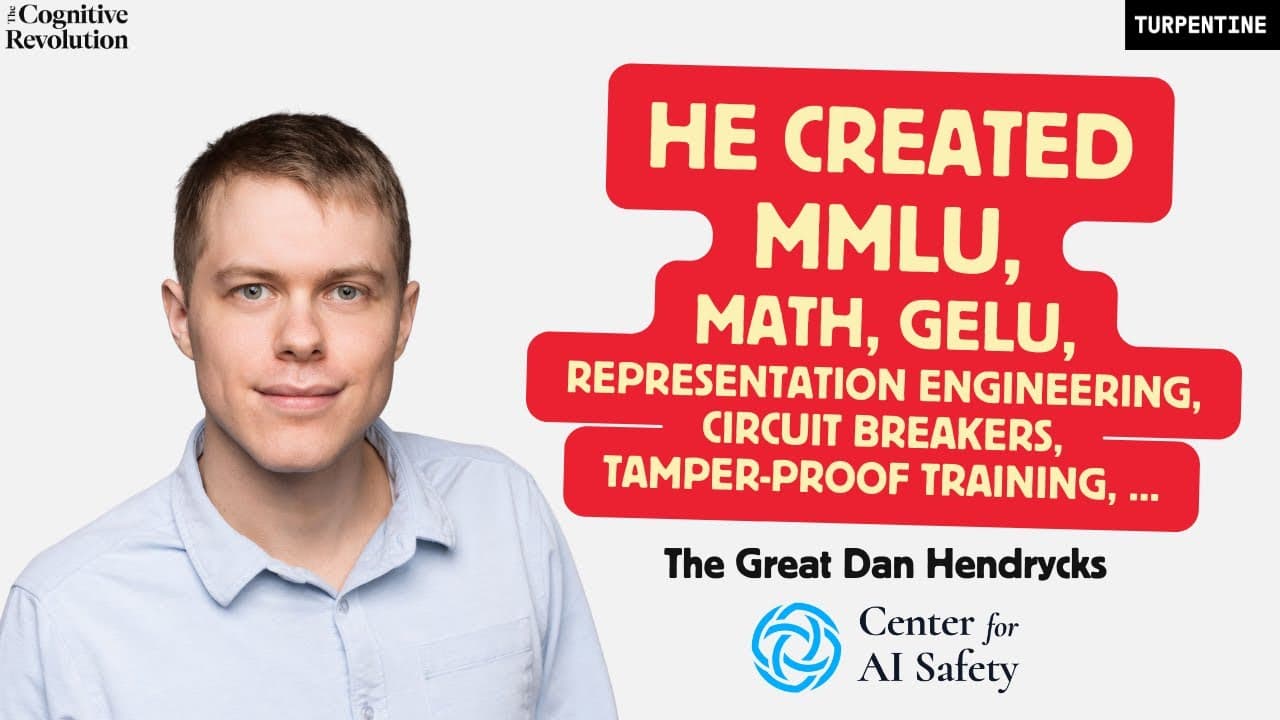
Dan Hendrycks, a leading figure in AI safety, discusses his work on AI robustness, alignment, and governance. He emphasizes the importance of data and compute over algorithmic insights and introduces concepts like representation engineering and circuit breakers to improve AI systems' reliability. Hendrycks also highlights the need for a defense-in-depth strategy to mitigate AI risks.
Transcript
the idea was that a lot of the linguistic understanding benchmarks were not being sufficiently difficult elon's description of it is it's basically like an undergraduate level knowledge and skill test there's a benchmark call MAK Val which is largely assessing the propensities of llm Agents see what sort of decisions do they make along the way do t... Read More
Key Insights
- Dan Hendrycks is a prominent researcher in AI safety and alignment, contributing significantly to the field.
- The GELU activation function, developed by Hendrycks, is widely used in modern transformer models.
- MMLU is a benchmark created by Hendrycks to assess AI's knowledge and reasoning across diverse subjects.
- Representation engineering focuses on understanding and controlling AI models' internal representations.
- Circuit breakers are designed to improve AI robustness by disrupting harmful output pathways.
- Tamper-resistant training aims to prevent unauthorized modifications of open-source AI models.
- Hendrycks advocates for a defense-in-depth strategy to address potential AI risks.
- He believes data and compute are more critical than algorithmic advances for AI capabilities.
Install to Summarize YouTube Videos and Get Transcripts
Explore YouTube Video Summarizer or Get YouTube Transcript Extractor
Questions & Answers
Q: What is the significance of the GELU activation function in AI models?
The GELU activation function, developed by Dan Hendrycks, is significant because it is widely used in modern transformer models, such as GPT and LLaMA. It provides a smoother transition compared to the traditional ReLU activation function, which can enhance model performance by reducing sharp transitions in the neural network's output. This has made GELU a preferred choice in many state-of-the-art AI models.
Q: How does the MMLU benchmark assess AI capabilities?
The MMLU benchmark, created by Dan Hendrycks, assesses AI capabilities by evaluating models across 57 different subjects, including history, calculus, and law. It aims to measure the models' knowledge and reasoning abilities at an undergraduate level. MMLU is considered one of the most comprehensive benchmarks, providing a broad and deep evaluation of AI's understanding and problem-solving skills.
Q: What is representation engineering in AI?
Representation engineering in AI involves understanding and controlling the internal representations of AI models. It focuses on identifying and manipulating the directions in activation space associated with specific concepts or behaviors. By doing so, researchers can improve model performance, enhance robustness, and ensure that AI systems behave in a desired manner. This approach contrasts with bottom-up mechanistic interpretability, offering a more top-down perspective.
Q: What are circuit breakers in AI models?
Circuit breakers in AI models are mechanisms designed to improve robustness by disrupting harmful output pathways. They work by identifying harmful representations within the model and altering them to prevent the model from executing undesirable behaviors. This approach enhances the model's resistance to adversarial attacks and jailbreaking attempts, contributing to safer and more reliable AI systems.
Q: How does tamper-resistant training work in AI?
Tamper-resistant training in AI aims to prevent unauthorized modifications of open-source models by simulating adversaries trying to remove safeguards. The training process involves creating circuit breakers that are difficult to bypass, even with fine-tuning efforts. This approach ensures that open-source models retain their safety features, reducing the risk of misuse or weaponization by malicious actors.
Q: Why is a defense-in-depth strategy important for AI safety?
A defense-in-depth strategy is important for AI safety because it provides multiple layers of protection against potential risks. By implementing various safety measures, such as circuit breakers and tamper-resistant training, AI systems can be made more robust and reliable. This approach helps mitigate the risks associated with advanced AI capabilities, ensuring that models behave safely and ethically in diverse scenarios.
Q: What role do data and compute play in AI development?
Data and compute play a crucial role in AI development, as they are considered more critical than algorithmic advances for driving AI capabilities. Dan Hendrycks emphasizes that scaling up data and compute resources can lead to significant improvements in AI performance. By providing models with more data and computational power, researchers can enhance their ability to learn, reason, and generalize across various tasks.
Q: How does Dan Hendrycks view the future of AI safety and alignment?
Dan Hendrycks views the future of AI safety and alignment as requiring a comprehensive approach that integrates robust technical solutions with ethical considerations. He advocates for a defense-in-depth strategy, emphasizing the importance of data and compute in advancing AI capabilities. Hendrycks believes that by focusing on representation engineering, circuit breakers, and tamper-resistant training, the AI community can effectively address potential risks and ensure the safe deployment of advanced AI systems.
Summary & Key Takeaways
-
Dan Hendrycks discusses his pioneering work in AI safety, focusing on robustness and alignment. He highlights the importance of data and compute over algorithmic insights, introducing concepts like representation engineering and circuit breakers to enhance AI systems' reliability. Hendrycks also emphasizes the need for a comprehensive defense-in-depth strategy to mitigate AI risks effectively.
-
Hendrycks' work includes developing the GELU activation function and creating benchmarks like MMLU to assess AI's knowledge and reasoning. He explores representation engineering, which involves understanding and controlling AI models' internal representations, and introduces circuit breakers to improve robustness by disrupting harmful output pathways.
-
Tamper-resistant training is another focus of Hendrycks, aiming to prevent unauthorized modifications of open-source AI models. He advocates for a defense-in-depth strategy to address potential AI risks and believes that data and compute are more critical than algorithmic advances in driving AI capabilities.
Read in Other Languages (beta)
Share This Summary 📚
Summarize YouTube Videos and Get Video Transcripts with 1-Click
Try YouTube Summary with ChatGPT & Claude or YouTube Transcript Generator
Explore More Summaries from Cognitive Revolution "How AI Changes Everything" 📚




Summarize YouTube Videos and Get Video Transcripts with 1-Click
Try YouTube Summary with ChatGPT & Claude or YouTube Transcript Generator