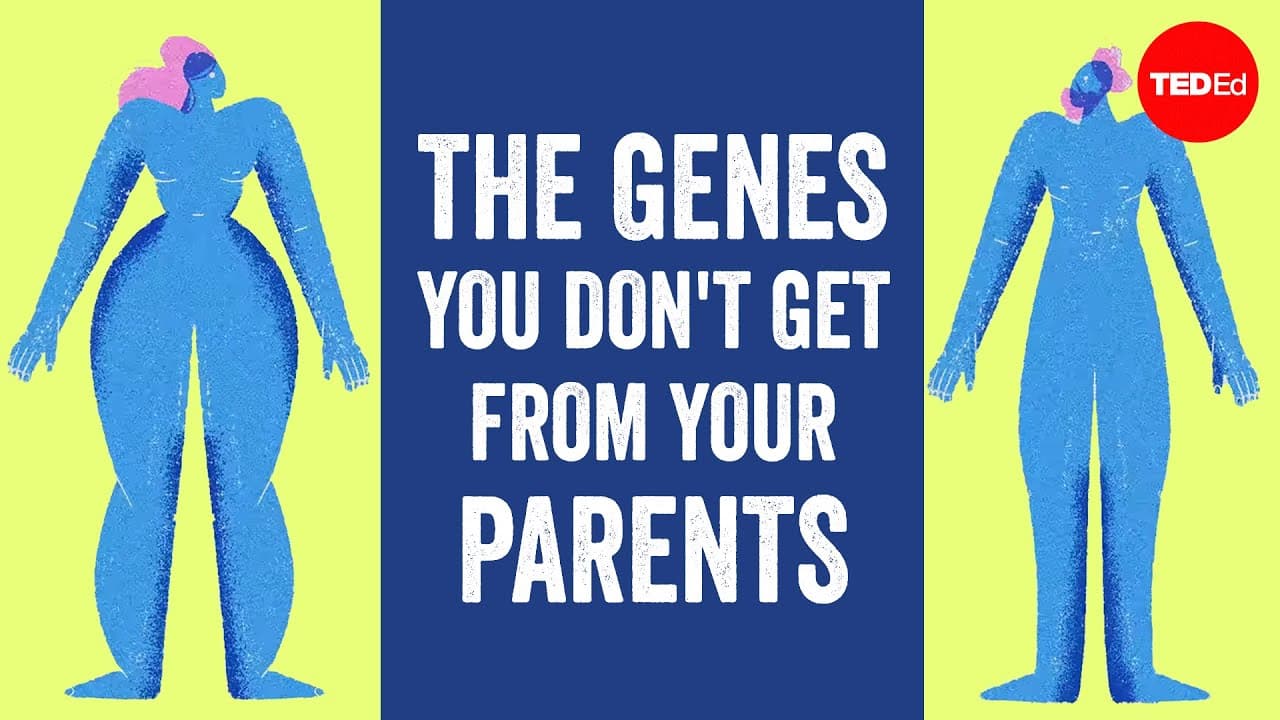
What genes do you not get from your parents but cannot live without? Devin Shuman
TL;DR
The indispensable genes outside our 23 chromosome pairs belong to mitochondria, organelles that use food and oxygen to produce ATP, the energy cells need to survive. Humans inherit mitochondrial DNA from their mothers, while genes that build and regulate mitochondria come from both parents. Read on to see how this unusual genome varies across species, cells, bodies, and lifetimes.
Transcript
Inside our cells, each of us has a second set of genes completely separate from the 23 pairs of chromosomes we inherit from our parents. And this isn’t just the case for humans— it’s true of every animal, plant, and fungus, and nearly every multicellular organism on Earth. This second genome belongs to our mitochondria, an organelle inside our cel... Read More
Key Insights
- "Mitochondria play an essential role: they convert energy from the food we eat and oxygen we breathe into a form of energy our cells can use, which is a molecule called ATP." (0:52)
- "Humans have over 200 types of cells, and all except mature red blood cells have mitochondria." (1:07)
- "In almost all species, mitochondrial DNA is passed down from only one parent." (2:21)
- "This translates to over 150,000 copies of mitochondrial DNA that we inherit from our mothers, each of which is independent and could vary slightly from the others." (2:47)
- "Learning more about them can both give us tools to protect human health in the future, and teach us more about our history." (4:35)
Install to Summarize YouTube Videos and Get Transcripts
Explore YouTube Video Summarizer or Get YouTube Transcript Extractor
Questions & Answers
Q: What are the genes we do not get from both parents?
They are genes in mitochondrial DNA, a second genome separate from the 23 chromosome pairs inherited from our parents. In humans and most animals, mitochondrial DNA comes only from the mother.
Q: Why can humans not live without mitochondria?
Mitochondria convert energy from food and oxygen into ATP, a form of energy cells can use. Without this energy, cells start to die.
Q: Why do mature red blood cells not have mitochondria?
Mature red blood cells transport oxygen and are the exception among more than 200 human cell types. They lack mitochondria because mitochondria would use the oxygen before it reached its destination.
Q: How much mitochondrial DNA do humans inherit from their mothers?
An egg contains thousands of mitochondria, with multiple copies of mitochondrial DNA in each one. This amounts to over 150,000 copies of mitochondrial DNA inherited from the mother.
Q: What happens to mitochondria from the father after conception?
Sperm contain approximately 50 to 75 mitochondria in their tails to help them swim. These mitochondria dissolve with the tail after conception.
Q: Can mitochondrial DNA differ within one person?
Yes. Slightly different mitochondrial DNA copies are distributed randomly as the fertilized egg develops, so variations become scattered throughout the body's tissues and organs.
Q: Can mitochondrial DNA change during a person's life?
Yes. Mitochondria replicate separately from cells and continually fuse and divide, so the selection of maternal mitochondrial DNA can change throughout a person's life and body.
Q: How many genes do mitochondria have in different species?
Mammalian mitochondria usually have 37 genes, while mitochondria in some plants, including cucumbers, have up to 65. Some fungal mitochondria have only 1 gene.
Summary & Key Takeaways
-
Mitochondria are unique organelles found in our cells that convert energy from food and oxygen into usable energy for our cells.
-
They have their own DNA, separate from our nuclear DNA, and vary across species in terms of the number of genes they possess.
-
Mitochondrial DNA is inherited only from the mother and can change throughout an individual's life and body due to their dynamic nature.
Read in Other Languages (beta)
Share This Summary 📚
Summarize YouTube Videos and Get Video Transcripts with 1-Click
Try YouTube Summary with ChatGPT & Claude or YouTube Transcript Generator
Explore More Summaries from TED-Ed 📚
Summarize YouTube Videos and Get Video Transcripts with 1-Click
Try YouTube Summary with ChatGPT & Claude or YouTube Transcript Generator