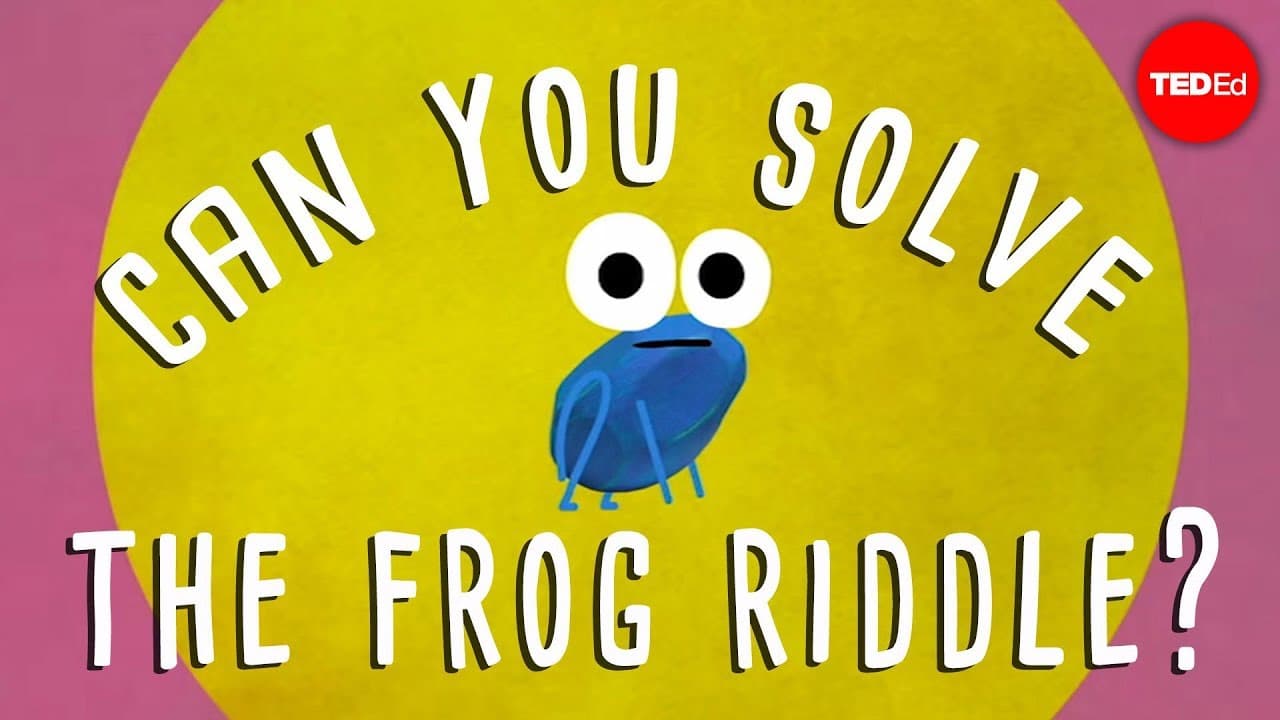
Can you solve the frog riddle? - Derek Abbott
TL;DR
Head to the clearing: licking both frogs there gives you a two-in-three, or about 67%, chance of survival, compared with 50% at the tree stump. The male frog’s croak eliminates the two-female possibility, leaving three possible pairs, two of which include a female that produces the antidote. Read on to see how conditional probability rules out the tempting but incorrect 75% answer.
Transcript
So you're stranded in a huge rainforest, and you've eaten a poisonous mushroom. To save your life, you need the antidote excreted by a certain species of frog. Unfortunately, only the female of the species produces the antidote, and to make matters worse, the male and female occur in equal numbers and look identical, with no way for you to tell th... Read More
Key Insights
- 👶 Conditional probability refines outcomes based on new information.
- 🥺 Mistaken assumptions in probability lead to inaccurate predictions.
- 🌍 Real-world applications of conditional probability include data analysis and decision-making.
- 🖐️ Information plays a crucial role in refining probability estimates.
- 🦻 Understanding conditional probability aids in making informed choices.
- ❓ Rainforest scenario emphasizes the importance of accurate probability calculations.
- 👾 Probability concepts like sample space are crucial in solving complex scenarios.
Install to Summarize YouTube Videos and Get Transcripts
Explore YouTube Video Summarizer or Get YouTube Transcript Extractor
Questions & Answers
Q: What is the correct answer to Derek Abbott’s frog riddle?
You should go to the clearing and lick both frogs. Your chance of finding at least one female and receiving the antidote is two in three, or about 67%, compared with 50% at the tree stump.
Q: Why is the chance of survival at the clearing two in three?
The croak reveals that at least one of the two frogs is male, so the two-female combination can be eliminated. Of the three possible combinations left, two contain a female, giving you a two-in-three chance of survival.
Q: Why is the survival chance at the tree stump 50%?
The single frog on the stump has an equal chance of being male or female. Because no additional information identifies its sex, the probability that it is the antidote-producing female remains one in two, or 50%.
Q: Why is 75% the wrong answer for the two frogs in the clearing?
The 75% calculation starts with all four possible male-female combinations and treats only the two-male pair as a failure. However, the croak tells you that at least one frog is male, eliminating the two-female pair and leaving only three possible combinations.
Q: What is the sample space in the frog riddle?
Before hearing the croak, the sample space contains four possible sex combinations for the two frogs. After learning that at least one frog is male, the two-female combination is removed, leaving three possibilities.
Q: How does conditional probability solve the frog riddle?
Conditional probability updates the odds when new information becomes available. Here, the male croak shrinks the sample space from four possible combinations to three, and two of those remaining combinations include a female.
Q: What information changes the probability in the clearing?
The decisive information is the distinctive croak, which can only come from a male frog. It establishes that at least one of the two frogs is male and rules out the possibility that both are female.
Q: Where does the transcript say conditional probability is used in real life?
Computers and other devices use conditional probability to detect likely errors in strings of 1s and 0s. People also use information from past experience and their surroundings to narrow their choices to better options.
Summary
In this video, the speaker presents a scenario where a person is stranded in a rainforest and needs the antidote from a certain species of frog to survive after eating a poisonous mushroom. The challenge is that only the female frog produces the antidote, while the male and female frogs look identical, except for the distinctive croak of the male. The person hears a male frog croaking from a clearing where there are two frogs, and also sees a frog on a tree stump nearby. The question is, which direction should the person go to have the highest chance of survival?
Questions & Answers
Q: What are the chances of survival if the person licks both frogs in the clearing?
The chances of survival are not 100%, contrary to what might be intuitive. The probability of getting the antidote from a female frog in the clearing is two in three, or about 67%. This is determined through the concept of conditional probability.
Q: What are the common incorrect ways of solving this problem?
The two common incorrect ways of solving this problem are:
- Assuming a 50% chance for any individual frog to be female, without considering the additional information of the croak.
- Multiplying the probability of each individual frog being male together to calculate the probability of both frogs being male. This method neglects the fact that information about one male frog affects the probability of the other frog being male.
Q: Why does the croak give additional information in determining the probability?
The croak indicates the presence of at least one male frog in the clearing. With this information, the possibility of having a pair of female frogs is eliminated, reducing the sample space from four possible combinations to three. Out of the three remaining combinations, only one includes two male frogs, resulting in a two in three chance (or 67%) of getting a female frog.
Q: How does conditional probability work?
Conditional probability involves starting with a larger sample space that includes all possible combinations, and then using additional information to eliminate certain possibilities, thus increasing the probability of the desired outcome. In this scenario, the information from the croak narrows down the potential combinations and increases the chances of encountering a female frog.
Q: Where else does conditional probability occur in real life?
Conditional probability is not just a concept for abstract mathematical games. It has practical applications in various fields. For example, computers and devices use conditional probability to identify possible errors in data transmission. In our everyday lives, we also use conditional probability when making decisions based on past experiences and observations.
Takeaways
Conditional probability plays a crucial role in determining outcomes when additional information is available. It allows us to narrow down possibilities and increase the chances of a desired outcome. Understanding conditional probability can have implications not only in mathematical problem-solving but also in various real-life situations where information affects probability.
Summary & Key Takeaways
-
Stranded in a rainforest, need antidote from female frog.
-
Males and females look identical, male has croak.
-
Conditional probability dictates higher chance of survival at the clearing.
Read in Other Languages (beta)
Share This Summary 📚
Summarize YouTube Videos and Get Video Transcripts with 1-Click
Try YouTube Summary with ChatGPT & Claude or YouTube Transcript Generator
Explore More Summaries from TED-Ed 📚


Summarize YouTube Videos and Get Video Transcripts with 1-Click
Try YouTube Summary with ChatGPT & Claude or YouTube Transcript Generator