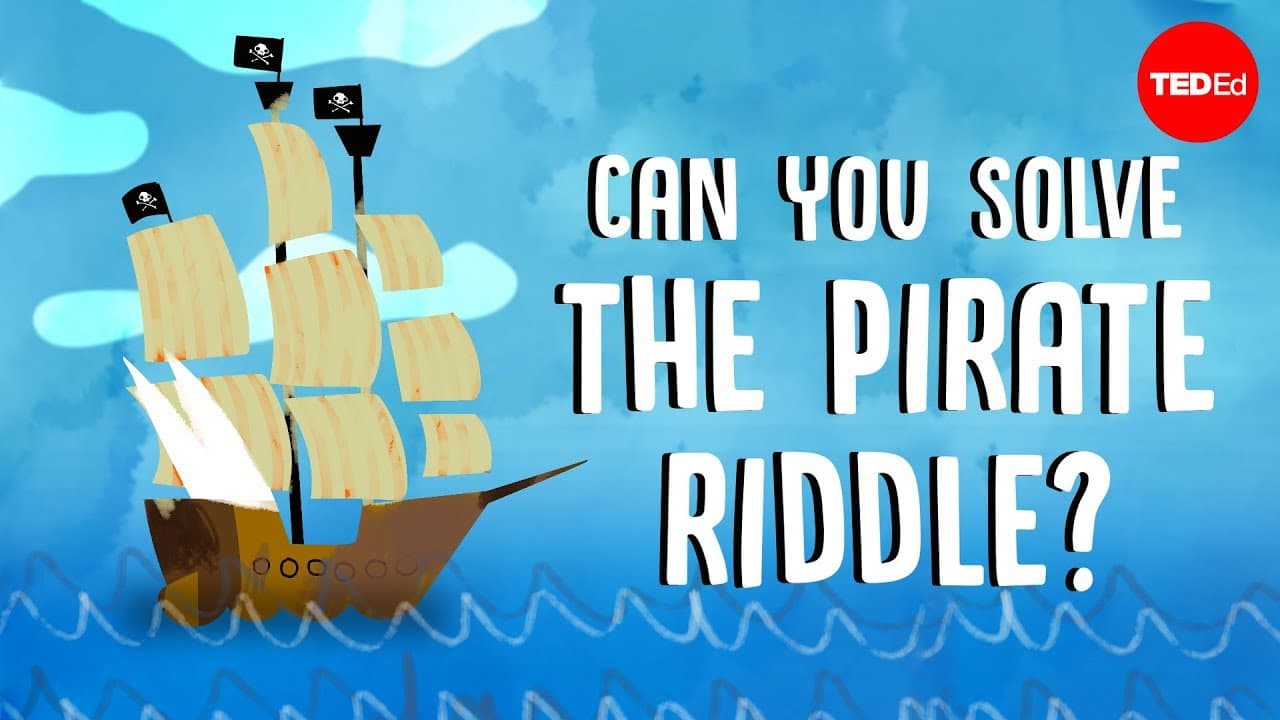
Can you solve the pirate riddle? - Alex Gendler
TL;DR
To ensure his survival, pirate captain Amaro should propose to keep 98 coins for himself and give 1 coin each to Charlotte and Eliza. This strategic offer secures the votes of Charlotte and Eliza while minimizing what he gives away, thus allowing his proposal to pass and avoiding walking the plank.
Transcript
It's a good day to be a pirate. Amaro and his four mateys, Bart, Charlotte, Daniel, and Eliza have struck gold: a chest with 100 coins. But now, they must divvy up the booty according to the pirate code. As captain, Amaro gets to propose how to distribute the coins. Then, each pirate, including Amaro himself, gets to vote either yarr or nay. If th... Read More
Key Insights
- 🖐️ Strategic voting plays a crucial role in the distribution of resources.
- 👾 Game theory concepts like common knowledge and Nash equilibrium apply in real-world scenarios.
- ◀️ Backward reasoning helps make optimal decisions.
- ❓ Trust and collaboration issues impact outcomes in strategic situations.
- 🏅 Amaro's clever proposal secures his survival and most of the gold.
- ☠️ The pirate scenario highlights the complexity of decision-making under strategic constraints.
- 🤩 Understanding others' strategies is key in strategic interactions.
Install to Summarize YouTube Videos and Get Transcripts
Explore YouTube Video Summarizer or Get YouTube Transcript Extractor
Questions & Answers
Q: What must Amaro consider when proposing a gold distribution plan?
Amaro must consider potential voting outcomes, knowing each pirate's strategic thinking and the consequences of rejected proposals to ensure his survival.
Q: How does each pirate's position in the voting sequence influence their decisions?
Each pirate considers future voting scenarios, backward reasoning from worst outcomes, strategizing to secure votes, ultimately leading to Amaro keeping most gold.
Q: What concepts from game theory are illustrated in the pirate scenario?
Concepts like common knowledge, where each pirate predicts others' reasoning, and Nash equilibrium, where players adjust strategies based on others', are demonstrated.
Summary
This video discusses a pirate game where Captain Amaro and his four mateys must distribute a chest of 100 coins among themselves according to the pirate code. Each pirate gets a chance to propose a distribution, and if the majority votes against it, the captain is replaced, and a new proposal is made. The game continues until a proposal is accepted or there's only one pirate left. The challenge is for Amaro to propose a distribution that ensures his survival and maximizes his share of the gold.
Questions & Answers
Q: What factors do the pirates consider when voting on the distribution proposal?
The pirates consider not only the current proposal but also all possible outcomes down the line. They know each other to be excellent logicians and can accurately predict how others would vote in any situation. This foresight allows them to adjust their own votes accordingly.
Q: How does Eliza reason through the decision-making process?
Eliza works backward from the last possible scenario with only her and Daniel remaining. She knows that Daniel would propose to keep all the gold in that situation, so she wants to avoid it. Moving to the previous decision point with three pirates and Charlotte making the proposal, Eliza understands that if Charlotte is outvoted, Daniel gets all the gold. Therefore, Charlotte only needs to offer Eliza slightly more than nothing (one coin) to ensure her support.
Q: What would Bart propose if there are four pirates?
As captain, Bart would only need one other vote for his plan to pass. He knows that Daniel wouldn't want the decision to pass to Charlotte, so he would offer Daniel one coin for his support, without offering anything to Charlotte or Eliza.
Q: How does Amaro ensure his survival and maximize his share of the gold?
Considering all the other scenarios, Amaro knows that if he walks the plank, the decision would come down to Bart, which would be unfavorable for Charlotte and Eliza. To secure their votes, Amaro offers each of them one coin, keeping 98 for himself. Despite Bart and Daniel voting against the proposal, Charlotte and Eliza reluctantly vote in favor, knowing it's the better option for them.
Q: What concepts from game theory are involved in the pirate game?
The pirate game illustrates the concept of common knowledge, where each pirate is aware of what others know and uses this information to predict their reasoning. Additionally, the final distribution represents a Nash equilibrium, where each pirate knows the strategies of every other pirate and chooses their own accordingly. Even though cooperation may lead to better outcomes, no individual player can benefit by changing their strategy in this scenario.
Q: What can be concluded from the final distribution?
Amaro successfully keeps most of the gold while ensuring his survival. However, the distribution may not be the most optimal outcome for all the pirates involved. The game highlights the need for the pirates to find better ways to utilize their logical skills and consider revising the pirate code.
Takeaways
The pirate game demonstrates the application of logic and strategic thinking in decision-making processes. It showcases how individuals use their knowledge of others' strategies to predict outcomes and make choices accordingly. Despite the potential for cooperation leading to better results, the game reveals instances where individual self-interest prevails, resulting in suboptimal outcomes for all parties involved. The video suggests the importance of reconsidering and improving upon an outdated and unfair code of conduct to achieve more favorable and mutually beneficial outcomes.
Summary & Key Takeaways
-
Amaro proposes gold distribution among pirates.
-
Each pirate votes yarr or nay, with consequences.
-Through logical deduction and strategic voting, Amaro retains most of the gold.
Read in Other Languages (beta)
Share This Summary 📚
Summarize YouTube Videos and Get Video Transcripts with 1-Click
Try YouTube Summary with ChatGPT & Claude or YouTube Transcript Generator
Explore More Summaries from TED-Ed 📚




Summarize YouTube Videos and Get Video Transcripts with 1-Click
Try YouTube Summary with ChatGPT & Claude or YouTube Transcript Generator