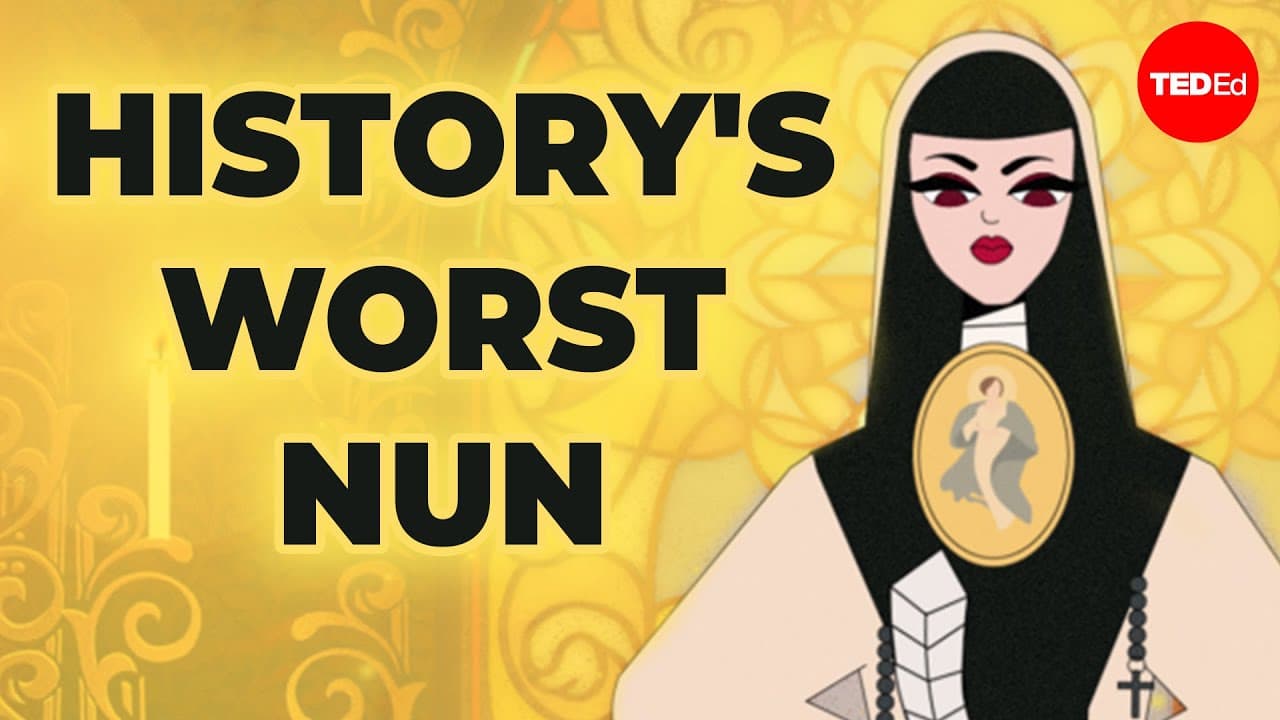
History's "worst" nun - Theresa A. Yugar
TL;DR
Sor Juana Inés de la Cruz was a groundbreaking 17th-century nun and writer in Mexico, recognized as the first feminist in the Americas. She challenged societal norms by advocating for women's education and intellectual equality, despite facing significant censorship and oppression from the Church. Her courage, works, and legacy continue to inspire discussions on feminism and women's rights today.
Transcript
Juana Ramírez de Asbaje sat before a panel of prestigious theologians, jurists, and mathematicians. The viceroy of New Spain had invited them to test the young woman’s knowledge by posing the most difficult questions they could muster. But Juana successfully answered every challenge, from complicated equations to philosophical queries. Observers... Read More
Key Insights
- 👱♀️ Sor Juana Inés de la Cruz was a remarkable woman who defied societal expectations, challenged sexism, and advocated for women's intellectual capabilities.
- 🤴 Her intelligence and literary talent attracted recognition from the royal court, but she chose a life of independence and respectability in the Church to pursue her thirst for knowledge.
- 💦 The Church, while providing her with a platform for intellectual pursuits, ultimately became a source of conflict due to censorship and suppression of her work.
- 🫒 Sor Juana's legacy lives on as the first feminist figure in the Americas, celebrated for her courage, intellect, and unwavering commitment to challenging societal norms.
Install to Summarize YouTube Videos and Get Transcripts
Explore YouTube Video Summarizer or Get YouTube Transcript Extractor
Questions & Answers
Q: How did Juana Ramírez de Asbaje gain recognition for her intelligence and literary talent?
Juana gained recognition for her intelligence and literary talent through her plays and poems, which impressed and sometimes outraged the royal court in Mexico City. Despite controversy, her works garnered admiration and several marriage proposals.
Q: Why did Sor Juana enter the Church as a nun?
Sor Juana entered the Church as a nun to pursue knowledge and retain her independence and respectability in a patriarchal society. Catholicism, despite being influenced by the Spanish Inquisition, offered her an opportunity to continue her intellectual pursuits without being confined to traditional gender roles.
Q: How did Sor Juana's outspokenness lead to conflicts and censorship?
Sor Juana's outspokenness led to conflicts and censorship when a bishop published her private critique of a respected sermon. In response, the conservative Archbishop of Mexico stripped her of her prestige and forced her to sell her books and give up writing.
Q: What was Sor Juana's final act of defiance?
Sor Juana's final act of defiance was signing her renewed vows as a nun with her own blood and the words "I, the worst of all." This was a poignant symbol of her frustration and anger at the censorship and limitations imposed on her intellectual pursuits.
Summary
This video highlights the life of Juana Ramírez de Asbaje, a remarkable woman from 17th century Mexico. Despite the complex social hierarchy and inequality of the time, Juana's intelligence and determination led her to overcome numerous challenges and become a celebrated figure in history. From her early education and struggles with societal expectations to her time as a lady-in-waiting and eventual entrance into the Church, Juana's life was filled with intellectual pursuits, writings, and controversy. The video recognizes her as a feminist pioneer and credits her work for shaping history itself.
Questions & Answers
Q: Who was Juana Ramírez de Asbaje?
Juana Ramírez de Asbaje was a woman born in mid-17th century Mexico who defied societal expectations and became a renowned intellectual figure of her time.
Q: What was Juana's upbringing like?
Juana's maternal grandparents were members of the esteemed class in Mexico, but she was born out of wedlock. Her father, a Spanish military captain, left her mother to raise Juana and her sisters alone. Despite these challenges, her upbringing was comfortable thanks to her grandfather's moderate means and her mother's successful management of one of her father's estates.
Q: How did Juana's early education shape her?
At a young age, Juana secretly followed her older sister to school, sparking her passion for learning. However, she later discovered that higher education was only available to men. Despite her request to attend disguised as a boy being denied, she found solace in her grandfather's library and continued to educate herself. By early adolescence, she had already mastered philosophical debate, Latin, and the Aztec language Nahuatl.
Q: How did Juana's intellectual abilities attract attention?
Juana's exceptional intellect garnered attention from the royal court in Mexico City. At sixteen, she became the lady-in-waiting for the viceroy and his wife. Here, she dazzled and outraged the court with her plays and poems, such as the infamous Foolish Men, which critically addressed sexist double standards.
Q: Why did Juana choose the Church as a path for knowledge?
In the patriarchal society of the time, Juana found the Church to be the only institution that allowed her to retain her independence, respectability, and access to knowledge while remaining unmarried. Despite the zealous influence of the Spanish Inquisition, she believed it was the best place for a woman like her to continue her intellectual pursuits.
Q: What did Juana accomplish within the Church as Sor Juana Inés de la Cruz?
As Sor Juana Inés de la Cruz, Juana continued to write prolifically, composing dramas, comedies, treatises on philosophy and mathematics, as well as religious music and poetry. She accumulated a significant library and received visits from many prominent scholars. Additionally, she fulfilled administrative duties within the convent, protecting the livelihoods of her family members from exploitative men.
Q: How did Sor Juana face conflict and censorship within the Church?
Sor Juana's outspokenness and critical opinions eventually clashed with her benefactors. In 1690, a bishop published her private critique of a respected sermon, leading to a conservative Archbishop taking notice. This resulted in the gradual stripping of Sor Juana's prestige, forcing her to sell her books and give up writing. Despite her deep frustration with this censorship, she chose to remain within the Church, bitterly renewing her vows.
Q: How did Sor Juana's life ultimately come to an end?
Deprived of her intellectual pursuits, Sor Juana turned her focus to charity work. However, in 1695, she contracted an illness while nursing her sisters and tragically passed away.
Q: How is Sor Juana remembered today?
Sor Juana Inés de la Cruz is now recognized as the first feminist in the Americas. Her life and works have been the subject of countless documentaries, novels, and operas. She is also honored by appearing on Mexico's 200-peso banknote. Nobel laureate Octavio Paz noted that Sor Juana's work not only shaped history but also highlighted the reciprocal influence history had on her.
Q: What were Sor Juana's main contributions to history?
Sor Juana's main contributions to history lie in her intellectual pursuits, writings, and her defiance of societal expectations. She challenged the patriarchal norms of her time, advocated for women's rights, and used her intellect to provoke thought and discussion on various subjects. Her work continues to inspire generations of feminists and thinkers around the world.
Takeaways
Juana Ramírez de Asbaje, better known as Sor Juana Inés de la Cruz, defied the societal constraints of 17th century Mexico to become an intellectual, a feminist pioneer, and a symbol of empowerment. Despite facing censorship and challenges, Juana's writings and intellectual contributions left an indelible mark on history. Her life serves as a reminder that women have always had the power to challenge and change the world, even when surrounded by adversity. Sor Juana Inés de la Cruz continues to inspire and shape the fight for gender equality today.
Summary & Key Takeaways
-
Juana Ramírez de Asbaje, born out of wedlock in 17th-century Mexico, showed remarkable intelligence from a young age and sought knowledge despite societal restrictions on women's education.
-
She gained prominence in the royal court for her plays and poems, which challenged sexism and double standards, but ultimately chose a life of independence and respectability in the Church.
-
As a nun, Sor Juana continued to write, collect an extensive library, and support her family, but her outspokenness led to conflicts with the Church hierarchy, resulting in censorship and the suppression of her work.
Read in Other Languages (beta)
Share This Summary 📚
Summarize YouTube Videos and Get Video Transcripts with 1-Click
Try YouTube Summary with ChatGPT & Claude or YouTube Transcript Generator
Explore More Summaries from TED-Ed 📚






Summarize YouTube Videos and Get Video Transcripts with 1-Click
Try YouTube Summary with ChatGPT & Claude or YouTube Transcript Generator