How Can Blockchain Systems Be Hacked or Secured?
TL;DR
Blockchain security depends as much on implementation as on cryptographic design. Hash-linked blocks, proof of work, transparent ledgers, and majority consensus can make altered transactions difficult to accept, but coding errors, flawed smart contracts, and deployment mistakes still create exploitable weaknesses, so organizations should assess security before applying blockchain broadly.
Transcript
We'll start this session. The title of this session is Hacking Blockchain, and it's presented by Constantinto, C- uh, sorry, Constanti- Constantinos, uh, Karagiannis, uh, Chief Technology Officer, Security Consulting, BT. Uh, let's welcome our speaker. Thanks. All righty. Okay. So, uh, before we begin, um, if Satoshi Nakamoto's here, he's required ... Read More
Key Insights
- Blockchain is a distributed ledger that allows parties to exchange payments, contracts, or other digital assets without a central organization controlling every transaction. Participating nodes validate transactions, group them into blocks, and preserve an openly viewable record intended to support trust.
- A blockchain links blocks through hashes, with each new block referring to the hash of the preceding block. Altering an earlier block changes its hash, which breaks the expected relationship and gives the network a basis for rejecting the altered data.
- Proof of work requires miners to perform computational work before a block can join the accepted chain. The work and comparison of hashes help validate blocks while making attacks based on computational power more difficult to execute successfully.
- Majority consensus determines which chain the network accepts. If someone submits an altered block intended to create illegitimate funds or transactions, the changed hash conflicts with the accepted record, and the majority network can discard the attempted modification.
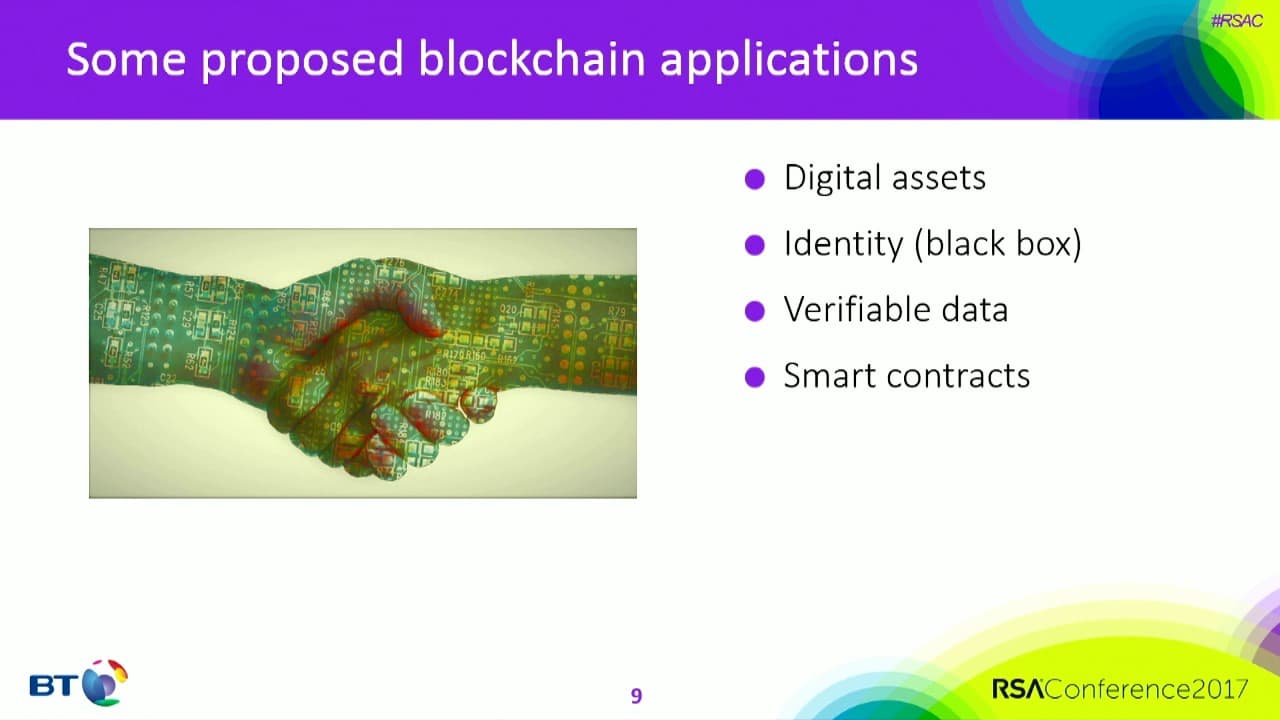
- Blockchain applications extend beyond cryptocurrency to digital assets, micropayments, identity management, verifiable records, property titles, and smart contracts. These uses rely on distributed information and automated interactions, but each implementation introduces its own security requirements and possible mistakes.
- Black box identity is a proposed blockchain model in which applications access only the specific identity information required for validation. The remaining information stays separate, reducing the need for banks, doctors, and other organizations to receive unrelated personal data.
- Blockchain attacks often exploit implementation flaws rather than disproving the underlying architecture. Secure concepts can become vulnerable when developers make coding, configuration, integration, or validation mistakes, which is why off-the-shelf software still requires assessment in its deployed environment.
- Bitcoin contained an early transaction-validation flaw described as a one-return bug. The validation logic left a one on top of the stack, creating a potential method to loop through the process and pay using another person's money, according to the presentation.
Install to Summarize YouTube Videos and Get Transcripts
Explore YouTube Video Summarizer or Get YouTube Transcript Extractor
Questions & Answers
Q: How does a blockchain validate and record transactions?
A blockchain network verifies a transaction immediately or places it in a queue for later processing, depending on the network. Multiple transactions are grouped into a block identified by a hash. After miners or other network participants validate the block, it is added to the accepted chain, where each block refers to the preceding block's hash.
Q: Why are blockchain records difficult to alter?
Blockchain records are difficult to alter because every block is identified by a hash and refers to the hash of the preceding block. Changing a stored block also changes its hash, disrupting the expected sequence. The altered version conflicts with the majority chain, so participating nodes can recognize and reject the attempted modification.
Q: What role does proof of work play in blockchain security?
Proof of work requires miners to complete computational work and compare hashes before a block is accepted. This process validates the block and makes the network harder to fool through a computational power attack. Miners can receive Bitcoin for successful work, while the validated block becomes part of the majority chain and distributed ledger.
Q: Why do blockchain implementations remain vulnerable to hacking?
Blockchain implementations remain vulnerable because secure architectural ideas can be weakened by mistakes in code, configuration, validation, and integration. The presentation compares blockchain assessment with testing off-the-shelf financial software: the purpose is not necessarily to challenge the product's entire design, but to discover errors made while deploying and adapting it within a particular environment.
Q: What can blockchain be used for besides Bitcoin?
Blockchain can support digital assets, artist micropayments, identity management, verifiable data, property titles, and smart contracts. Its distributed and decentralized ledger can record exchanges without a controlling third party. These applications use the same general ability to validate and preserve data, although their implementations can create different security problems and require careful assessment.
Q: How could blockchain support identity management?
A proposed black box identity model would place identity information in a protected structure on a blockchain. An application needing to validate a person could access only the necessary piece of information, while unrelated details remained private. This separation could prevent a bank from receiving medical records or a doctor from receiving unnecessary financial information.
Q: What security risks can smart contracts create?
Smart contracts allow agreements or processes to interact without direct human involvement. That automation can be useful, but the presentation cautions that retaining human involvement may be advisable. Because blockchain attacks frequently target implementations, mistakes in the contract's coded behavior or surrounding system can create consequences that automated execution may carry out without human review.
Q: What was the early Bitcoin transaction-validation bug?
The presentation identifies a one-return bug as the first code issue manifested as a blockchain flaw in Bitcoin. During transaction validation, the logic left a one on top of the stack. That behavior could potentially enable a short loop that paid using somebody else's money, illustrating how a small coding detail can undermine transaction security.
Summary & Key Takeaways
-
Blockchain enables parties to exchange payments, contracts, or other digital assets without a central organization controlling each transaction. Transactions are collected into blocks, blocks are identified by hashes, and each block refers to the preceding hash. This structure creates a distributed ledger designed to expose unauthorized alterations to participating nodes.
-
Bitcoin uses miners, proof of work, and majority consensus to validate blocks and add them to the accepted chain. Miners perform increasingly difficult computational work and may receive Bitcoin as a reward. Attempts to insert an altered block change its hash, allowing the network to reject data that conflicts with the majority chain.
-
Many practical attacks target blockchain implementations rather than the underlying concept. Coding mistakes, deployment errors, and poorly designed automated contracts can undermine an otherwise strong architecture. The presentation highlights a Bitcoin transaction-validation bug and argues that security testing should examine how blockchain software is built, configured, and integrated into real environments.
Read in Other Languages (beta)
Share This Summary 📚
Summarize YouTube Videos and Get Video Transcripts with 1-Click
Try YouTube Summary with ChatGPT & Claude or YouTube Transcript Generator
Explore More Summaries from RSAC Cybersecurity 📚





Summarize YouTube Videos and Get Video Transcripts with 1-Click
Try YouTube Summary with ChatGPT & Claude or YouTube Transcript Generator