How Does STIX 2 Patterning Share Analytics?
TL;DR
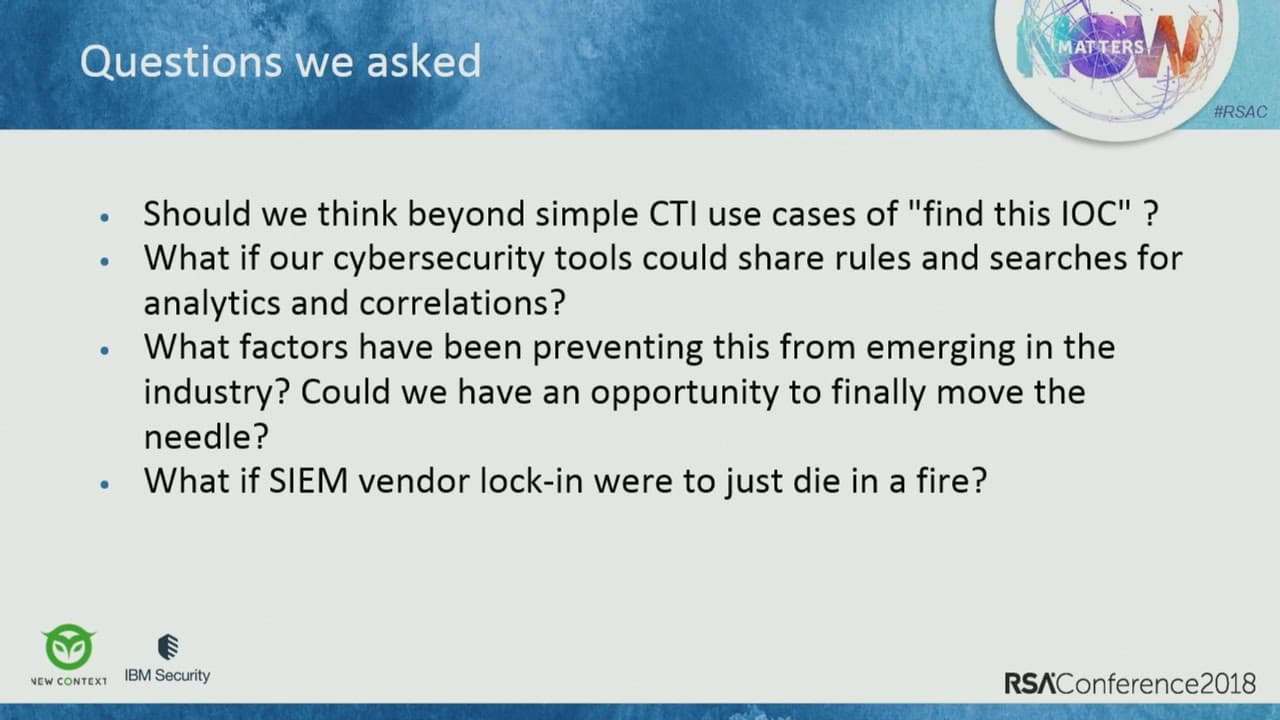
STIX 2 Patterning provides a common way to express and exchange indicators, behaviors, searches, and correlations across different security tools. It addresses STIX 1.X complexity, including multiple meanings of equality and redundant expression methods, while aiming to support temporal relationships and vendor-independent sharing beyond simple IP addresses, URLs, or file signatures.
Transcript
So, uh, without further ado, I'm Trey Arley from New Context. This is my co-presenter and friend, Jason Kierstead from IBM. And, uh, we're here to talk to you today about STIX Patterning in STIX2. So- Without further ado. So, uh, important front matter always. Um, next slide. So, uh, we're gonna try to give you a little bit of history before we tal... Read More
Key Insights
- STIX 1.X is complicated because it provides multiple meanings for equality and several ways to construct equivalent expressions. The resulting variability forces consuming software to support many code paths and can cause content to behave differently depending on how a tool interprets it.
- A comparison of two IP addresses could be expressed in 12 different ways in STIX 1.X, according to a count cited by the presenters. This illustrates how excessive representational flexibility can make interoperability and predictable tool behavior much harder to achieve.
- STIX 1.X lacks temporal matching despite its structural complexity. It cannot directly describe a sequence in which a file appears and then, five seconds later, contacts a particular IP address or destination, limiting its ability to represent malware behavior.
- Snort is valuable for finding network activity, but it does not describe malware behavior across endpoints and other data sources. Its domain-specific strengths therefore do not satisfy the need for a common expression that combines file, network, registry, and behavioral observations.
- YARA works by matching patterns in blobs of data, including files on disk, files on the wire, or content in memory. It can identify relevant files, but it cannot directly describe network traffic or a sequence of malware actions.
- Sigma is described as an approach resembling Snort for log files. It enables platform-independent sharing of field-and-value matches for SIEM data, but it still represents another domain-specific language rather than a single method for combining logs, endpoints, and live network observations.
- The target behavioral use case is a pattern that connects several activities, such as matching a malware signature, observing characteristic beacon traffic, and detecting a dropped registry key or persistence mechanism. STIX Patterning is intended to express these related observations together.
- Security information sharing can include analytics rather than only atomic indicators such as IP addresses and URLs. STIX Patterning aims to let a useful query, rule, search, or correlation created for one platform be shared with organizations using different SIEM, endpoint, or network toolchains.
Install to Summarize YouTube Videos and Get Transcripts
Explore YouTube Video Summarizer or Get YouTube Transcript Extractor
Questions & Answers
Q: Why was STIX 2 Patterning created?
STIX 2 Patterning was created to address problems encountered with STIX 1.X indicator expressions. The earlier design offered multiple meanings of equality, several ways to combine observations, unusual list syntax, and no temporal matching. The newer approach seeks a clearer, more consistent language that can represent simple indicators, complex malware behavior, searches, analytics, and correlations across different tools.
Q: What was wrong with pattern matching in STIX 1.X?
Pattern matching in STIX 1.X was difficult because equivalent ideas could be represented in many different ways. Composite expressions could be assembled at the indicator level, the observable level, or both. The presenters cite a count of 12 ways to compare two IP addresses. Consuming tools consequently needed many code paths and might not interpret the same content consistently.
Q: How does STIX Patterning differ from Snort?
Snort is presented as a strong language for finding activity on networks, but its applicability is limited to that domain. It cannot describe broader malware behavior involving endpoint changes, dropped files, registry keys, persistence, and subsequent communications. STIX Patterning seeks to connect observations across these domains instead of restricting the shared expression to network matching alone.
Q: How does STIX Patterning differ from YARA?
YARA is useful for finding patterns within blobs of data, including files on disk, content moving across a network, and data in memory. However, it does not directly describe network traffic or behavioral sequences. STIX Patterning is intended to express relationships among file matches, communications, registry changes, persistence activity, and other observations that occur across different environments.
Q: What limitation does Sigma have compared with STIX Patterning?
Sigma provides a common, platform-independent way to express field-and-value matches in log data and is described as resembling Snort for logs. Its limitation in this discussion is its focus on log-based detection. STIX Patterning aims to support analytics that may run in a SIEM, on an endpoint, on the network, or against live observations where logs are unavailable.
Q: Can STIX Patterning describe temporal malware behavior?
Temporal behavior is one of the capabilities motivating the move beyond STIX 1.X. The presenters describe a desired indicator in which a file is created on disk and then, five seconds later, contacts a particular IP address or destination. STIX 1.X could not express that temporal relationship, even though its indicator representation was already complicated in other ways.
Q: What kinds of complex detections can STIX Patterning represent?
The intended use cases combine observations such as a malware signature match, beacon traffic with a particular form, and a later action such as dropping a registry key, creating another file, hiding itself, or establishing persistence. The language is meant to move beyond isolated IP addresses and URLs by expressing related behaviors across network and endpoint evidence.
Q: Why is vendor-independent analytics sharing important?
Vendor-independent sharing allows detection knowledge created in one tool to remain useful to organizations using another toolchain. The presenters envision a strong query created by a Splunk user being shared with an ISAO, an ISAC, another security operations center, or an endpoint practitioner. The recipient could then use its logic without needing the original platform.
Summary & Key Takeaways
-
STIX 1.X made indicator matching unnecessarily difficult because equality and composite expressions could be represented in several ways. One cited analysis found 12 ways to compare two IP addresses. This variability complicated implementations, produced inconsistent content, and could cause consuming tools to interpret or execute equivalent indicators differently.
-
Existing detection languages serve valuable but distinct purposes. Snort focuses on network matching, YARA finds patterns in blobs such as files or memory, and Sigma provides a platform-independent approach to log matching. None alone provides the cross-domain behavioral representation sought for combined endpoint, network, and temporal observations.
-
STIX 2 Patterning seeks to make security analytics portable across organizations, platforms, and toolchains. Its broader goal is to let practitioners exchange not only atomic indicators but also searches, rules, correlations, and behavioral descriptions, allowing useful detection logic created in one environment to retain value in another environment.
Read in Other Languages (beta)
Share This Summary 📚
Summarize YouTube Videos and Get Video Transcripts with 1-Click
Try YouTube Summary with ChatGPT & Claude or YouTube Transcript Generator
Explore More Summaries from RSAC Cybersecurity 📚




Summarize YouTube Videos and Get Video Transcripts with 1-Click
Try YouTube Summary with ChatGPT & Claude or YouTube Transcript Generator