How Open Security Enables Zero Trust Adoption
TL;DR
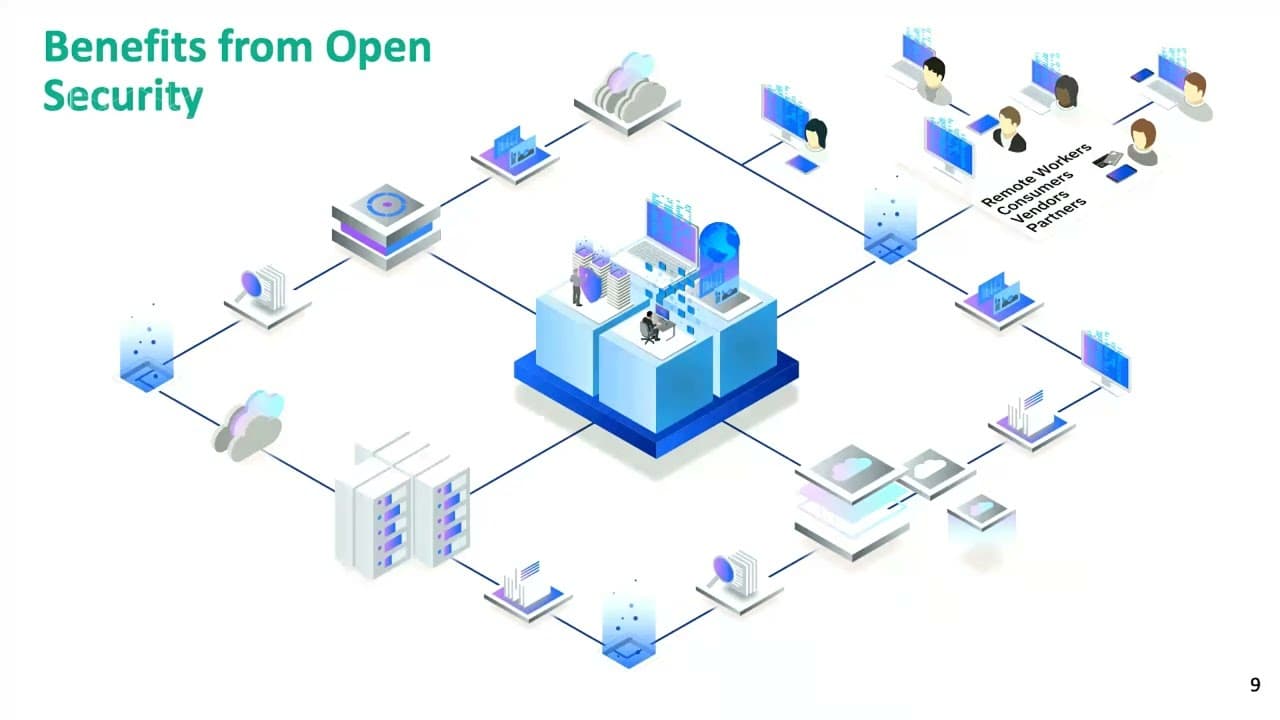
Open security makes zero trust more practical by giving security tools standard APIs, interfaces, and data ontologies for exchanging telemetry and taking action. Without those standards, cloud adoption, remote work, regulation, and expanding threats create fragmented systems that require costly point-to-point integrations, weaken visibility, disconnect workflows, and force analysts to maintain detections separately across multiple products.
Transcript
Um, okay. Uh, hi. Hi, everyone. Thanks for coming along today. Uh, great to see a good turnout. Um, it's awesome. Um, so today I'm gonna talk about open security and how, um, and how it's really essential to enable new architectures, new security architectures such as zero trust, um, as organizations are, are, are evolving. Um, this, this whole con... Read More
Key Insights
- Security complexity is increasing as organizations adopt cloud infrastructure, SaaS services, containers, and the security capabilities built into those environments. Each addition can introduce another product or data source, making the overall security infrastructure more fragmented rather than consolidating it.
- Cloud adoption is encouraging organizations to use controls already available within platforms such as AWS, Azure, and Google. This approach supports rapid adoption, but it also distributes security functions and data across more systems, increasing the need for those systems to communicate effectively.
- Vendor-specific interfaces are a central obstacle to interoperability because security products do not naturally exchange information through shared protocols. Even interfaces described as open remain proprietary when every integration requires custom knowledge, mapping, implementation, and ongoing maintenance.
- Point-to-point integration is costly because teams must determine how fields such as IP addresses, hashes, and process names correspond across products. They must also understand how different APIs connect, creating substantial technical overhead beyond the direct work of detecting and responding to threats.
- Fragmented security systems create poor visibility, disconnected workflows, and additional work for security teams. When tools do not communicate quickly or correctly, defenders struggle to combine relevant information and coordinate actions, while adversaries gain opportunities from the resulting gaps.
- Threat detection becomes difficult to maintain when every new threat must be represented separately in each tool. Teams must determine how to detect the same activity across multiple products and verify coverage repeatedly, increasing the risk that detections become outdated.
- Open security is an approach based on standard APIs, standard interfaces, and shared data ontologies. Its goal is to let security systems exchange telemetry, ask equivalent questions, and perform common response actions without requiring a custom integration between every pair of products.
- Zero trust architectures depend on effective coordination across security technologies. Applying zero trust, XDR, or cybersecurity mesh concepts through a collection of proprietary point-to-point integrations would add more work, so broader interoperability is presented as essential for practical adoption.
Install to Summarize YouTube Videos and Get Transcripts
Explore YouTube Video Summarizer or Get YouTube Transcript Extractor
Questions & Answers
Q: What is open security in a zero trust architecture?
Open security is an approach in which security products use standard APIs, interfaces, and data ontologies to exchange telemetry and initiate actions. It goes beyond sharing threat intelligence because it aims to make routine questions and responses consistent across tools. The intended result is easier coordination among existing and newly adopted technologies, reducing dependence on custom point-to-point integrations.
Q: Why does zero trust require security tools to interoperate?
Zero trust requires multiple security technologies to share context and coordinate decisions or actions across a distributed environment. If each product uses a proprietary interface, teams must create and maintain separate integrations before the tools can work together. That burden makes a modern architecture harder to operate, especially as cloud services, remote employees, and new security capabilities expand the number of participating systems.
Q: Why is cloud adoption making security more complex?
Cloud adoption introduces new infrastructure, SaaS services, containers, cloud workload protection, cloud security posture management, and platform-specific controls. Organizations often use these built-in capabilities because they are immediately available and support rapid adoption. However, each additional capability can create another source of security data or another operational silo, increasing fragmentation and the effort required to obtain unified visibility.
Q: What problems are caused by proprietary security interfaces?
Proprietary interfaces prevent security tools from communicating naturally through common protocols. Teams must build point-to-point connections, map equivalent data fields, learn product-specific query methods, and keep integrations current. This work consumes resources that could otherwise support defense. It also contributes to poor visibility, disconnected workflows, delayed coordination, and inconsistent detection coverage across an organization's collection of security products.
Q: How can standard APIs improve security operations?
Standard APIs can give different security tools a consistent way to request information and perform actions. An analyst could ask equivalent questions about a user's activity, visited websites, downloaded hashes, or activity surrounding a domain without learning a separate language for every product. Standardized actions could similarly support applying multifactor authentication or quarantining a user or endpoint through a common method.
Q: Why do security detections become outdated across multiple tools?
Detections become difficult to maintain because a new threat may require separate implementation in every security product. Teams must determine how each tool represents the relevant activity, create the appropriate detection, and then verify that coverage exists throughout the environment. When products use different formats and rules, this repeated work increases operational pressure and makes it harder for teams to keep pace.
Q: How does open security differ from STIX and TAXII?
STIX and TAXII are presented as earlier efforts involving a protocol and ontology for exchanging threat intelligence information. Open security extends the idea beyond threat intelligence. It seeks standard APIs, interfaces, and data ontologies for broader security telemetry and response actions, allowing products to ask common questions, exchange operational information, and coordinate protective steps through consistent mechanisms.
Q: What security challenges are increasing pressure on teams?
Security teams face expanding cloud infrastructure, SaaS services, containers, regulatory and privacy controls, remote or hybrid work, and a threat environment described as increasingly severe. Organizations respond by adopting more security tools and built-in platform controls. The resulting fragmentation demands more data integration, more movement between screens, and more effort to connect workflows, adding pressure to already complex operations.
Summary & Key Takeaways
-
Cloud infrastructure, SaaS services, containers, regulatory obligations, remote work, and increasingly severe threats are adding strain to security teams. Organizations often adopt the built-in controls of new platforms to move quickly, but this expands the number of tools and distributes security data across a fragmented collection of systems and silos.
-
Most security products expose vendor-specific interfaces rather than shared protocols, so they cannot communicate naturally. Organizations must build and maintain point-to-point integrations, map fields across products, and understand different query languages. The presenter says this integration burden can require another person for every security professional using tools for defense.
-
Open security extends beyond exchanging threat intelligence through STIX and TAXII. It calls for standard APIs, interfaces, and data ontologies that let tools request common telemetry and initiate actions consistently. Such interoperability would help organizations use current investments, adopt new capabilities, and build zero trust, XDR, and cybersecurity mesh architectures more practically.
Read in Other Languages (beta)
Share This Summary 📚
Summarize YouTube Videos and Get Video Transcripts with 1-Click
Try YouTube Summary with ChatGPT & Claude or YouTube Transcript Generator
Explore More Summaries from RSAC Cybersecurity 📚





Summarize YouTube Videos and Get Video Transcripts with 1-Click
Try YouTube Summary with ChatGPT & Claude or YouTube Transcript Generator