How Do IoT Security Labels Help Consumers?
TL;DR
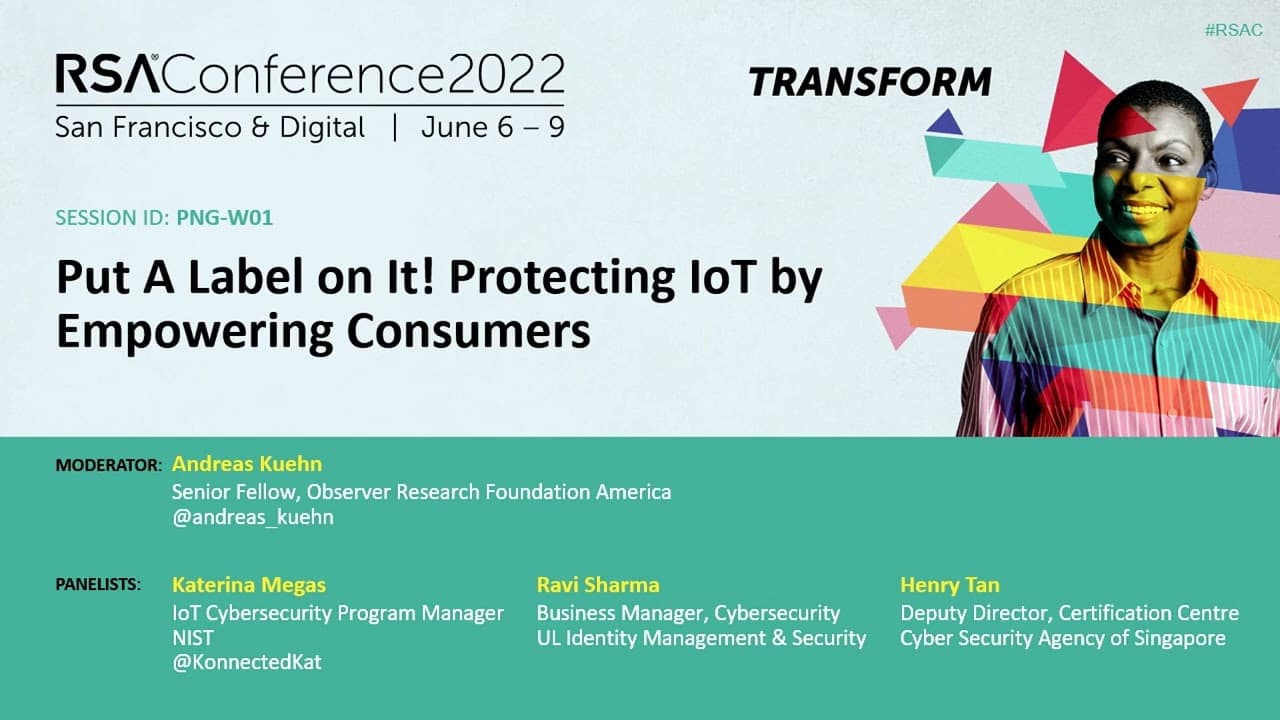
IoT cybersecurity labels help consumers choose connected products based on clearly communicated security criteria. A trustworthy program must define what the label means, specify the baseline a product must meet, and establish how manufacturers prove conformity, while limiting fragmentation and allowing stronger products to distinguish themselves in the marketplace.
Transcript
Hello, everyone. Uh, thank you for joining us this morning for our panel on the label on IoT protecting IoT by empowering consumers. IoT cybersecurity labeling is an important topic. Um, at RSA, we'll talk a lot about what the industry can do, what governments can do to improve cybersecurity. But I think we do not talk enough about how we can empow... Read More
Key Insights
- IoT cybersecurity labels are consumer-facing tools that communicate whether connected products satisfy defined security expectations. They are intended to help buyers make risk-informed purchasing decisions instead of requiring every consumer to independently evaluate complex technical features and practices.
- A cybersecurity label is more than a symbol placed on a device or package. It also depends on the criteria the product must meet and the process used by a manufacturer or product owner to demonstrate that those requirements are satisfied.
- Trust is the foundation of an effective IoT labeling program. Consumers need confidence that labeled products have undergone an appropriate level of security checking and that label claims correspond to meaningful practices concerning issues such as passwords, personal data, and payment information.
- IoT labeling can reward manufacturers that offer stronger cybersecurity. Clear market differentiation helps those organizations communicate product quality, while informed consumer demand can encourage the broader market to improve the security features and capabilities available in connected products.
- Fragmentation is a major challenge for cybersecurity labeling. NIST responded by starting from a core baseline intended to capture areas of broad agreement across different markets, while recognizing that unusual products or use cases may still require special consideration.
- NIST's IoT criteria were informed by existing publications, public workshops, stakeholder feedback, standards activity, and labeling initiatives from other countries, including Singapore. This approach sought to adapt an established baseline while considering both domestic and international work.
- A binary label was recommended as a practical consumer-facing approach. Under that model, a product either meets the applicable baseline or does not, making the primary message easier to understand than a detailed technical assessment presented directly on the package.
- A voluntary labeling scheme can support both manufacturer self-declaration of conformity and third-party assessment. Allowing both methods gives a program multiple ways to establish that products meet its criteria, while keeping proof of conformity separate from the consumer-facing label itself.
Install to Summarize YouTube Videos and Get Transcripts
Explore YouTube Video Summarizer or Get YouTube Transcript Extractor
Questions & Answers
Q: What is an IoT cybersecurity label?
An IoT cybersecurity label is a consumer-facing indication that a connected product meets defined security criteria. The label may appear physically on a product or its packaging, or it may be digital. Its credibility also depends on the underlying requirements and on a process through which the manufacturer or product owner demonstrates conformity with those requirements.
Q: How do IoT security labels help consumers?
IoT security labels give consumers accessible information for making risk-informed purchasing decisions. Instead of expecting buyers to analyze technical security details themselves, a label communicates whether a product meets an established baseline. It can also educate people who are unfamiliar with cybersecurity and provide reassurance about risks involving passwords, personal data, or connected household devices.
Q: What makes an IoT security label trustworthy?
A trustworthy label connects a clear consumer-facing claim to meaningful cybersecurity criteria and credible evidence of conformity. Consumers must know what the product is expected to do and how the manufacturer established that it meets those expectations. Without sound criteria and a dependable verification process, the symbol alone cannot provide reliable assurance about a product's security.
Q: Why does IoT labeling matter to manufacturers?
IoT labeling can help manufacturers with stronger security practices distinguish their products in a marketplace where cybersecurity quality varies. When consumers can identify products that meet a recognized baseline, they can create demand for better protection. That market signal gives organizations an incentive to communicate their security capabilities clearly and improve products that fall short of consumer expectations.
Q: How were NIST's IoT labeling criteria developed?
NIST began with its existing core baseline for IoT cybersecurity, then considered international initiatives, domestic work, and relevant standards. It also gathered stakeholder input through public workshops and adapted the baseline for consumer labeling. The resulting criteria describe what an IoT manufacturer or producer would need to do for a product to qualify for the proposed label.
Q: Why is fragmentation a problem for IoT labeling?
Fragmentation can produce competing baselines, inconsistent label meanings, and different expectations across markets. Stakeholders therefore urged NIST to avoid creating another disconnected approach. NIST used a core baseline intended to reflect broad areas of agreement across industrial, government, and consumer contexts, while acknowledging that some edge cases may not fit a common framework perfectly.
Q: Should an IoT cybersecurity label be binary?
NIST recommended a binary label based on stakeholder input and the conditions discussed during its work. A binary approach tells consumers whether a product meets the applicable baseline, creating a direct and understandable message. The recommendation was presented as suitable for the current environment, with recognition that labeling approaches can change as technology, markets, and consumer needs evolve.
Q: How can IoT products prove conformity with label criteria?
A labeling program can permit manufacturers to declare that their own products conform to the criteria, while also allowing assessment by an independent third party. NIST recommended supporting both approaches for a voluntary scheme. Whichever method is used, the conformity process must provide credible support for the claim communicated by the label to consumers.
Summary & Key Takeaways
-
IoT cybersecurity labeling shifts part of the security conversation toward consumer choice. Inspired partly by familiar energy labels, the approach gives buyers accessible information about connected products so they can decide what security risk is acceptable and favor devices that provide stronger protections or greater assurance.
-
A complete labeling scheme includes the visible or digital label, the cybersecurity criteria a product must satisfy, and a method for demonstrating conformity. These elements must work together because the label has value only when consumers can trust that its claims accurately reflect the product's practices and capabilities.
-
NIST built its proposed criteria from an existing core baseline, reviews of domestic and international efforts, standards work, workshops, and stakeholder feedback. Its recommendations favored a voluntary binary label indicating whether a product meets the baseline, with conformity demonstrated through manufacturer self-declaration or independent third-party assessment.
Read in Other Languages (beta)
Share This Summary 📚
Summarize YouTube Videos and Get Video Transcripts with 1-Click
Try YouTube Summary with ChatGPT & Claude or YouTube Transcript Generator
Explore More Summaries from RSAC Cybersecurity 📚


Summarize YouTube Videos and Get Video Transcripts with 1-Click
Try YouTube Summary with ChatGPT & Claude or YouTube Transcript Generator