What Is the Largest Black Hole in the Universe?
TL;DR
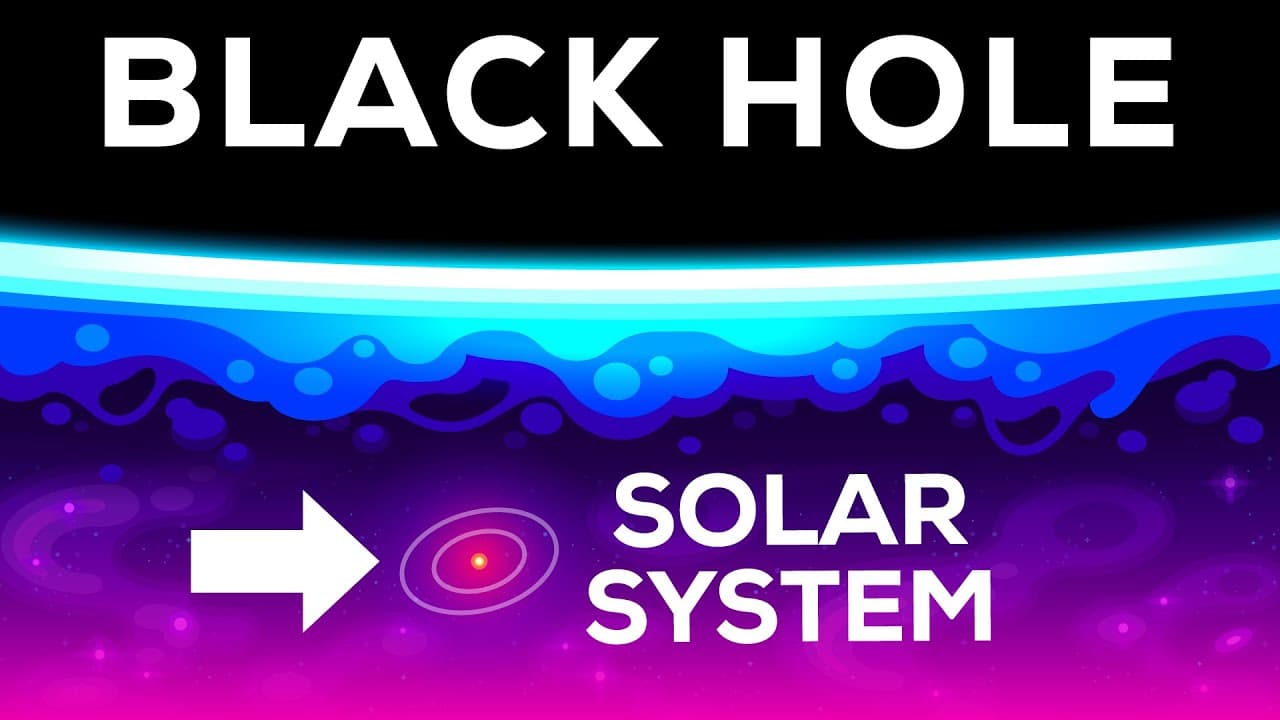
The largest known black hole is TON 618, an ultramassive giant with roughly 66 billion times the mass of our Sun. Because black holes have no physical size limit, they range from theoretical primordial ones no bigger than a proton, to stellar black holes just 16 km wide, to supermassive kings at galaxy centers like Sagittarius A* (about 4 million solar masses). Read on to see how each class forms and why there is a startling gap in scale between them.
Transcript
The largest things in the universe are black holes. In contrast to things like planets or stars they have no physical size limit, and can literally grow endlessly. Although in reality specific things need to happen to create different kinds of black holes, from really tiny ones to the largest single things in the universe. So how do bla... Read More
Key Insights
- 🌌 Primordial Black Holes: The smallest black holes, if they exist, formed after the big bang and could be the mysterious dark matter holding galaxies together, despite being incredibly difficult to observe.
- 🌟 Stellar Black Holes: These black holes require the collapse of enough matter, such as in the merger of neutron stars or the supernova of a massive star. They can range in size, from 16 km wide (smaller than Paris) to 92 km wide (casting a shadow on Corsica).
- 🔎 Mergers and Discoveries: Black holes can grow larger by devouring stars or merging with other black holes. Exciting discoveries of massive black holes, such as one 142 solar masses and the size of Germany, were made through the detection of gravitational waves.
- ⚓ Supermassive Black Holes: Contrary to popular belief, supermassive black holes, like Sagittarius A Star in the Milky Way, do not act as "anchors" that hold galaxies together. They make up only 0.001% of their galaxy's mass, with dark matter playing a larger role in gravitational effects.
- 💥 Feeding and Activity: Supermassive black holes can release jets of plasma and accretion disks of glowing gas when they devour mass, making them appear much larger than they actually are.
- 🌌 Ultramassive Black Holes: These black holes can reach tens of billions of solar masses, shining as bright as quasars. Examples include an ultramassive black hole at the center of galaxy OJ 287, 18 billion solar masses, and TON 618, with an incredible 66 billion solar masses.
- ❓ Uncertainties in Measurements: Black holes are challenging to study as we cannot directly observe them. Measurements and calculations involve uncertainties and assumptions, contributing to variations in size estimations.
- 📚 Behind the Scenes: Data on black holes is limited, and cataloging them is a relatively recent endeavor. The properties of black holes are derived from their gravitational effects on surrounding matter, adding to uncertainties. Additionally, physics on such scales is not fully understood.
Install to Summarize YouTube Videos and Get Transcripts
Explore YouTube Video Summarizer or Get YouTube Transcript Extractor
Questions & Answers
Q: What is the largest black hole in the universe?
The largest known black hole is TON 618, an ultramassive black hole with about 66 billion solar masses. Ultramassive black holes reach tens of billions of solar masses and shine as bright as quasars. Another example is the black hole at the center of galaxy OJ 287, at roughly 18 billion solar masses.
Q: How do primordial black holes differ from other black holes?
Primordial black holes, if they exist, are the smallest kind and would have formed just after the Big Bang, making them older even than atoms. The smallest one still around would have the mass of a big mountain (about a trillion kilograms) yet be no bigger than a proton. Other black holes instead form from violent events like supernovae or neutron star mergers.
Q: What is the smallest known black hole?
The smallest known black hole has about 2.7 times the mass of the Sun, forming a sphere roughly 16 km in diameter, large enough to cover Paris. Another lightweight example is the companion to the red giant V723 Mon, a black hole just 17.2 km wide that still throws the much larger star around.
Q: How do stellar black holes grow larger?
Stellar black holes grow by devouring stars or by merging with other black holes. M33 X-7, one of the largest stellar black holes, is only 15.65 solar masses and 92 km wide, but as it eats a 70 solar mass blue giant the infalling matter heats up and shines 500,000 times brighter than our Sun. Mergers, like one that formed a 142 solar mass black hole the size of Germany, are detected through gravitational waves.
Q: Why is there a gap between stellar and supermassive black holes?
There are many black holes up to about 150 solar masses, then a long gap until black holes that are millions of times more massive. The universe is not old enough for supermassive black holes to have grown this large just by eating stars and merging, so something else must have happened. One proposed explanation is Quasi Stars, hypothetical early stars whose collapsing cores could have seeded supermassive black holes.
Q: Do supermassive black holes hold their galaxies together?
No. Contrary to popular belief, supermassive black holes like Sagittarius A* in the Milky Way do not act as anchors that hold galaxies together. They make up only about 0.001% of their galaxy's mass, and dark matter plays a far larger role in the galaxy's gravitational effects.
Q: Why are black hole sizes uncertain?
Black holes cannot be observed directly, so their properties are derived from their gravitational effects on surrounding matter. Cataloging them is a relatively recent effort and data is limited, so measurements rely on approximations and assumptions. This means size and mass estimates carry real uncertainty and can vary.
Summary & Key Takeaways
-
Primordial black holes, if they exist, would be the smallest black holes in the universe, with a mass of a trillion kilograms or less.
-
Stellar black holes are formed from the collapse of massive stars and can range in size from 16 km to 92 km in diameter.
-
Supermassive black holes are located at the centers of galaxies and can have masses ranging from millions to billions of solar masses.
-
Ultramassive black holes are the largest known black holes, with masses of tens of billions of solar masses or more.
Read in Other Languages (beta)
Share This Summary 📚
Summarize YouTube Videos and Get Video Transcripts with 1-Click
Try YouTube Summary with ChatGPT & Claude or YouTube Transcript Generator
Explore More Summaries from Kurzgesagt – In a Nutshell 📚




Summarize YouTube Videos and Get Video Transcripts with 1-Click
Try YouTube Summary with ChatGPT & Claude or YouTube Transcript Generator