What Is Deviance in Sociology and Why Does It Matter?
TL;DR
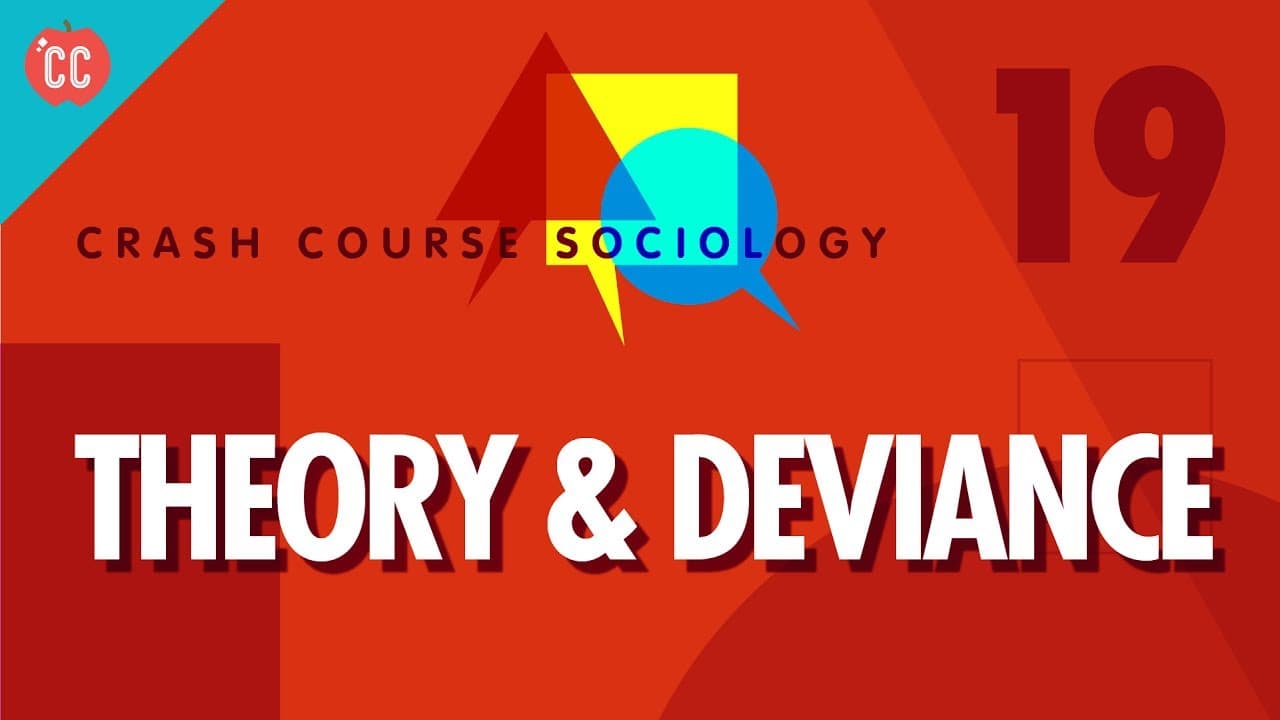
Deviance in sociology refers to behaviors that violate societal norms, which can serve various functions, such as defining cultural values and encouraging social change. Understanding deviance involves examining perspectives like structural functionalism, symbolic interactionism, and conflict theory to see how societal responses and power dynamics shape perceptions of deviant behavior.
Transcript
As we noted last week, an armed robber and a pacifist have something in common: They're both social deviants. But they're obviously also really different. It's hard to imagine that some people resort to armed robbery for some of the same reasons that other people reject violence. That’s why there are many different theories of deviance that can giv... Read More
Key Insights
- Deviance is a social construct that varies across different societies and cultures, influenced by societal norms and values.
- Structural functionalism views deviance as a necessary function in society, helping to define cultural values and norms.
- Symbolic interactionism focuses on how deviance is constructed through social interactions and labels, impacting self-concept and identity.
- Conflict theory ties deviance to power dynamics, highlighting how norms and laws reflect the interests of the powerful.
- Durkheim's theory suggests deviance clarifies moral boundaries and can unite society against breaches of these boundaries.
- Merton's strain theory explains deviance as a result of the gap between culturally defined goals and the means available to achieve them.
- Labeling theory demonstrates how social labels can transform minor deviance into a significant part of an individual's identity.
- Social power dynamics often determine which behaviors are labeled as deviant, with the powerless more likely to be stigmatized.
Install to Summarize YouTube Videos and Get Transcripts
Explore YouTube Video Summarizer or Get YouTube Transcript Extractor
Questions & Answers
Q: What is the structural functionalist perspective on deviance?
The structural functionalist perspective views deviance as a necessary part of society that serves several functions. It helps define cultural values and norms, clarifies moral boundaries, unites society against breaches of these boundaries, and can encourage social change. Deviance is seen as an integral part of social order.
Q: How does symbolic interactionism explain deviance?
Symbolic interactionism explains deviance through social interactions and the process of labeling. It suggests that deviance is not inherent in any act but is constructed through the labels society assigns to certain behaviors. This perspective highlights how labels can impact an individual's self-concept and social identity, often leading to further deviance.
Q: What role does power play in the conflict theory of deviance?
In conflict theory, power plays a crucial role in defining deviance. Norms and laws are seen as reflecting the interests of the powerful, who can label behaviors that threaten their power as deviant. This perspective highlights how the powerless are more likely to be stigmatized and punished for deviant behaviors, while the powerful can often avoid such labels.
Q: How does Merton's strain theory explain deviance?
Merton's strain theory explains deviance as a result of the gap between culturally defined goals and the means available to achieve them. When individuals cannot achieve societal goals through legitimate means, they may resort to deviant behaviors. This theory categorizes responses to this strain as conformity, innovation, ritualism, retreatism, and rebellion.
Q: What is the impact of labeling on deviance?
Labeling can transform minor deviance into a significant aspect of an individual's identity. The process of labeling can lead to secondary deviance, where the individual internalizes the deviant label, affecting their self-concept and social interactions. This can result in a stigma, influencing how others perceive and interact with the individual.
Q: How does deviance relate to societal norms and values?
Deviance is closely related to societal norms and values, as it helps define what is considered acceptable or unacceptable behavior. By reacting to deviance, societies clarify moral boundaries and reinforce cultural norms. Deviance also reflects changes in societal values, as what is considered deviant can evolve over time.
Q: What are the functions of deviance according to Durkheim?
According to Durkheim, deviance serves several functions: it helps define cultural values and norms, clarifies moral boundaries, unites society against breaches of these boundaries, and can encourage social change. Deviance is seen as an integral part of maintaining social order and facilitating progress.
Q: How does conflict theory view the application of deviant labels?
Conflict theory views the application of deviant labels as a reflection of power dynamics. The powerful can defend their interests by labeling behaviors that threaten their power as deviant. This perspective highlights the inequality in how deviant labels are applied, often targeting the powerless while the powerful escape such labels.
Summary & Key Takeaways
-
The video discusses the concept of deviance in sociology, exploring how different paradigms like structural functionalism, symbolic interactionism, and conflict theory understand deviance. It highlights how deviance serves functions in society, is constructed through labels, and is influenced by power dynamics.
-
Structural functionalism views deviance as fulfilling roles such as defining cultural norms and encouraging social change. Symbolic interactionism examines how deviance is labeled and internalized. Conflict theory links deviance to power, showing how norms reflect the interests of the powerful.
-
The video illustrates how deviance is not inherently negative but serves various societal functions. It also emphasizes the role of social interactions and power in shaping perceptions and responses to deviance, offering insights into the complexity of societal norms and behaviors.
Read in Other Languages (beta)
Share This Summary 📚
Summarize YouTube Videos and Get Video Transcripts with 1-Click
Try YouTube Summary with ChatGPT & Claude or YouTube Transcript Generator
Explore More Summaries from CrashCourse 📚





Summarize YouTube Videos and Get Video Transcripts with 1-Click
Try YouTube Summary with ChatGPT & Claude or YouTube Transcript Generator