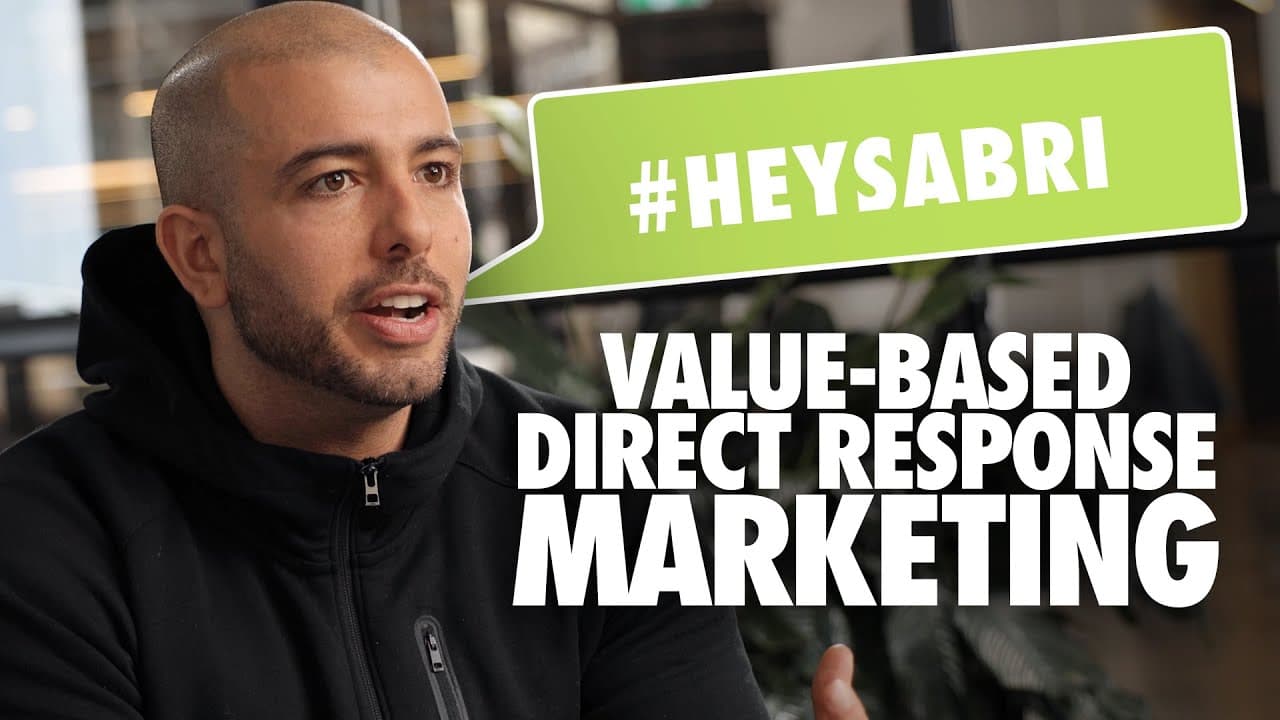
How Does Value-Based Direct Response Marketing Work?
TL;DR
Provide useful help inside the sales message itself, because demonstrating value can reduce skepticism and prove that an offer may help the prospect. The approach combines direct-response psychology with practical teaching, creating marketing that encourages action while giving people something useful enough to apply or share before they purchase.
Transcript
Hey guys, this week on Hey Subbury, I'm going to be answering [music] Barley Bubba's question. Um, that's a very cool name, by the way. Hey Sabry, can you make a video explaining the difference between valuebased marketing and direct response marketing? And what your opinion is about producing content, giving value, and [music] selling. Are they tw... Read More
Key Insights
- Direct-response marketing is designed to elicit a specific action, such as clicking an advertisement, opting in, registering for a webinar, purchasing an offer, or converting during a sales call. Its effectiveness depends on understanding the words, incentives, and psychological triggers that influence behavior.
- Telephone selling is a practical testing environment because different words, openers, and sequences can be tried repeatedly across many conversations. The speaker developed his direct-response skills by observing how small changes in sales language produced different outcomes with thousands of people.
- Value-based marketing works by helping prospects through the marketing itself. Instead of presenting only a pitch, an advertisement, email, sales letter, or video can teach something useful and help solve part of the prospect's problem before requesting a purchase.
- Skepticism is a major barrier to persuasive marketing because prospects may arrive at an advertisement, landing page, or video already questioning whether the person and offer are legitimate. Demonstrated value helps answer those concerns through useful experience rather than unsupported promises.
- Market skepticism increases when low barriers to entry allow more competitors and self-described experts to address the same prospects. When people buy products that fail to produce results, the added disappointment creates more noise and friction for later marketers to overcome.
- A valuable sales message can establish credibility by allowing prospects to apply its advice and observe whether it works. If the free guidance already helps, prospects have a concrete reason to believe that the marketer is legitimate and that paid material may deliver additional help.
- Effective value-based direct response combines a strong pitch with useful instruction and persuasive psychological triggers. The objective is not to remove selling from the content, but to make the sales vehicle valuable enough that the audience benefits while receiving the offer.
- Value-based marketing is not simply the continuous publication of free content or the unrestricted release of everything a business knows. The central principle is to embed meaningful value within the sales message so that teaching, credibility building, persuasion, and conversion support one another.
- More videos from this channel:
- More from this channel: Sabri Suby
Install to Summarize YouTube Videos and Get Transcripts
Explore YouTube Video Summarizer or Get YouTube Transcript Extractor
Questions & Answers
Q: What is the difference between value-based marketing and direct-response marketing?
Direct-response marketing seeks a specific action, such as a click, opt-in, webinar registration, purchase, or sales-call conversion. Value-based marketing focuses on helping prospects through the message itself. The presented approach combines them: it uses direct-response psychology and persuasive triggers while making the advertisement, email, sales letter, or video genuinely useful to the audience.
Q: How does providing value reduce customer skepticism?
Providing value lets prospects evaluate a marketer through direct experience rather than relying only on claims. When an advertisement or sales message teaches something useful or helps solve part of a problem, the prospect can test that guidance personally. A positive result can reduce doubts about legitimacy and make the paid offer more credible.
Q: Why are modern prospects highly skeptical of marketing claims?
Modern prospects face many competitors, gurus, advertisements, and sales claims because barriers to entering a market and reaching an audience are low. Some people purchase products that do not deliver the expected results, which creates disappointment, noise, and friction. Each poor experience can make future claims harder to believe, even when another marketer has useful material.
Q: How can a sales message provide value before a purchase?
A sales message can teach a useful principle, address a real problem, or give prospects guidance they can apply immediately. That value can be delivered through an advertisement, email, landing page, video sales letter, or traditional sales letter. The offer remains embedded in the message, but the prospect receives practical help before deciding whether to purchase.
Q: Why is testing different sales language important?
Testing reveals how specific words, openers, and sequences affect a prospect's response. The speaker learned this through repeated telephone sales conversations, where changing one word or a string of words could produce a different outcome. The same principle can be applied to advertisements and other one-to-many messages to identify language that generates stronger results.
Q: How can telephone sales experience improve advertising?
Telephone sales provides immediate feedback from real conversations. By speaking with thousands of people from varied backgrounds, a salesperson can observe which phrases create interest, resistance, trust, or action. Those lessons can then be transferred to advertisements by treating the ad like a scaled sales conversation and testing its wording, structure, and persuasive elements.
Q: Should marketers give all their knowledge away for free?
The recommended approach is not to publish endless content or give everything away without purpose. Instead, marketers should make the sales message valuable in itself. Useful teaching should demonstrate competence, help the prospect, and reduce skepticism, while the message still contains a clear pitch and the psychological triggers intended to encourage a direct response.
Q: What makes value-based direct-response content shareable?
Value-based direct-response content becomes shareable when it is useful enough that prospects want other people to see it. The message should teach, help solve a problem, and demonstrate that the marketer's methods work, while also presenting an offer. When the audience gains meaningful value before purchasing, sharing becomes a natural response to that usefulness.
Summary & Key Takeaways
-
Value-based marketing and direct-response marketing can work together rather than functioning as opposites. Direct response aims to produce a measurable action, such as an ad click, webinar registration, purchase, or sales-call conversion. Value-based marketing strengthens that process by helping prospects before asking them to buy, which can reduce skepticism.
-
The approach developed from testing different words, openers, and sequences during thousands of telephone conversations. Those experiences showed that small changes in language can produce different responses. Applying the same testing mindset to advertisements helped identify which messages generated results and encouraged deeper study of psychology, incentives, and decision-making.
-
Modern prospects encounter abundant marketing claims, low barriers to market entry, and disappointing products, so they may approach advertisements with strong skepticism. A useful sales message provides evidence through experience: prospects can try the advice, see whether it helps, and then judge whether the marketer and paid offer deserve further attention.
Read in Other Languages (beta)
Share This Summary 📚
Summarize YouTube Videos and Get Video Transcripts with 1-Click
Try YouTube Summary with ChatGPT & Claude or YouTube Transcript Generator
Explore More Summaries from Sabri Suby 📚

Summarize YouTube Videos and Get Video Transcripts with 1-Click
Try YouTube Summary with ChatGPT & Claude or YouTube Transcript Generator