Why Is AI Threatening YouTube Educational Content?
TL;DR
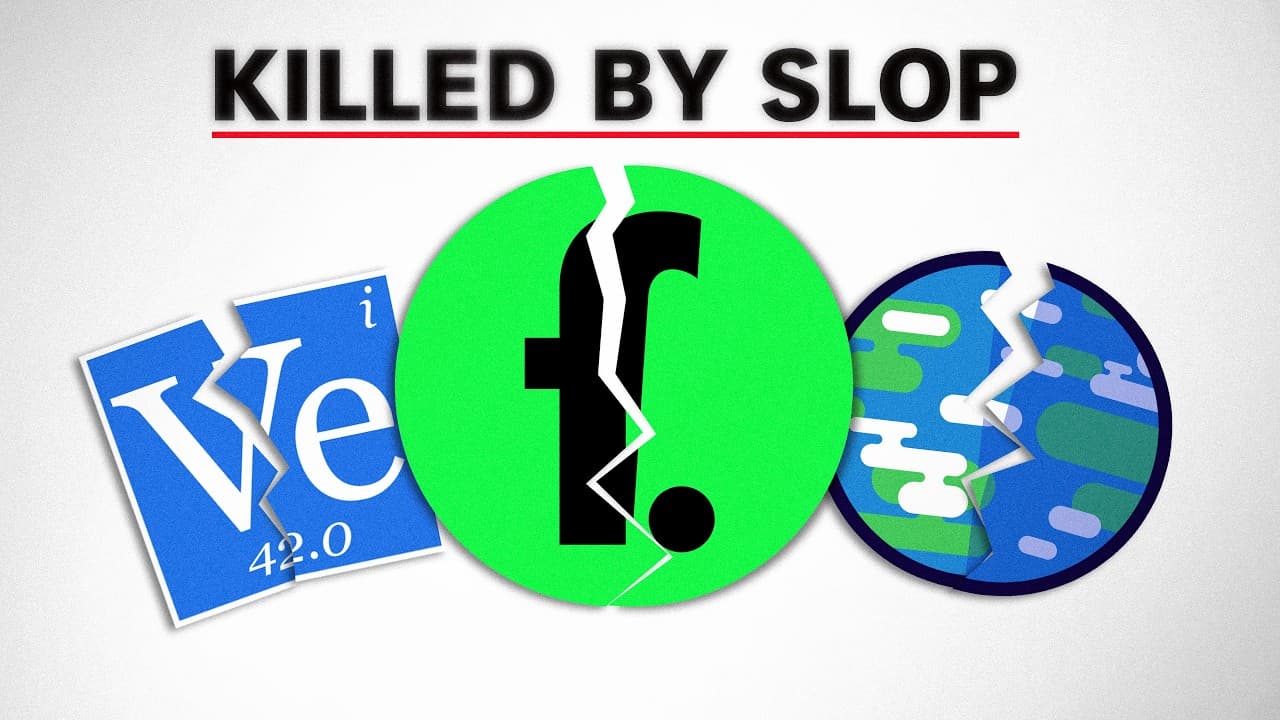
AI threatens YouTube educational content by making low-quality imitation cheap to mass-produce, spreading misinformation and weakening trust in genuine creators. The investigation found channels copying thumbnails, titles, animations, and even entire videos; the team also paid $75 for coaching inside a related Discord community. With more than 20% of videos shown to new users potentially being slop, read on to see why skilled creators struggle to compete.
Transcript
There's this brilliant KFC ad. >> Welcome to Chicken Town, home of the imitators. Because when you're on top, everybody wants a piece of you. >> And lately, we've been feeling a lot like KFC. There's this thumbnail, this one, this. What even is this? Every thumbnail we invent, every title we construct, every animation we build, sometimes entire vid... Read More
Key Insights
- AI-generated content is increasingly prevalent on YouTube, often mimicking popular creators.
- The cost of producing AI content is significantly lower than traditional methods, leading to mass production.
- AI slop channels undermine trust in educational content by spreading misinformation.
- YouTube's algorithm may promote low-quality AI content, affecting user experience.
- Creators struggle to differentiate their genuine work from AI-generated content.
- Some AI channels profit significantly by copying styles and formats of successful creators.
- YouTube is implementing policies to curb low-quality, repetitive content.
- AI tools are both a threat and a resource, depending on how they are used in content creation.
Install to Summarize YouTube Videos and Get Transcripts
Explore YouTube Video Summarizer or Get YouTube Transcript Extractor
Questions & Answers
Q: Why is AI threatening educational content on YouTube?
Generative AI makes it easy to mass-produce videos that imitate the thumbnails, titles, animations, voices, and ideas of established educational creators. The resulting low-cost content can spread misinformation, compete with carefully researched work, and undermine trust in educational videos and journalism.
Q: How common is AI slop in YouTube recommendations?
The transcript says that more than 20% of the videos YouTube’s algorithm shows to new users may now be slop. This means low-quality generated content can occupy a substantial share of what newcomers encounter.
Q: How did the creators investigate AI imitation channels?
They examined the channels to identify who was likely behind them, joined a Discord community, and paid $75 for coaching. Their fact-checking team also reviewed a large amount of AI misinformation reaching hundreds of thousands of people.
Q: What parts of educational videos are AI channels copying?
The creators report copies of thumbnails, titles, animations, and sometimes entire videos. One demonstrated workflow used screenshots from Fern videos with ChatGPT, while other tools were presented as a Fern idea generator, script writer, and image generator.
Q: Why is edutainment attractive to AI content producers?
Edutainment channels are often faceless, their animation styles can now be replicated with AI, and their thumbnails do not depend on a creator’s face. That makes it easier to imitate the appearance of considerable production effort without having the same animation, research, or voice-over skills.
Q: How does AI-generated misinformation harm educational videos?
The investigation encountered false material on serious subjects, including the Holocaust, that was distributed to hundreds of thousands of people. Such inaccuracies can mislead viewers and damage trust in journalism and educational content.
Q: How does AI slop affect skilled human creators?
Human-made videos may require substantial time, investment, research, and specialized production skills, while AI can generate competing material at very low cost. One creator also says a 3D visual style that once signaled quality has become associated with low-effort AI content, even though their videos take months to research.
Q: Do the creators reject all uses of AI?
No. Their organization selectively uses AI to organize and skim research, and in rare cases uses generated imagery as a basis for Photoshop compositions when comparable stock images are unavailable. Their concern is specifically the mass production of imitative, misleading, or low-effort content.
Summary & Key Takeaways
-
AI-generated content is saturating YouTube, posing a threat to educational content by lowering production costs and enabling mass production of low-quality videos. This trend undermines trust in genuine creators and spreads misinformation, especially on sensitive topics. YouTube is taking steps to address this issue, but the challenge remains significant.
-
Many creators find their work imitated by AI channels that prioritize quantity over quality, leading to a loss of trust in educational videos on YouTube. The platform's policies aim to combat this, but AI's role in content creation continues to be a double-edged sword.
-
AI-driven channels often mimic successful creators, producing content that lacks depth and accuracy. This trend threatens the integrity of educational content on YouTube, prompting the platform to update its policies to discourage low-quality, inauthentic uploads.
Read in Other Languages (beta)
Share This Summary 📚
Summarize YouTube Videos and Get Video Transcripts with 1-Click
Try YouTube Summary with ChatGPT & Claude or YouTube Transcript Generator
Explore More Summaries from fern 📚
Summarize YouTube Videos and Get Video Transcripts with 1-Click
Try YouTube Summary with ChatGPT & Claude or YouTube Transcript Generator