How McDonald's Kiosks Make Customers Spend More
TL;DR
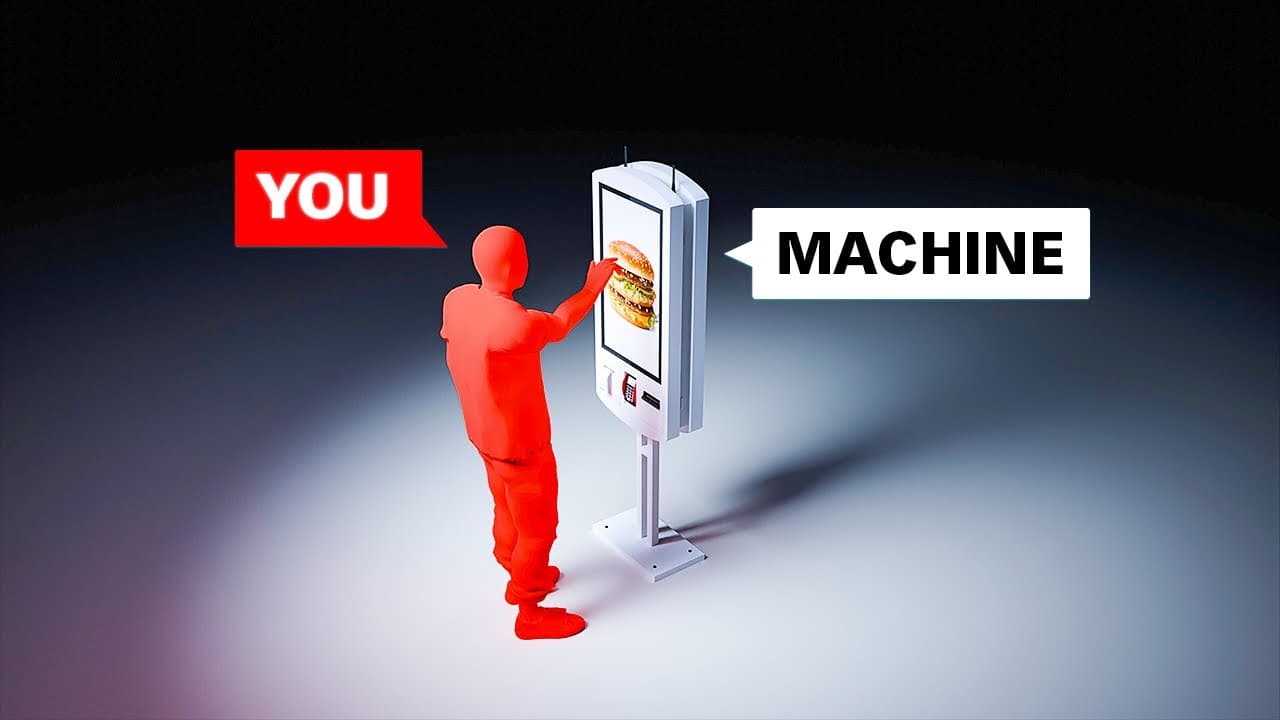
McDonald's self-order terminals increase average order size by steering customers toward profitable meals, upgrades, add-ons, and card payments. Large product images, expensive reference items, hidden totals, rewarding animations, bundling, and repeated recommendations make each incremental purchase feel reasonable, while the complete order can become far larger and more expensive than the customer originally intended.
Transcript
you're at McDonald's and you're craving a Double Cheeseburger so you find yourself in front of one of these self-order terminals or SS are in almost every restaurant of the chain now you start browsing and end up buying a big tasty bacon with fries in a Coke plus nuggets and a McFlurry for dessert once you see your food in front of you you feel gui... Read More
Key Insights
- Self-order terminals are a major part of McDonald's restaurant strategy, appearing in almost all of its restaurants after the company first tested them in Europe in 2008. Their large touchscreens support simultaneous ordering and give the interface substantial control over how products and prices are presented.
- Expensive products establish a reference value that changes how cheaper options feel. When prominent premium burgers appear first, a double cheeseburger seems relatively affordable, and upgrading from that cheaper item can feel reasonable even when the customer initially intended to buy only one burger.
- Visual hierarchy directs attention toward profitable choices. Large central menus and appealing food images command more attention than small category icons, while expensive burgers appear near the top of submenus and cheaper alternatives may sit lower, requiring customers to scroll before seeing them.
- Rewarding animations reinforce additional purchases by making customers feel good when they add products. After an item is selected, the terminal can return to the menu instead of proceeding directly to checkout, creating another opportunity to consider nuggets, desserts, or other unplanned additions.
- The displayed order total functions as a dark pattern because it is placed in a small corner of a much larger, colorful interface. Customers must actively look down to notice the accumulated price, while visually prominent food options continue competing for their attention.
- Bundling makes larger orders appear economical while improving profitability for McDonald's. A meal combines a costly main product with drinks and fries that are cheap to buy and easy to prepare, allowing customers to perceive savings compared with purchasing every item separately.
- Self-order terminals strengthen cross-selling because they repeatedly recommend complementary products without the social pressure of counter ordering. Customers can browse longer, often without a queue immediately behind them or an employee watching, making kiosk suggestions more effective than a single verbal prompt.
- Self-ordering offers genuine convenience alongside manipulation. The terminals can shorten perceived waiting, allow multiple people to order at once, and make ordering more comfortable for customers who dislike counter interactions, yet the same interface is explicitly optimized to encourage larger and less restrained purchases.
Install to Summarize YouTube Videos and Get Transcripts
Explore YouTube Video Summarizer or Get YouTube Transcript Extractor
Questions & Answers
Q: How do McDonald's self-order terminals increase spending?
McDonald's self-order terminals increase spending by repeatedly presenting customers with premium products, meal upgrades, larger sizes, nuggets, and desserts. The interface uses prominent images, reference prices, rewarding animations, bundling, and cross-selling. It also keeps the total price visually unobtrusive, so each addition can feel individually reasonable even when the final order becomes unexpectedly large.
Q: What nudges are used in McDonald's kiosk design?
The kiosks use nudges by giving expensive products more visual space, placing premium burgers near the top, and making cheaper products less immediately visible. They also frame small price differences as attractive upgrades, celebrate additions with colorful animations, return customers to the menu after selections, and emphasize card payment with a larger or more visible option.
Q: Why are expensive burgers displayed prominently on the kiosks?
Expensive burgers are displayed prominently to attract attention and establish a reference value. Once customers see a premium burger first, they subconsciously compare later prices with that expensive option. A cheaper burger or an upgrade can then appear more affordable, increasing the likelihood that customers move beyond their original choice and purchase a more profitable product or meal.
Q: Why can hiding the total price increase order size?
Keeping the total price in a small corner reduces its visibility beside large, colorful product images. Customers must actively search for the accumulated cost while the interface continues presenting tempting additions. This encourages them to evaluate each upgrade separately rather than comparing the final order directly with the inexpensive burger they originally planned to purchase.
Q: How does bundling benefit McDonald's and its customers?
Bundling combines a main product with fries and a drink at a price that appears cheaper than buying every item separately. Customers therefore perceive the meal as a bargain. McDonald's benefits because drinks, fries, and similar additions are cheap to buy and easy to prepare, making the complete meal more profitable than selling a single burger with a low margin.
Q: Why are kiosk recommendations effective for cross-selling?
Kiosk recommendations are effective because the terminal can suggest additional products throughout the ordering process rather than asking one counter question. Customers can take longer without feeling watched, and there may be no immediate queue behind them. This reduced social pressure creates more opportunities to accept recommendations for nuggets, desserts, larger meals, and other products they had not planned to buy.
Q: Why does McDonald's encourage customers to pay by card?
The terminal encourages card payment by making that option more prominent while showing a smaller button for paying cash at the register. According to the transcript, customers paying by card are more likely to make impulse purchases and spend more overall. Card payments also support the efficiency of two-sided terminals, which allow more customers to order at the same time.
Q: Does McDonald's use A/B testing on self-order terminals?
The terminals could theoretically support A/B testing by showing customers different button sizes, colors, wording, product arrangements, or nugget recommendations, then measuring which version produces more purchases. McDonald's Germany told the creators that it does not conduct A/B testing in Germany. It did not confirm practices elsewhere, and McDonald's Global had not responded to the request for comment.
Summary & Key Takeaways
-
McDonald's self-order terminals use visual hierarchy to shape purchasing decisions. Expensive burgers receive prominent placement, while cheaper products can require scrolling. These initial prices establish reference values that make upgrades and bundles appear affordable, encouraging customers who wanted one inexpensive burger to choose a larger and more profitable order.
-
The ordering flow repeatedly promotes meals, larger sizes, nuggets, desserts, and card payments. Colorful animations reward additions, the interface returns customers to the menu instead of immediately checking out, and the total price remains in a small corner. These design choices reduce attention to accumulated cost while sustaining product discovery.
-
Self-ordering can save time, reduce social pressure, and let several customers order simultaneously, but it also creates an effective upselling environment. McDonald's Germany confirmed that kiosk orders were slightly larger than counter orders. The terminals may also generate extensive behavioral data, although McDonald's Germany said it does not conduct A/B testing there.
Read in Other Languages (beta)
Share This Summary 📚
Summarize YouTube Videos and Get Video Transcripts with 1-Click
Try YouTube Summary with ChatGPT & Claude or YouTube Transcript Generator
Explore More Summaries from fern 📚






Summarize YouTube Videos and Get Video Transcripts with 1-Click
Try YouTube Summary with ChatGPT & Claude or YouTube Transcript Generator