How to Build AI Agents: A YouTube Curriculum

Jul 31, 2026
8 min read
40 views
Last updated: July 2026
This curriculum takes you from knowing nothing about AI agents to building working ones and shaping them into a business. It is for aspiring founders who want to build with AI but do not want to start by writing code, and by the end you will understand what an agent is, build one with no-code tools, and know how to turn it into an offer.
The path is organized as six questions you will naturally ask in order, from concept to fundamentals to building to business. Video-first learning works here because most of these tools are visual and hands-on, so watching someone set up a trigger, connect a model, and test it teaches faster than reading about it.
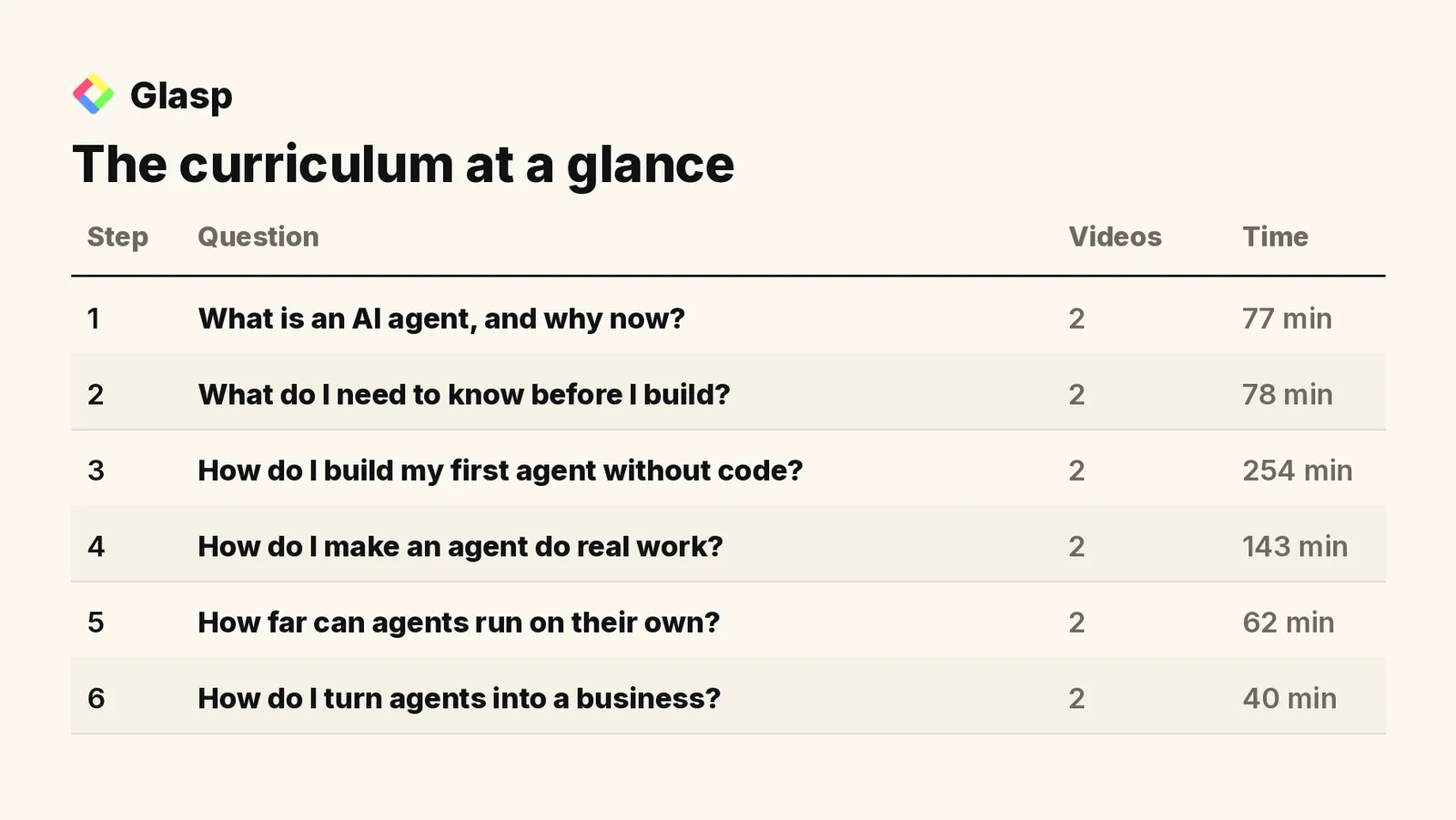
The steps in this curriculum are:
What is an AI agent, and why now? (2 videos, 77 min)
What do I need to know before I build? (2 videos, 78 min)
How do I build my first agent without code? (2 videos, 254 min)
How do I make an agent do real work? (2 videos, 143 min)
How far can agents run on their own? (2 videos, 62 min)
How do I turn agents into a business? (2 videos, 40 min)
Total: 12 videos, 654 minutes of watch time (about 11 hours), and 13.9M combined views.
Step 1: What is an AI agent, and why now?
In short: An AI agent differs from a chat AI because it has autonomy, memory, and tools to plan and complete tasks on its own instead of only answering from training data. Agents are already reshaping coding and research by letting people delegate the execution and focus on higher-level goals.

Start with the short framing of agentic AI as a shift from doing to directing, then sit with a longer conversation about where code agents are taking work. Together they set expectations before you touch any tool, so you build with a clear picture of what an agent actually is.
The most powerful AI Agent I’ve ever used in my life (Dan Martell, 11 min, 819K views): Short explainer on agentic AI and the director mindset Watch on YouTube
Skill Issue: Andrej Karpathy on Code Agents, AutoResearch, and the Loopy Era of AI (No Priors: AI, Machine Learning, Tech, & Startups, 66 min, 932K views): Deeper conversation on delegating real work to code agents Watch on YouTube
Step 2: What do I need to know before I build?
In short: Before building agents, master a few fundamentals: large language models, tokens, context windows, embeddings, and orchestration. Embeddings convert meaning into vectors so a system retrieves relevant content by intent rather than exact keywords, which is what lets an agent work with your own data.

The fundamentals video walks through why an LLM cannot see your private documents and how embeddings and retrieval fix that. Pair it with a hands-on look at running a model privately, so the concepts of local models, RAG, and fine-tuning become concrete before you automate anything.
Don't learn AI Agents without Learning these Fundamentals (KodeKloud, 56 min, 997K views): Explains LLMs, tokens, context windows, and embeddings clearly Watch on YouTube
Run your own AI (but private) (NetworkChuck, 22 min, 2.5M views): Shows running a private model with RAG and fine-tuning Watch on YouTube
Step 3: How do I build my first agent without code?
In short: You can build your first AI agent with no code using n8n: set a trigger like a Telegram message, connect a model such as OpenAI or Anthropic, then add tools like Gmail and Google Calendar. Test each step as you go so the agent runs reliably.

The shorter walkthrough gets you an agent that reads email and manages a calendar in under an hour of watching. The full zero to hero course then grounds you in nodes, data types, and API keys, so your first build is not a one-off you cannot repeat.
Build Everything with AI Agents: Here's How (David Ondrej, 39 min, 1.7M views): Quick end-to-end build of a first no-code agent Watch on YouTube
n8n Tutorial – Zero to Hero Course (freeCodeCamp.org, 215 min, 799K views): Full course on n8n nodes, data flows, and integrations Watch on YouTube
Step 4: How do I make an agent do real work?
In short: A single AI agent plus no-code tools can act like a small team, creating images, writing posts, qualifying leads, and generating proposals. The value comes from connecting the agent to real business tools and workflows, not from the model alone.

The marketing-team build shows one agent handling images, posts, and articles through connected tools. The longer automations guide then covers business tasks like lead qualification and proposal generation, so you see how agents replace manual work you could actually charge for.
I Built a Marketing Team with 1 AI Agent and No Code (free n8n template) (Nate Herk | AI Automation, 33 min, 895K views): One agent runs image, post, and article workflows Watch on YouTube
How to Build & Sell AI Automations: Ultimate Beginner’s Guide (Liam Ottley, 110 min, 951K views): Deeper guide to automating lead qualification and proposals Watch on YouTube
Step 5: How far can agents run on their own?
In short: Autonomous agents can run on a server, keep persistent memory, create their own skills, and carry out multi-step tasks with little human input. In one case a non-technical person used an AI agent to reach $8,500 in monthly revenue within 13 days, though results depend on the problem it is pointed at.

One video installs a self-improving agent that builds its own skills and manages its own memory. The other is a grounded case study of a non-technical user pointing an agent at business opportunities, so you see both the capability and the honest limits.
you need to use Hermes RIGHT NOW!! (goodbye OpenClaw!!) (NetworkChuck, 32 min, 1.3M views): Self-improving agent with memory that writes its own skills Watch on YouTube
He Asked AI To Make Money. It Did. (Chris Koerner on The Koerner Office Podcast, 30 min, 989K views): Case study of a non-technical user monetizing an agent Watch on YouTube
Step 6: How do I turn agents into a business?
In short: AI agent development ranks as a top business opportunity for its high profitability and low competition, and solo founders can build large businesses by automating painful problems instead of hiring. Start by solving the problem manually, build a simple prototype, then scale with AI agents rather than headcount.

The solo-business video gives a clear method: solve the problem by hand, make a clickable prototype, then productize and scale with agents. The rankings video sets it in context by weighing which AI business models actually last, so you pick a direction with eyes open.
How to Build a $10M Solo AI Business (Zero Code) (Dan Martell, 14 min, 787K views): Method to validate and scale a solo AI business Watch on YouTube
The Only 14 Ways to Make Money with AI in 2026 (Dan Martell, 26 min, 1.2M views): Ranks AI business models by profit, competition, longevity Watch on YouTube
Frequently asked questions
Do I need to know how to code to build AI agents?
No, tools like n8n let you build agents visually by connecting a trigger, a model, and services without writing code.
What is the difference between a chatbot and an AI agent?
A chatbot answers from its training data, while an agent has autonomy, memory, and tools to plan and carry out tasks on its own.
What are embeddings and why do they matter for agents?
Embeddings turn text into vectors that capture meaning, so an agent can retrieve relevant information by intent rather than by exact keywords.
Can AI agents actually make money for a business?
Yes, agents can qualify leads, generate proposals, and automate workflows, and AI agent development is ranked a top opportunity for profitability.
How long does this curriculum take to finish?
It is about eleven hours of video across six steps, which you can spread over a few weeks while building alongside each section.
Where should I start if I want to learn how to build AI agents?
Start with what an AI agent actually is and why the technology matters now, then cover the background concepts before touching any tools. This curriculum is ordered as six steps, moving from that definition to foundations, a first no-code agent, agents that do real work, agent autonomy, and finally agents as a business.
Who is a YouTube curriculum on AI agents actually for?
It is built for someone starting from zero, since the first step explains what an AI agent is before anything gets built. It also carries far enough for people with commercial intent, because the final step covers turning agents into a business.
Can AI agents really run on their own without a human watching?
How far an agent can run unsupervised is its own question, and it comes late in the learning path rather than at the start. The sensible order is to first get an agent doing real work reliably, then look at how much autonomy it can safely be given.
Is watching videos enough to learn AI agents, or do I need to build something?
Watching alone will not get you there: the third step is building your first agent, and it is designed so you can do it without code. The videos are structured so each stage has something you build before moving to the next.
How to work through this curriculum
Work through the six steps in order and build as you watch: after the concept and fundamentals steps, open n8n and rebuild each agent yourself rather than only watching. Once you finish, pick one painful problem you understand well, build a small agent that solves it, and put it in front of a real user, because the fastest way to learn what to build next is to ship something that someone actually needs.
Related lists
💡 Want summaries and transcripts for any YouTube video? Try YouTube Summary with ChatGPT & Claude.