Andrej Karpathy on Code Agents, AutoResearch, and the Loopy Era of AI: How Is Engineering Changing?
TL;DR
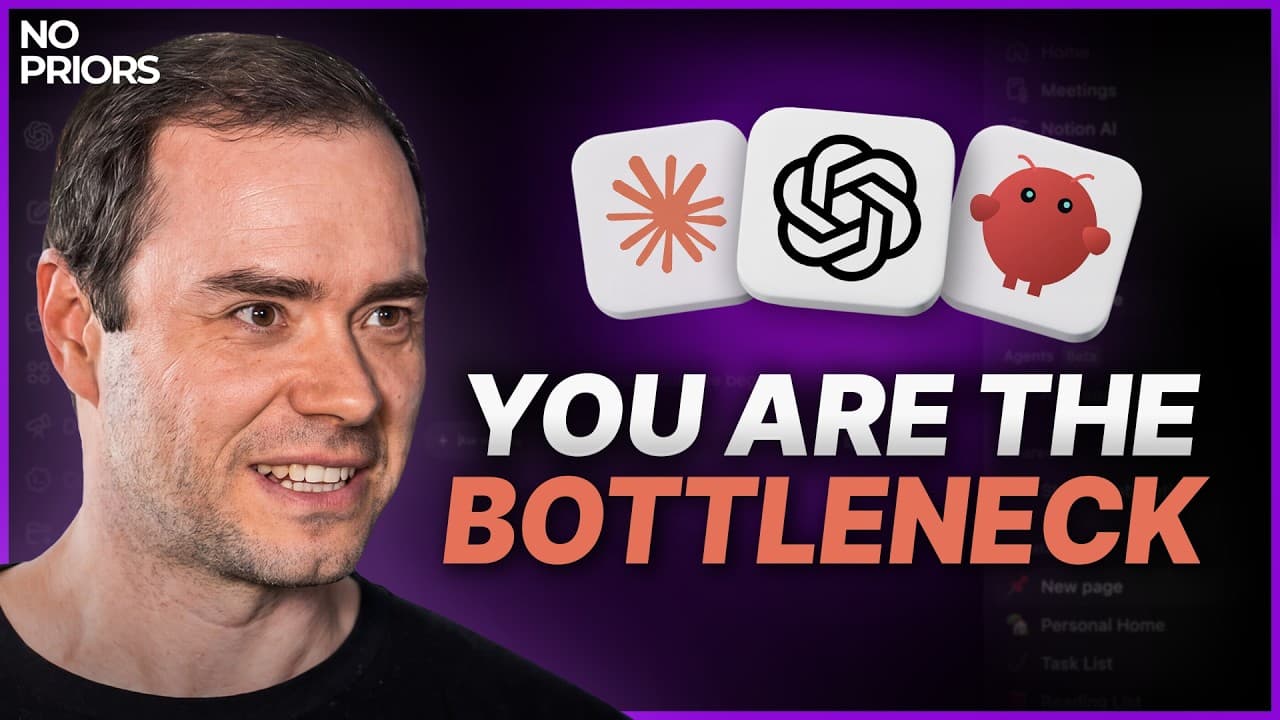
AI agents are transforming coding by shifting Andrej Karpathy’s work from writing code himself to delegating larger tasks across multiple agents. He says the change became dramatic around December, moving from roughly an 80/20 split to 20/80 and eventually almost no manual coding. The conversation explores parallel agents, better instructions, and repository-level “macro actions”. Read on for Karpathy’s emerging workflow.
Transcript
code's not even the right verb anymore, right? But I have to um express my will to my agents for 16 hours a day manifest. >> How can I have not just a single session of clot code or codeex or some of these agent harnesses? How can I have more of them? How can I do that appropriately? The agent part is now taken for granted. Now the claw-like entiti... Read More
Key Insights
- AI agents have transformed coding by allowing researchers to delegate tasks, significantly reducing the need for manual coding.
- The concept of 'AutoResearch' involves AI agents autonomously conducting experiments, optimizing models, and improving research outcomes.
- The rise of AI agents necessitates new skills, focusing on leveraging AI capabilities rather than traditional coding proficiency.
- Open-source AI models are closing the gap with proprietary models, offering competitive capabilities and democratizing access.
- The integration of AI agents in the workforce will redefine job roles, emphasizing collaboration with AI tools rather than replacement.
- AI's impact on education involves shifting from traditional teaching methods to agent-assisted learning, where AI aids in personalized education.
- Robotics and automation in the physical world will lag behind digital advancements due to the complexity of manipulating atoms.
- The future of AI development may involve a balance between open and closed models, ensuring both innovation and accessibility.
Install to Summarize YouTube Videos and Get Transcripts
Explore YouTube Video Summarizer or Get YouTube Transcript Extractor
Questions & Answers
Q: How do AI agents change Andrej Karpathy’s coding process?
Karpathy says he shifted from mostly writing code himself to mostly delegating it to agents. He describes moving from roughly an 80/20 split to 20/80 around December and says he has probably not typed a line of code since then.
Q: Why does Andrej Karpathy say “code” may no longer be the right verb?
His work increasingly involves expressing his intent to agents rather than manually entering code. He jokingly calls this activity “manifesting” and says he can spend 16 hours a day directing agents.
Q: What changed in software engineering around December?
Karpathy says agent capabilities reached a point where his default workflow changed dramatically around December. Instead of being constrained by typing speed, he could delegate most implementation work and explore what one person could accomplish with agents.
Q: How can developers use multiple code agents at once?
Karpathy describes checking out multiple repositories and assigning independent functionality to different agents so their work does not interfere. Other agents can simultaneously research, plan an implementation, or write code while the developer moves between them and reviews the results.
Q: What are “macro actions” in agent-assisted coding?
Macro actions are larger repository changes delegated to agents, such as adding an entire functionality rather than writing one line or function at a time. Karpathy describes manipulating a software repository through these larger assignments while several agents work in parallel.
Q: How long can a Codex agent task take in the workflow described?
Karpathy says Peter Steinberger’s Codex agents take about 20 minutes when prompted correctly and run with high effort. Steinberger keeps multiple agents working across about 10 checked-out repositories and moves between them to provide new work.
Q: Why does Karpathy describe agent failures as a “skill issue”?
He says many failures feel less like missing capability and more like problems in how the available tools were assembled or instructed. Possible weaknesses include insufficient instructions in an agents MD file or the absence of a useful memory tool.
Q: What limits an individual’s productivity with code agents?
Karpathy suggests the main limits are increasingly the user’s ability to give instructions, coordinate parallel work, and combine available tools effectively. He is trying to develop the judgment and muscle memory needed to assign large tasks and review agent output according to how much the code matters.
Q: Why does Andrej Karpathy feel nervous when he has unused AI agent tokens?
He sees unused tokens as a sign that he has not maximized his token throughput. He compares the feeling to being a PhD student with idle GPUs, except the resource he now wants to keep busy is tokens rather than compute flops.
Q: What does mastery of coding agents look like to Andrej Karpathy?
Karpathy says mastery involves moving beyond a single agent session to multiple agents that collaborate in teams. He describes this as going up the stack and says people are still trying to figure out what that workflow looks like.
Q: What does Andrej Karpathy mean by a “claw” in AI agents?
A claw is a layer that gives an agent much greater persistence and keeps looping without the user interactively supervising it. It has its own sandbox and can do work on the user’s behalf even when they are not looking.
Summary & Key Takeaways
-
AI agents are reshaping research and coding by automating tasks, allowing researchers to focus on strategic goals. This transformation enhances productivity and exploration of new frontiers, impacting job markets and education systems.
-
The emergence of 'AutoResearch' signifies a shift in research methodologies, where AI autonomously conducts experiments and optimizes models. This development requires new skills and adaptation to AI-driven workflows.
-
Open-source AI models are rapidly advancing, providing competitive capabilities and democratizing access. This trend suggests a future where AI development balances open and closed models for innovation and accessibility.
Read in Other Languages (beta)
Share This Summary 📚
Summarize YouTube Videos and Get Video Transcripts with 1-Click
Try YouTube Summary with ChatGPT & Claude or YouTube Transcript Generator
Explore More Summaries from No Priors: AI, Machine Learning, Tech, & Startups 📚


Summarize YouTube Videos and Get Video Transcripts with 1-Click
Try YouTube Summary with ChatGPT & Claude or YouTube Transcript Generator