What Will Shape AI Adoption and Markets in 2026?
TL;DR
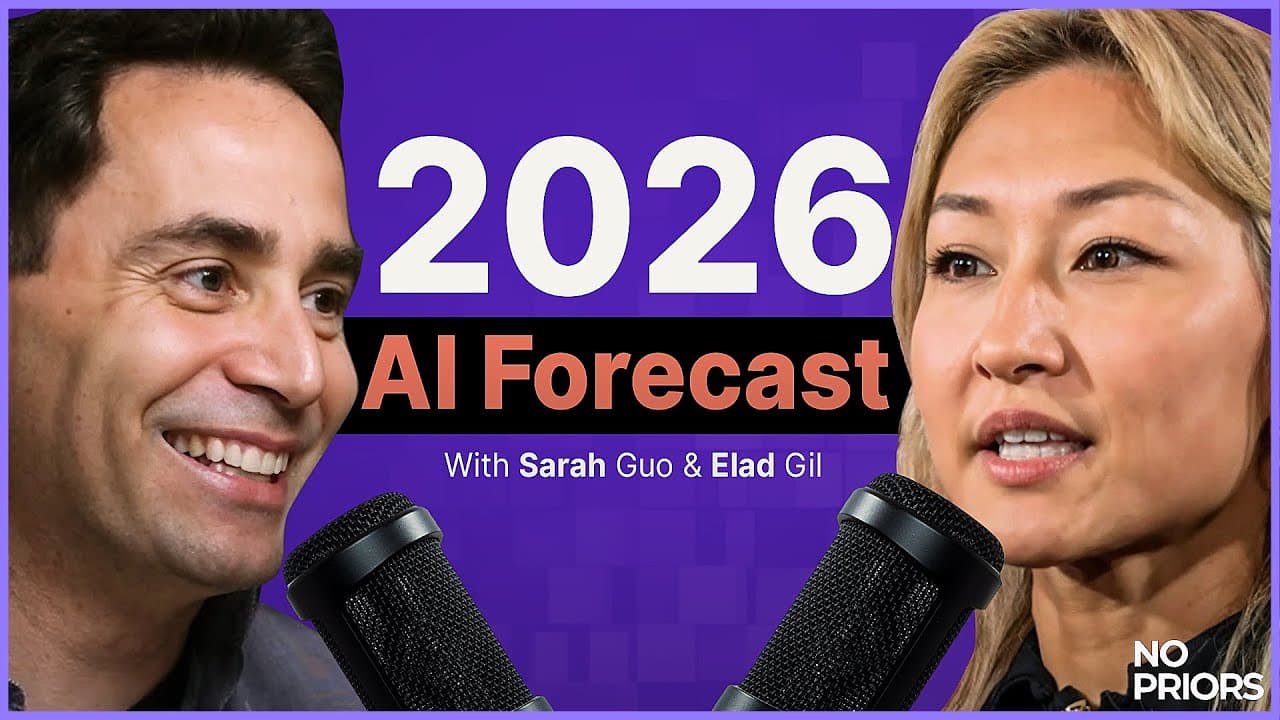
AI adoption is accelerating fastest where reasoning over unstructured data can improve professional work, including medicine, law, accounting, compliance, coding, and customer support. The 2026 outlook combines continued enterprise growth with volatility: vertical markets may consolidate, scientific models may produce isolated breakthroughs, robotics deployments may disappoint inflated expectations, and consumer agents, IPOs, acquisitions, defense technology, and AI-driven trading may advance.
Transcript
Hi listeners, welcome to No Priors. How can we even begin to wrap this year up? The AI field has grown, breaking out into the mainstream and taking center stage with policy makers. Chat GPT shipped massive numbers and asked for massive [music] dollars. Gemini and Google roared back strong. And on the application front, AI coding has shifted to agen... Read More
Key Insights
- AI adoption is already producing substantial value in professional work, according to the discussion, even though critics continue to describe the technology as overhyped. The hosts expect similar skepticism throughout 2026 because major technologies often take years to propagate fully across organizations and industries.
- Historically conservative professions are adopting AI unusually quickly, with medicine, law, accounting, and compliance highlighted as notable examples. These occupations benefit from tools that can reason over unstructured information, improve documentation, support decisions, and make demanding workflows easier for trained professionals.
- Vertical AI markets are likely to consolidate around a small number of leading companies. Coding, medical scribing, and legal technology are presented as markets where consolidation has already begun, while another group of specialized industries is expected to reach substantial scale during 2026.
- Scientific foundation models are expected to expand beyond general language tasks into physics, materials science, and mathematics. One or two visible achievements, such as a new material or a proved conjecture, could generate excessive short-term confidence while the broader long-term trend remains underestimated.
- Robotics sentiment is likely to weaken when some companies miss ambitious schedules or deliver imperfect systems. The forecast still anticipates small-scale deployments of humanoid or semihumanoid robots in industrial or consumer settings, treating early failures as part of a longer development process rather than proof that the field cannot progress.
- Robotics may favor established companies because successful deployment requires substantial capital, hardware expertise, and manufacturing capability. Tesla, Google through Waymo, Chinese companies, industrial incumbents, and selected startups are discussed as possible contenders, with the hosts differing on how strongly incumbency determines eventual winners.
- Market volatility may diverge from AI's underlying adoption trend. Investors could react sharply if a major supplier such as Nvidia fails to exceed expectations in a quarter, but the hosts argue that such sentiment changes would not erase the broader secular shift toward AI-supported work.
- AI's next commercial opportunities may include consumer agent software, renewed technology IPOs and acquisitions, and profitable market trading with language models. The discussion also expects non-AI developments in defense technology startups and second-order effects from GLP-1 drugs on biohacking.
Install to Summarize YouTube Videos and Get Transcripts
Explore YouTube Video Summarizer or Get YouTube Transcript Extractor
Questions & Answers
Q: Why could AI adoption continue despite bubble concerns?
AI adoption could continue because organizations and professionals are already obtaining meaningful value from the technology, especially in workflows involving reasoning and unstructured data. The hosts argue that technological change often takes years to spread fully, so short-term reports claiming limited impact may miss the longer adoption cycle. Market anxiety or an overhyped narrative does not necessarily reflect the underlying pace of practical use.
Q: Which professional industries are adopting AI quickly?
Medicine, law, accounting, and compliance are identified as professional areas adopting AI faster than their historically conservative approach to technology might suggest. Physicians are using categories such as documentation and clinical decision support, while legal and other professional workflows can benefit from reasoning over unstructured information. Coding and customer support are also described as areas where enterprise adoption and agent-based tools are accelerating.
Q: How might vertical AI markets develop in 2026?
Vertical AI markets are expected to reach greater scale and consolidate around a limited group of providers. The discussion points to coding, medical scribing, and legal software as areas where this pattern has already appeared, mentioning Harvey within legal technology. The next phase may bring similar consolidation to additional specialized industries as adoption grows and customers concentrate usage among products that deliver reliable workflow value.
Q: What scientific breakthroughs could AI models produce?
Foundation models focused on physics, materials science, and mathematics could produce one or two prominent successes, according to the forecast. Examples raised include inventing a new material or proving a conjecture. The hosts expect such isolated results to inspire exaggerated claims that scientific discovery has been solved, while also believing that the cumulative long-term contribution of these models could prove more important than early commentary suggests.
Q: Why might robotics companies face a sentiment correction?
Robotics companies may face a correction because investors and observers are beginning to attach firm timelines to systems that will not all perform as promised. Small-scale humanoid or semihumanoid deployments may occur in consumer or industrial settings, but some will work imperfectly. Because expectations around humanoid robots are elevated, ordinary deployment failures could provoke an outsized reaction and create a sharper distinction among companies.
Q: Will incumbents or startups lead the robotics market?
The discussion does not settle on a single winner, but it explains why incumbents may have an advantage. Robotics demands capital, hardware development, manufacturing capacity, and specialized expertise, characteristics that can favor established organizations. Tesla, Google through Waymo, Chinese companies, industrial firms, and startups are all considered possible leaders. The hosts disagree about whether incumbents generally have better odds than startups across industries.
Q: How are market volatility and AI adoption connected?
Market sentiment can deteriorate even while practical AI adoption continues to expand. The hosts suggest that investors may react negatively if Nvidia does not outperform expectations by a large amount in a quarter, reflecting concern about deployed capital and uncertainty around technical bets. They view such reactions as distinct from the underlying secular change, which includes rapid adoption by enterprises and traditionally cautious professional groups.
Q: What other technology and market trends are forecast for 2026?
The wider forecast includes a return of technology IPOs and mergers and acquisitions, another wave of consumer agent software, and the possibility that someone earns hundreds of millions of dollars by trading markets with language models. It also anticipates faster development among defense technology startups and second-order effects of GLP-1 drugs on biohacking, while noting that consumer product innovation has progressed more slowly than expected.
Summary & Key Takeaways
-
Sarah Guo and Elad Gil argue that doubts about AI adoption overlook substantial use already occurring in professional fields. Physicians, lawyers, accountants, compliance teams, coders, and customer-support organizations benefit from systems that reason over unstructured information. They expect adoption to continue despite recurring claims that the technology is overhyped or ineffective.
-
The forecast expects another group of vertical AI markets to reach scale and consolidate, following coding, medical scribing, and legal software. New foundation models aimed at physics, materials science, and mathematics may deliver isolated successes. Those achievements could initially be overstated, even though their cumulative scientific importance may ultimately be underestimated.
-
Robotics is expected to encounter a sentiment correction when deployments fail to meet projected timelines. Small-scale humanoid or semihumanoid deployments may appear in consumer or industrial environments, but uneven performance could separate credible companies from weaker ones. Other predictions include renewed technology IPOs and acquisitions, consumer agents, defense startups, GLP-1 effects, and AI-assisted trading.
Read in Other Languages (beta)
Share This Summary 📚
Summarize YouTube Videos and Get Video Transcripts with 1-Click
Try YouTube Summary with ChatGPT & Claude or YouTube Transcript Generator
Explore More Summaries from No Priors: AI, Machine Learning, Tech, & Startups 📚






Summarize YouTube Videos and Get Video Transcripts with 1-Click
Try YouTube Summary with ChatGPT & Claude or YouTube Transcript Generator