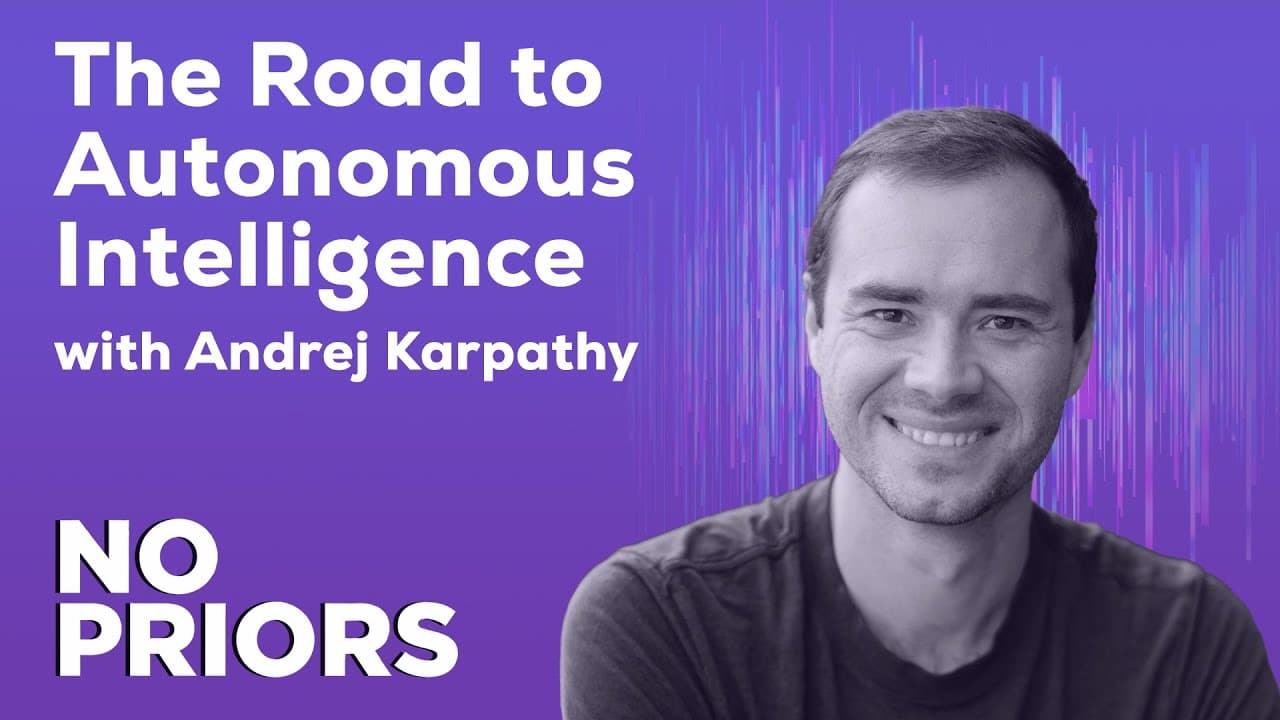
No Priors Ep. 80: How Does Andrej Karpathy Compare Tesla’s AI With Waymo’s?
TL;DR
Andrej Karpathy argues that Tesla’s self-driving strategy could surpass Waymo’s because Tesla primarily faces a software problem, while Waymo faces a hardware and scaling problem. Tesla uses expensive sensors such as LiDAR during training, then distills that information into a vision-only package deployed across its cars. He also explains why turning an impressive demo into a widely available product can take a decade. Read on for the full comparison.
Transcript
[Applause] hi listeners welcome back to no priors today we're hanging out with Andre karpathy who needs no introduction Andre is a renowned researcher beloved AI educator and cuber an early team member from open aai the lead for autopilot at Tesla and now working on AI for Education we'll talk to him about the state of research his new company and ... Read More
Key Insights
- Tesla and Waymo differ in their self-driving strategies; Tesla focuses on software, while Waymo relies on hardware.
- Tesla uses expensive sensors during training but deploys a vision-only system in vehicles.
- The transition from demo to product in self-driving cars involves overcoming regulatory and technological challenges.
- Tesla's humanoid robot, Optimus, benefits from its automotive technologies, showcasing the company's expertise in robotics.
- AI development bottlenecks now focus more on data and loss functions rather than neural network architecture.
- Synthetic data generation is crucial for future AI progress, but maintaining data diversity is essential.
- Human cognition and AI models show parallels, but AI systems may eventually surpass human capabilities in certain areas.
- AI-driven education can democratize learning, offering personalized and scalable teaching solutions.
Install to Summarize YouTube Videos and Get Transcripts
Explore YouTube Video Summarizer or Get YouTube Transcript Extractor
Questions & Answers
Q: How does Tesla’s approach to self-driving cars differ from Waymo’s?
Karpathy describes Tesla as primarily having a software problem and Waymo as primarily having a hardware problem. Tesla can deploy a vision-only system across its existing cars, while Waymo uses costly sensors such as LiDAR and still needs to achieve comparable scale.
Q: Why does Andrej Karpathy think Tesla may be ahead of Waymo?
Karpathy believes software problems are easier to solve than hardware and deployment problems. Although Waymo appears to be winning now, he expects Tesla’s large-scale vehicle deployment to become a major advantage once its self-driving software works reliably.
Q: Does Tesla use LiDAR or other expensive sensors for self-driving?
Tesla uses expensive sensors, including LiDAR, on some vehicles during training. It also performs mapping and other work that does not scale, then distills the resulting information into the vision-only package deployed in customer cars.
Q: Why does Tesla deploy a vision-only self-driving system?
The strategy moves expensive sensors and extra data collection to training time instead of putting that hardware in every deployed car. Karpathy says the camera pixels contain the necessary information and expects the neural network to become capable of using it.
Q: How large is the gap between a self-driving demo and a commercial product?
Karpathy first experienced a nearly perfect Waymo demonstration around 2014, but it took about 10 years before he could pay for rides across a city. A 30-minute demo does not expose all the situations that must be handled before a system becomes a product.
Q: How much do regulation and technology affect self-driving deployment?
Karpathy says both contribute to the massive gap between a demonstration and a usable product. The technological work includes handling situations that may never appear during one short drive, while regulatory requirements also slow deployment.
Q: When might Tesla’s self-driving software turn the corner?
Karpathy hopes the transition could happen within the next few years, but he does not give a firm date. He says recent builds made strong improvements and drove him around successfully, including some driving he described as miraculous.
Q: How does self-driving development relate to AGI?
Karpathy compares the two because achieving a convincing capability does not immediately transform the world. Waymo can already provide paid rides in San Francisco, yet global adoption has not happened; he suspects AGI will likewise face a long gap between its arrival and widespread impact.
Summary & Key Takeaways
-
Tesla's approach to self-driving cars focuses on software innovation and leveraging existing vehicle deployment, while Waymo prioritizes advanced hardware like LiDAR. Tesla's strategy involves using expensive sensors for training but deploying a vision-only system, which could lead to broader scalability and integration into various car models.
-
Andrej Karpathy discusses the similarities between Tesla's self-driving technology and its humanoid robot, Optimus. Tesla's expertise in robotics at scale allows for efficient transfer of technology from cars to humanoids, highlighting the company's focus on AI and robotics innovation.
-
AI development faces bottlenecks in data and loss functions rather than neural network architecture. The importance of synthetic data generation is emphasized, with a focus on maintaining data diversity to prevent model collapse. AI-driven education offers opportunities for personalized and scalable learning, potentially transforming knowledge networks and societal status.
Read in Other Languages (beta)
Share This Summary 📚
Summarize YouTube Videos and Get Video Transcripts with 1-Click
Try YouTube Summary with ChatGPT & Claude or YouTube Transcript Generator
Explore More Summaries from No Priors: AI, Machine Learning, Tech, & Startups 📚

Summarize YouTube Videos and Get Video Transcripts with 1-Click
Try YouTube Summary with ChatGPT & Claude or YouTube Transcript Generator