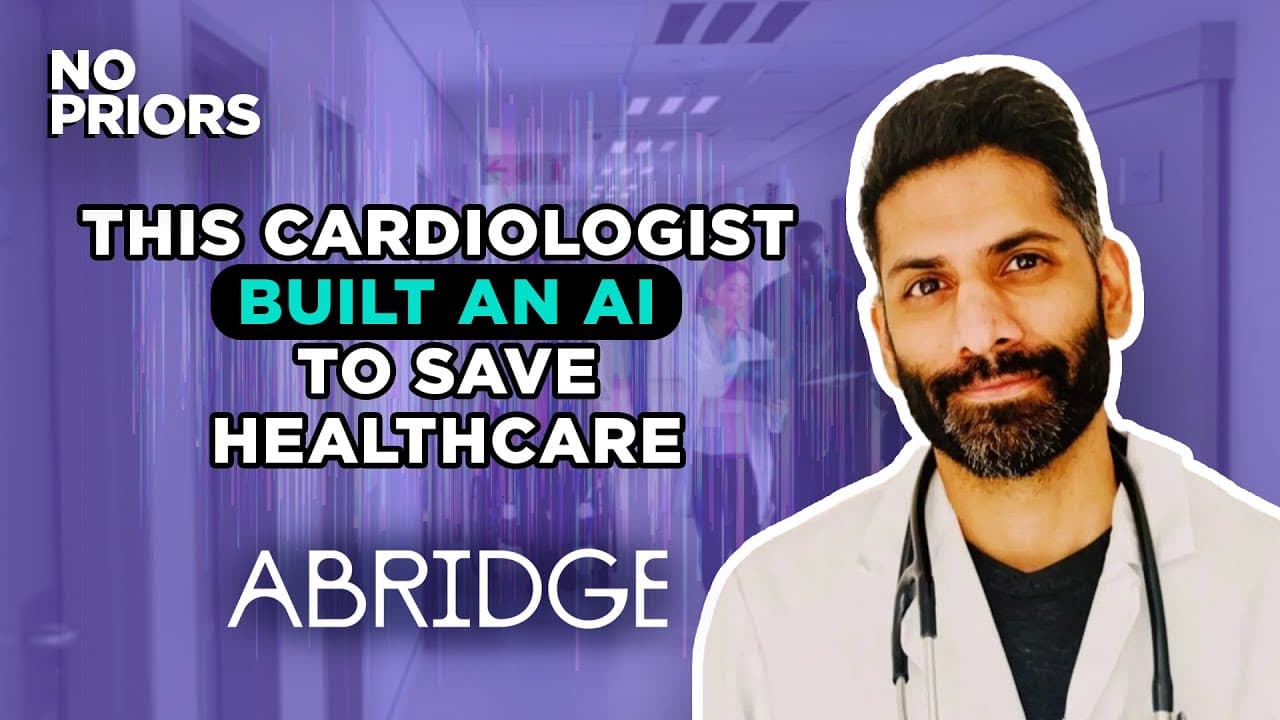
How does Abridge AI reduce clinician clerical work?
TL;DR
Abridge focuses on reducing clerical burden by transforming clinical conversations into comprehensive notes that cover clinical and billable elements, enabling clinicians to spend more time with patients. The approach targets large health systems first due to higher entry barriers and complex workflows, leveraging clinician insight and advanced AI science to improve revenue cycle and care delivery.
Transcript
Hi listeners and welcome to No Priors. This week we're speaking to Shivrao, CEO and founder of a bridge, an AI company that processes medical conversations to unbburden clinicians from clerical and financial work allowing them to focus on patient care. A practicing cardiologist at UPMC, Dr. Ralph has recently led a bridge to secure a $250 million s... Read More
Key Insights
- Abridge’s core thesis is that doctors will not be fully automated in the next decade, so the first value signal is the patient professional dialogue. This focus drives product design and workflow integration.
- The note generated by Abridge is not just a clinical note but a billable note that includes patient, insurer, and geographic context to support revenue cycle processes.
- The market entry strategy prioritizes large health systems over smaller practices to address higher barriers to entry and scale impact rapidly.
- Clinical expertise from founder Shiv Rao, who remains a practicing cardiologist, informs product design and go-to-market decisions to fit real clinic workflows.
- Abridge emphasizes a clinician-centric approach, aiming to replace tedious clerical tasks rather than automate clinical judgment, preserving the physician’s role while reducing burnout.
- The company has demonstrated rapid adoption with logos like Kaiser and Sutter, indicating strong market validation in a competitive landscape.
- Advances in generative AI, coupled with post-pandemic burnout, create a favorable timing window for scalable AI solutions in healthcare.
- The research background, including papers and a collaboration with Carnegie Mellon, underpins the technical credibility and depth of the product stack.
Install to Summarize YouTube Videos and Get Transcripts
Explore YouTube Video Summarizer or Get YouTube Transcript Extractor
Questions & Answers
Q: What is Abridge attempting to automate in healthcare workflows?
Abridge targets clerical and administrative tasks that accompany clinical conversations, turning patient and physician dialogue into structured notes that capture both clinical content and billable elements. By doing this, clinicians can focus more on direct patient care while ensuring accurate documentation for revenue cycle management. The approach is designed to scale across outpatient, inpatient, urgent care, and emergency settings, accommodating multiple specialties and languages.
Q: Why did the company choose to work with large health systems first?
The strategic decision to engage large health systems stems from the high barriers to entry and the complexity of workflows within those organizations. By meeting the stringent requirements of integrated delivery networks and academic medical centers, Abridge can establish robust, multi-year partnerships that provide scalable impact and a clear path to wide adoption across diverse settings and specialties.
Q: How does the product handle clinical versus billable notes?
The product generates notes that serve both clinical documentation and billing requirements. It accounts for the clinician’s identity, specialty, patient details, insurance plan, geography, and other variables to produce a comprehensive billable note. This ensures that the documentation aligns with reimbursement needs while preserving the integrity of clinical narratives that inform patient care.
Q: What role does Shiv Rao play in product development?
Shiv Rao, a practicing cardiologist and founder, guides product development with firsthand clinical experience. His perspective shapes how the AI tools integrate into real workflows, ensuring that features address clinicians’ day-to-day needs, support multiple specialties, and maintain a clinician-centric ethos throughout the product lifecycle.
Q: How has nursing and physician burnout influenced the market?
Burnout has highlighted a critical need for solutions that reduce administrative workload and improve clinician experience. Health systems are actively seeking tools that free clinicians from clerical tasks, enabling them to spend more time with patients. This demand creates a favorable market for AI-enabled documentation and workflow optimization solutions.
Q: What makes healthcare AI different now compared to earlier attempts?
Several factors converge: a post-pandemic urgency to address staffing shortages, improved AI capabilities in natural language processing, and growing recognition that workflows hinge on high-quality communication. These elements combine to make AI-assisted documentation both feasible and essential for reducing clinician burden while maintaining care quality.
Q: What evidence supports Abridge’s progress with large health systems?
Abridge has secured multi-year agreements with major health systems and counts Kaiser and Sutter among its live customers, signaling strong market traction and validation. Such logos indicate credible deployment across diverse healthcare networks and readiness to scale further within large organizations.
Q: Where does the leadership see the future of AI in healthcare going?
The leadership envisions AI enabling clinicians to deliver care more efficiently by automating clerical tasks and enhancing documentation accuracy. The focus is on augmenting the clinician’s workflow rather than replacing professional judgment, with ongoing research and product iteration designed to adapt to evolving regulatory and clinical environments.
Summary & Key Takeaways
-
Abridge aims to unburden clinicians from clerical tasks by capturing structured notes during patient conversations, including billable elements essential for revenue cycle. This workflow supports doctors across multiple settings and languages, aligning with demand for improved efficiency in healthcare delivery.
-
The company strategically targets large health systems where barriers to entry are high, enabling meaningful scale and impact, while building on a clinician founder background to ensure domain relevance and practical usability.
-
Generative AI and post-pandemic burnout create a favorable market environment for AI-enabled documentation tools, with hospitals seeking solutions to staffing challenges and cost pressures, accelerating adoption and collaboration with major health systems.
Read in Other Languages (beta)
Share This Summary 📚
Summarize YouTube Videos and Get Video Transcripts with 1-Click
Try YouTube Summary with ChatGPT & Claude or YouTube Transcript Generator
Explore More Summaries from No Priors: AI, Machine Learning, Tech, & Startups 📚



Summarize YouTube Videos and Get Video Transcripts with 1-Click
Try YouTube Summary with ChatGPT & Claude or YouTube Transcript Generator