10 Best Prompt Engineering Videos on YouTube

Jul 31, 2026
11 min read
70 views
Last updated: July 2026
This is a curated path of ten videos for founders who want to learn prompt engineering from the ground up, ordered as a learning journey rather than ranked by views. It moves from the basic anatomy of a prompt to production systems, so you build a working mental model before reaching for advanced techniques.
Together the ten run about six hours and twenty minutes. The set draws on primary sources like Anthropic, Google's framework, IBM, and a Stanford lecture, alongside the most watched practitioner tutorials, which is what makes it a canonical starting point rather than one creator's opinion.
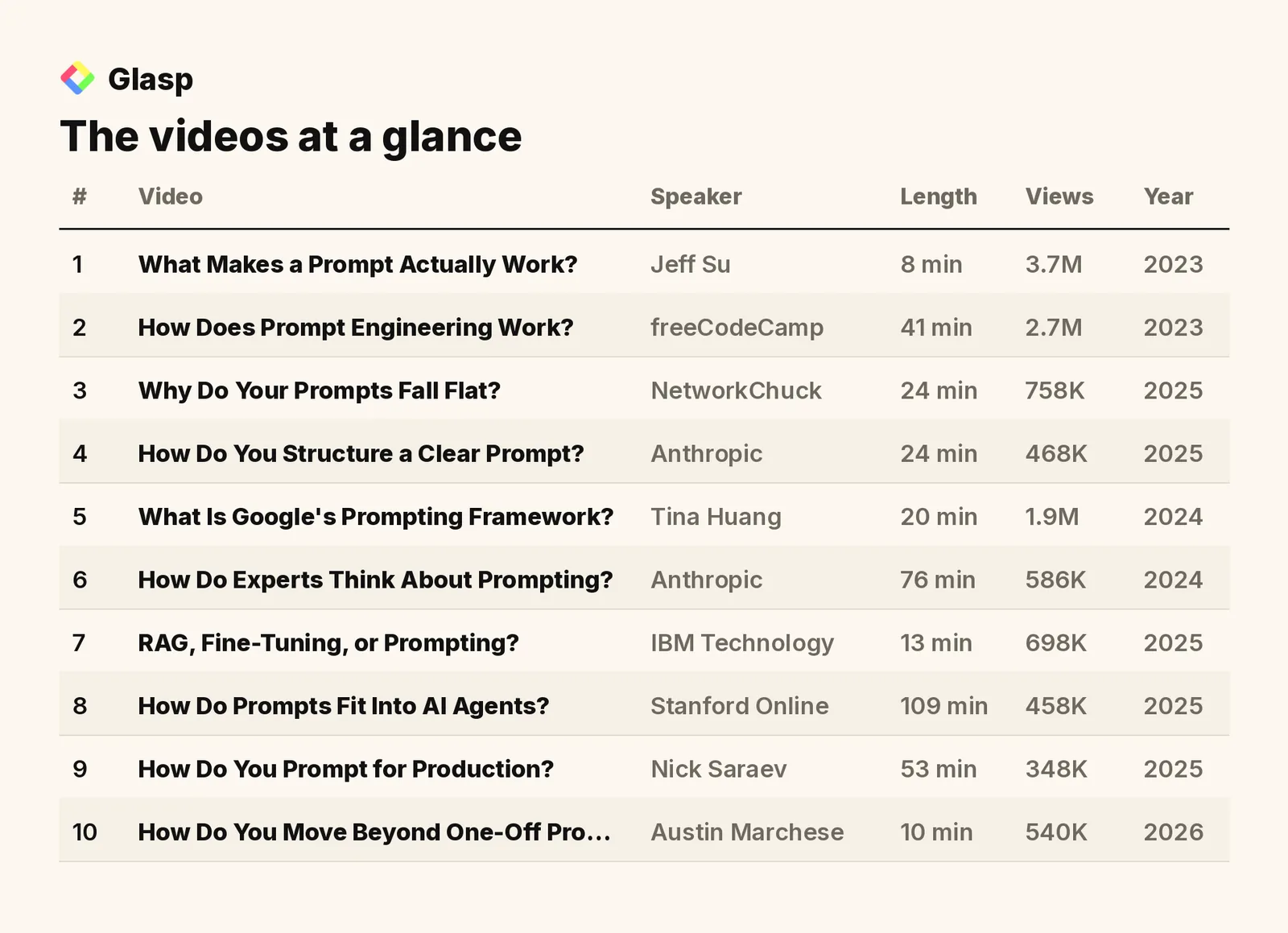
The videos on this list, in the order to watch them, are:
What Makes a Prompt Actually Work? (Jeff Su)
How Does Prompt Engineering Work? (freeCodeCamp)
Why Do Your Prompts Fall Flat? (NetworkChuck)
How Do You Structure a Clear Prompt? (Anthropic)
What Is Google's Prompting Framework? (Tina Huang)
How Do Experts Think About Prompting? (Anthropic)
RAG, Fine-Tuning, or Prompting? (IBM Technology)
How Do Prompts Fit Into AI Agents? (Stanford Online)
How Do You Prompt for Production? (Nick Saraev)
How Do You Move Beyond One-Off Prompts? (Austin Marchese)
Total: 10 videos, 378 minutes of watch time (about 6 hours), and 12.2M combined views.
1. What Makes a Prompt Actually Work?

Jeff Su · 8 min · 3.7M views · 2023
In short: A strong prompt combines six elements: task, context, exemplars, persona, format, and tone, with the task carrying the most weight.
The fastest way into prompt engineering is a repeatable checklist, and this video gives you one in eight minutes. It answers what a good prompt is actually made of, so every prompt you write afterward has a structure to follow.
Key takeaways
The six building blocks of an effective prompt are task, context, exemplars, persona, format, and tone, and the task element matters most.
Adding relevant examples or frameworks as exemplars raises output quality because the model gets a concrete pattern to follow instead of guessing intent.
A persona can be a real individual or a fictional character that represents the expertise the prompt requires from the model.
The order and inclusion of the six building blocks can change depending on what a given prompt needs to accomplish.
Watch on YouTube · Read the summary and Q&A
2. How Does Prompt Engineering Work?
freeCodeCamp · 41 min · 2.7M views · 2023
In short: Prompt engineering refines the words you give a model, using techniques like zero-shot and few-shot prompting to shape accurate responses.
Once you have a formula, you need to understand why it works. This tutorial covers the mechanics behind prompting, from few-shot examples to embeddings, answering how the model interprets what you type.
Key takeaways
Zero-shot prompting relies on a pre-trained model's existing understanding of words and concepts to complete a task with no examples in the prompt.
Few-shot prompting adds a handful of training examples directly in the prompt, improving the model's ability to produce accurate responses.
AI hallucinations are unusual outputs a model produces when it misinterprets data, and they reveal how the system interprets information.
Text embeddings represent words and sentences as vectors, capturing semantic meaning so algorithms can find similar words or phrases.
Watch on YouTube · Read the summary and Q&A
3. Why Do Your Prompts Fall Flat?

NetworkChuck · 24 min · 758K views · 2025
In short: Prompting is a skill built on clarity and context, and treating a prompt like programming with words produces sharper, more reliable outputs.
Most weak results come from vague inputs, not a weak model. This video reframes prompting as a skill issue and answers how clarity, context, and personas fix the problem.
Key takeaways
Providing detailed context reduces hallucinations because the model fills gaps with the information you supplied instead of inventing its own.
Assigning the model a persona tailors its responses, making the output more specific and relevant to the task at hand.
Chain-of-thought prompting asks the model to reason step by step, which improves both the accuracy and the transparency of its answer.
Clarity of thought is the underlying meta skill, because clearer thinking leads directly to clearer prompts and better responses.
Watch on YouTube · Read the summary and Q&A
4. How Do You Structure a Clear Prompt?

Anthropic · 24 min · 468K views · 2025
In short: Give the model a clear task description, relevant context, and examples, then refine iteratively using structured formats like XML tags.
This is the primary-source version of prompt structure, taught by the team that builds Claude. It answers how to lay out task, context, and examples so a model responds reliably.
Key takeaways
An effective prompt pairs a clear task description with the context the model needs to complete that task correctly.
Including examples and structured formats such as XML tags guides the model toward the response shape you actually want.
Instructing the model to answer factually and confidently, rather than guess, reduces fabricated content in its output.
Iterative refinement of a prompt steadily improves the model's accuracy and reliability over successive attempts.
Watch on YouTube · Read the summary and Q&A
5. What Is Google's Prompting Framework?

Tina Huang · 20 min · 1.9M views · 2024
In short: Google's five-step framework designs prompts through task, context, references, evaluation, and iteration, with refinement treated as the core habit.
This condenses Google's nine-hour course into a single framework you can apply immediately. It answers how to systematically design and iterate on prompts for real work tasks.
Key takeaways
Google's five-step framework for designing prompts covers task, context, references, evaluation, and iteration, treating refinement as central to good results.
Iteration methods include revisiting the framework, simplifying the prompt, trying different phrasing, and introducing constraints to sharpen the output.
Multimodal prompting lets you interact through text, images, audio, and video, but requires careful specification of input and output formats.
Advanced techniques such as prompt chaining, chain of thought, and tree of thought strengthen a model's reasoning and creativity.
Watch on YouTube · Read the summary and Q&A
6. How Do Experts Think About Prompting?
Anthropic · 76 min · 586K views · 2024
In short: Treat the model like a competent but uninformed temp worker, communicate clearly, and iterate on prompts based on how it responds.
A longer, deeper conversation among Anthropic prompt engineers about how the craft really works. It answers how experienced practitioners reason about model behavior and where prompting is heading.
Key takeaways
Prompt engineering is clear communication with a model, comparable to instructing a competent but uninformed temp worker on a task.
The shift from pretrained models to RLHF models changed how prompt engineers work to extract the best performance from a model.
Effective prompting requires understanding the model's capabilities and iterating on its responses rather than underestimating its intelligence.
As models improve, prompting may become collaborative, with models helping users refine and specify what they actually need.
Watch on YouTube · Read the summary and Q&A
7. RAG, Fine-Tuning, or Prompting?

IBM Technology · 13 min · 698K views · 2025
In short: Use prompt engineering for precise queries, RAG for up-to-date data, and fine-tuning for domain expertise, often combining all three.
Prompting is one of three levers for improving model output, and this video draws the boundaries. It answers when a better prompt is enough and when you need retrieval or fine-tuning instead.
Key takeaways
Retrieval augmented generation retrieves up-to-date information and integrates it into responses, improving accuracy but adding computational overhead from the retrieval step.
Fine-tuning trains an existing model on a specialized dataset for deep domain expertise, but demands extensive data and risks catastrophic forgetting.
Prompt engineering crafts specific queries to use a model's existing knowledge, giving immediate results but cannot extend what the model already knows.
Combining RAG, fine-tuning, and prompt engineering often optimizes outputs, and the best choice depends on a user's needs and resources.
Watch on YouTube · Read the summary and Q&A
8. How Do Prompts Fit Into AI Agents?
Stanford Online · 109 min · 458K views · 2025
In short: Prompt engineering, chaining, and retrieval augmented generation combine in agentic workflows to handle context, accuracy, and complex multi-step tasks.
This Stanford lecture places prompting inside the larger picture of agents and retrieval. It answers how prompting techniques scale up into systems that complete complex tasks on their own.
Key takeaways
Large language models have limits in context handling, accuracy, and control, which advanced prompting and retrieval techniques help address.
Retrieval augmented generation integrates external knowledge sources to improve accuracy and keep a model's answers current and grounded.
Agentic workflows use multi-step processes combining prompts, tools, and memory to complete complex tasks that a single prompt cannot.
Fine-tuning can overfit and consume heavy resources, which makes prompt optimization the preferred approach in many practical situations.
Watch on YouTube · Read the summary and Q&A
9. How Do You Prompt for Production?

Nick Saraev · 53 min · 348K views · 2025
In short: Move to API playgrounds, keep prompts concise, separate system and user roles, and define output formats like JSON for reliable results.
Prompting for a business workflow differs from chatting with a consumer app, and this video makes that shift concrete. It answers how to get consistent, machine-readable output you can build on.
Key takeaways
Moving from consumer chat models to API playgrounds gives more control and better prompt engineering results for business applications.
Shorter, denser prompts tend to improve model performance, so concise information delivery beats overloading the model with detail.
Understanding the system, user, and assistant prompt types helps you structure interactions more clearly and produce more predictable outputs.
Defining output formats explicitly with JSON, XML, or CSV lets model responses integrate cleanly with other systems and tools.
Watch on YouTube · Read the summary and Q&A
10. How Do You Move Beyond One-Off Prompts?

Austin Marchese · 10 min · 540K views · 2026
In short: Package procedural knowledge into reusable, composable skills instead of writing individual prompts, so tasks run consistently without repeating yourself.
The final step is graduating from single prompts to systems you reuse. This video answers how Anthropic engineers organize work into skills that improve over time.
Key takeaways
Anthropic engineers focus on building reusable skills rather than individual prompts, which streamlines automation and keeps results consistent.
A skill is an organized collection of procedural knowledge, comparable to an app on a smartphone, built from description, instructions, and tools.
Composable skills, rather than one-off custom skills, allow efficient task management and reuse across many different situations.
Skills improve over time as users refine them based on past interactions, creating a compounding loop of improvement.
Watch on YouTube · Read the summary and Q&A
Frequently asked questions
What are the key elements of a good prompt?
A strong prompt generally includes a clear task, relevant context, examples, a persona, a desired format, and a tone, with the task being the most important element.
What is the difference between zero-shot and few-shot prompting?
Zero-shot prompting asks a model to complete a task with no examples, while few-shot prompting includes a handful of examples in the prompt to guide more accurate responses.
When should I use RAG instead of prompt engineering?
Use prompt engineering to get more from a model's existing knowledge, and use retrieval augmented generation when the task needs current or private data the model was not trained on.
Is prompt engineering still worth learning?
Yes, because clearly specifying tasks to a model stays valuable even as models improve, and the same skills carry over into building agents and reusable skills.
What is chain-of-thought prompting?
Chain-of-thought prompting asks a model to reason step by step before answering, which improves accuracy and makes its reasoning easier to check.
Do I need coding experience to learn prompt engineering?
Prompt engineering is mostly about writing clear, well structured instructions, so no coding background is needed to get started with the fundamentals. Technical skills only become important later, when prompts are wired into AI agents and production systems.
Where should a beginner start with prompt engineering?
The best starting point is understanding what actually makes a prompt work and how prompt engineering works at a basic level, then learning to structure a clear prompt and follow a repeatable framework such as Google's. Agents, production use and reusable prompt systems are better tackled after those basics are solid.
Why do my prompts give vague or generic answers?
Prompts usually fall flat because the request is unclear or poorly structured, not because the model is incapable. Rewriting the prompt with a clearer structure and more specific instructions is normally what fixes weak output.
Should I fine-tune a model or just write better prompts?
Prompting is the cheapest and fastest option to try first, and fine-tuning is only worth considering once clear, well structured prompts stop being enough for the task. Choosing between prompting, retrieval and fine-tuning is a decision about what the task actually needs, not about which method is more advanced.
How to use this list
Watch these in order to build understanding layer by layer, and revisit the framework videos whenever your prompts stop working. If you only have ten minutes, start with Jeff Su's six-element formula, because it gives you a repeatable structure you can apply to every prompt today, then come back for the deeper Anthropic and Stanford sessions when you are ready to go further.
Related lists
💡 Want summaries and transcripts for any YouTube video? Try YouTube Summary with ChatGPT & Claude.