How Do You Build an Effective Prompt? | Prompting 101, Code w/ Claude
TL;DR
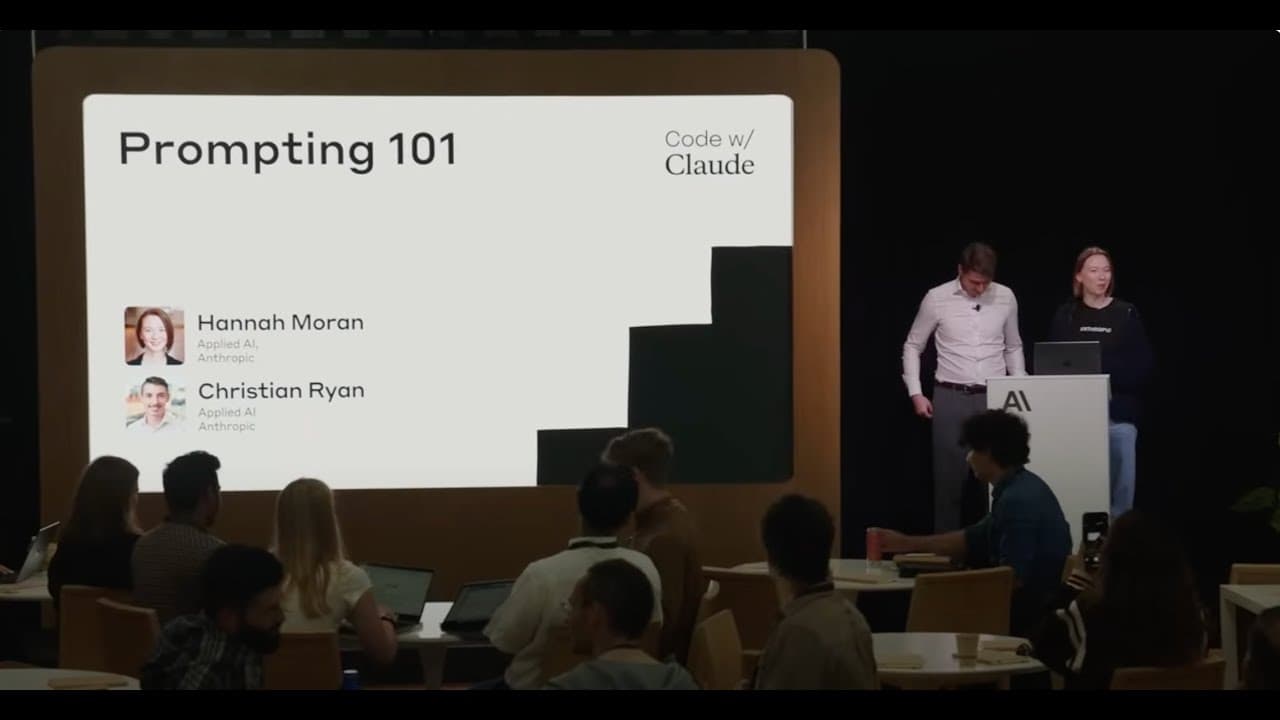
Effective prompt engineering starts with a clear task description, the necessary context, and detailed instructions arranged to guide the model toward the desired result. Anthropic applied AI team members Hannah and Christian demonstrate this through a Swedish car-insurance scenario, showing how an underspecified prompt led Claude to mistake a vehicle accident for a skiing accident. Read on for the recommended prompt structure and practical refinement techniques.
Transcript
Hi everyone. Thank you for joining us today for prompting 101. Uh my name is Hannah. I'm part of the applied AI team here at Anthropic. And with me is Christian, also part of the applied AI team. And what we're going to do today is take you through a little bit of prompting best practices. And we're going to use a real world scenario and build ... Read More
Key Insights
- Prompt engineering is the art of communicating with AI models through structured instructions.
- Effective prompts require a clear task description and relevant context for the AI model.
- Iterative refinement of prompts enhances the model's accuracy and reliability.
- Including examples and structured formats, like XML tags, aids in guiding the model's responses.
- The model should be instructed to provide factual and confident responses, avoiding guesses.
- Output formatting and pre-filled responses can streamline data integration and usability.
- Extended thinking features in AI models can help analyze and refine prompt effectiveness.
- Understanding the model's reasoning process can inform better prompt construction.
Install to Summarize YouTube Videos and Get Transcripts
Explore YouTube Video Summarizer or Get YouTube Transcript Extractor
Questions & Answers
Q: How do you structure an effective AI prompt?
Start with a task description that tells Claude its role and objective, then provide the dynamic content it must analyze. Follow with detailed, step-by-step instructions, add examples when useful, and finish by repeating the most critical requirements before telling Claude to begin.
Q: What is prompt engineering?
Prompt engineering is the practice of communicating with a language model to get it to perform a desired task. It involves writing clear instructions, supplying the context the model needs, and arranging the information to produce the best result.
Q: Why does an AI prompt need context?
Context establishes what is happening and helps the model interpret the supplied content correctly. In the demonstration, a simple prompt did not adequately establish the car-accident setting, so Claude interpreted the report as describing a skiing accident.
Q: Why is prompt engineering described as iterative and empirical?
A prompt can be tested against an expected result, then revised when the model misunderstands the task. The presenters suggest adding information that makes the vehicular setting clear and iteratively building on the prompt until it addresses the intended problem.
Q: What task description should appear at the start of a prompt?
The opening should tell Claude what it is there to do, what role it should take, and what task it must accomplish. In the insurance example, the intended task is to review an accident report, determine what happened, and judge who was at fault.
Q: What counts as dynamic content in an AI prompt?
Dynamic content is the material the model must process for the specific task. In the demonstrated scenario, it consists of a Swedish car-accident report form and a hand-drawn sketch, though the presenters note that content could also be retrieved from another system.
Q: How can examples improve a prompt?
Examples show Claude a representative piece of content and the response expected for it. They can be included after the detailed instructions to further guide how the model handles the task.
Q: Why repeat critical instructions at the end of a prompt?
Repeating the most important requirements reviews the task information with Claude and emphasizes what is especially critical. The recommended structure places this reminder near the end, immediately before directing Claude to perform the work.
Q: How do I stop Claude from guessing when it cannot understand an image?
Tell Claude to stay factual and not make an assessment unless it is fully confident. This helps prevent it from guessing and giving a misleading answer when the image is unclear.
Q: How should I prompt Claude for a one-shot API task?
Put the task description and Claude’s role first, followed by the dynamic content and detailed step-by-step instructions. You can then provide examples, repeat the most critical information, and tell Claude to begin the work.
Q: Why did Claude mistake a car accident report for a skiing accident?
Claude made the mistake because the simple prompt did not clearly establish the scenario shown in the images. Adding context that the task involved Swedish car accident reports helped Claude recognize that it was dealing with vehicles rather than skiing.
Summary & Key Takeaways
-
Prompt engineering involves crafting precise instructions for AI models to improve task performance. Key strategies include setting task descriptions, providing context, and using examples to guide responses. Structured formats and output guidelines ensure clarity and usability, while iterative refinement enhances model accuracy.
-
Using a structured approach, including task context and detailed instructions, can significantly improve AI model outputs. Examples and pre-filled responses help shape the model's reasoning, while output formatting ensures data integration. Extended thinking features offer insights into model reasoning, aiding prompt refinement.
-
Effective prompt engineering requires clear task descriptions and structured prompts to guide AI models like Claude. Providing examples and maintaining factual accuracy are crucial. Output formatting and extended thinking features support data integration and prompt refinement, enhancing model performance and reliability.
Read in Other Languages (beta)
Share This Summary 📚
Summarize YouTube Videos and Get Video Transcripts with 1-Click
Try YouTube Summary with ChatGPT & Claude or YouTube Transcript Generator
Explore More Summaries from Anthropic 📚

Summarize YouTube Videos and Get Video Transcripts with 1-Click
Try YouTube Summary with ChatGPT & Claude or YouTube Transcript Generator