How to Optimize AI Models with RAG and Fine-Tuning
TL;DR
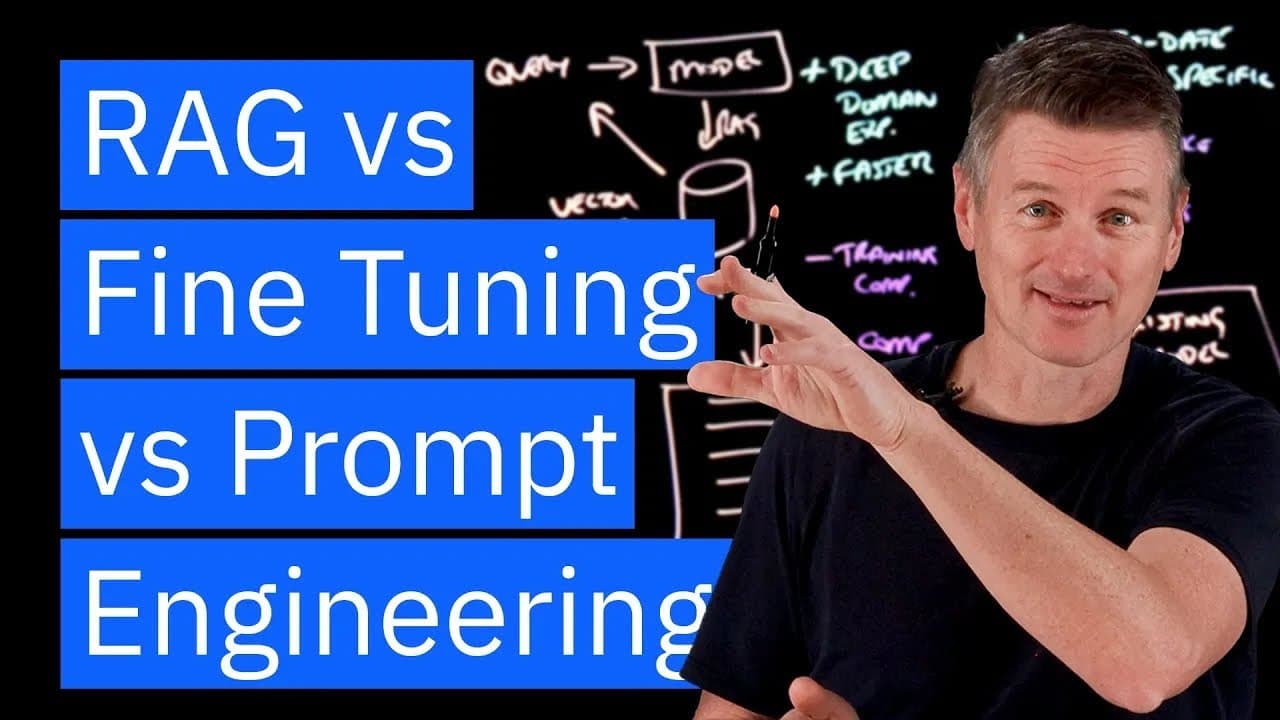
To enhance AI model responses, consider three approaches: Retrieval Augmented Generation (RAG) for integrating up-to-date data, fine-tuning for domain-specific expertise, and prompt engineering for precise queries. Each method has its strengths and limitations, and often a combination of these techniques yields the best results.
Transcript
Remember how back in the day people would Google themselves, you type your name into a search engine and you see what it knows about you? Well, the modern equivalent of that is to do the same thing with a chatbot. So when I ask a large language model, who is Martin Keen? Well, the response varies greatly depending upon which model I'm asking, becau... Read More
Key Insights
- RAG is a method that retrieves new, up-to-date information and integrates it into model responses, enhancing accuracy.
- Fine-tuning involves training an existing model on a specialized dataset to develop deep domain expertise.
- Prompt engineering focuses on crafting specific queries to leverage a model’s existing knowledge effectively.
- RAG adds computational overhead due to the retrieval step, impacting performance and cost.
- Fine-tuning requires extensive training data and computational resources, posing challenges in maintenance and risk of catastrophic forgetting.
- Prompt engineering offers immediate results without infrastructure changes but cannot extend a model’s knowledge.
- Combining RAG, fine-tuning, and prompt engineering can optimize AI model outputs for specific applications.
- Each method's effectiveness depends on the specific needs and resources of the user or organization.
Install to Summarize YouTube Videos and Get Transcripts
Explore YouTube Video Summarizer or Get YouTube Transcript Extractor
Questions & Answers
Q: How does Retrieval Augmented Generation (RAG) work?
RAG works by retrieving external, up-to-date information and incorporating it into AI model responses. It first converts queries and documents into vector embeddings, finds semantically similar documents, and then augments the original prompt with this information. This process enhances response accuracy but adds computational overhead due to the retrieval step.
Q: What is the purpose of fine-tuning in AI models?
Fine-tuning aims to develop deep domain expertise in AI models by training them on specialized datasets. It involves adjusting the model's weights through supervised learning, using input-output pairs that demonstrate desired responses. This method is effective for specific applications but requires extensive training data and computational resources.
Q: What are the benefits of prompt engineering?
Prompt engineering benefits include immediate results and the ability to leverage a model's existing knowledge without additional training or data retrieval. By crafting specific queries, users can direct the model's attention to relevant patterns learned during training. However, it cannot extend the model's knowledge or address outdated information.
Q: What are the limitations of RAG?
RAG's limitations include added computational overhead and latency due to the retrieval step. The process requires vector embedding conversion and storage, increasing processing and infrastructure costs. Despite providing up-to-date information, RAG's performance may be impacted, making it less efficient than other methods like fine-tuning.
Q: Why is fine-tuning considered resource-intensive?
Fine-tuning is resource-intensive because it requires substantial computational resources, including numerous GPUs, to adjust a model's weights through additional training. The process demands thousands of high-quality training examples and poses maintenance challenges, such as the risk of catastrophic forgetting and the need for periodic retraining.
Q: How does prompt engineering differ from other methods?
Prompt engineering differs from other methods by focusing on crafting specific queries to maximize a model's existing knowledge without additional training or data retrieval. It offers immediate results and requires no infrastructure changes. However, it cannot extend the model's knowledge or address outdated information, unlike RAG or fine-tuning.
Q: Can RAG, fine-tuning, and prompt engineering be used together?
Yes, RAG, fine-tuning, and prompt engineering can be used together to optimize AI model outputs for specific applications. Combining these methods allows users to leverage the strengths of each approach, such as RAG's up-to-date information, fine-tuning's domain expertise, and prompt engineering's immediate results, depending on their specific needs and resources.
Q: What factors influence the choice of AI optimization method?
The choice of AI optimization method depends on specific needs and resources. RAG is suitable for up-to-date information but adds computational overhead. Fine-tuning offers domain expertise but requires substantial resources. Prompt engineering provides immediate results without extending knowledge. Often, a combination of methods yields the best results for particular applications.
Summary & Key Takeaways
-
Retrieval Augmented Generation (RAG) enhances AI model responses by incorporating external, up-to-date information. This method involves searching for data not present in the original training set and integrating it into the model's output. However, it adds computational overhead and latency due to the retrieval step.
-
Fine-tuning adjusts a model's weights through additional training on specialized data, enabling deep domain expertise. It is faster at inference time compared to RAG but requires substantial computational resources and poses maintenance challenges, including the risk of catastrophic forgetting.
-
Prompt engineering crafts detailed queries to maximize a model's existing knowledge without additional training or data retrieval. It offers immediate results and requires no infrastructure changes, but cannot extend the model's knowledge or address outdated information.
-
(Content reviewed on 2026-08-27.)
Read in Other Languages (beta)
Share This Summary 📚
Summarize YouTube Videos and Get Video Transcripts with 1-Click
Try YouTube Summary with ChatGPT & Claude or YouTube Transcript Generator
Explore More Summaries from IBM Technology 📚


Summarize YouTube Videos and Get Video Transcripts with 1-Click
Try YouTube Summary with ChatGPT & Claude or YouTube Transcript Generator