How Can You Master Google AI Prompt Engineering?
TL;DR
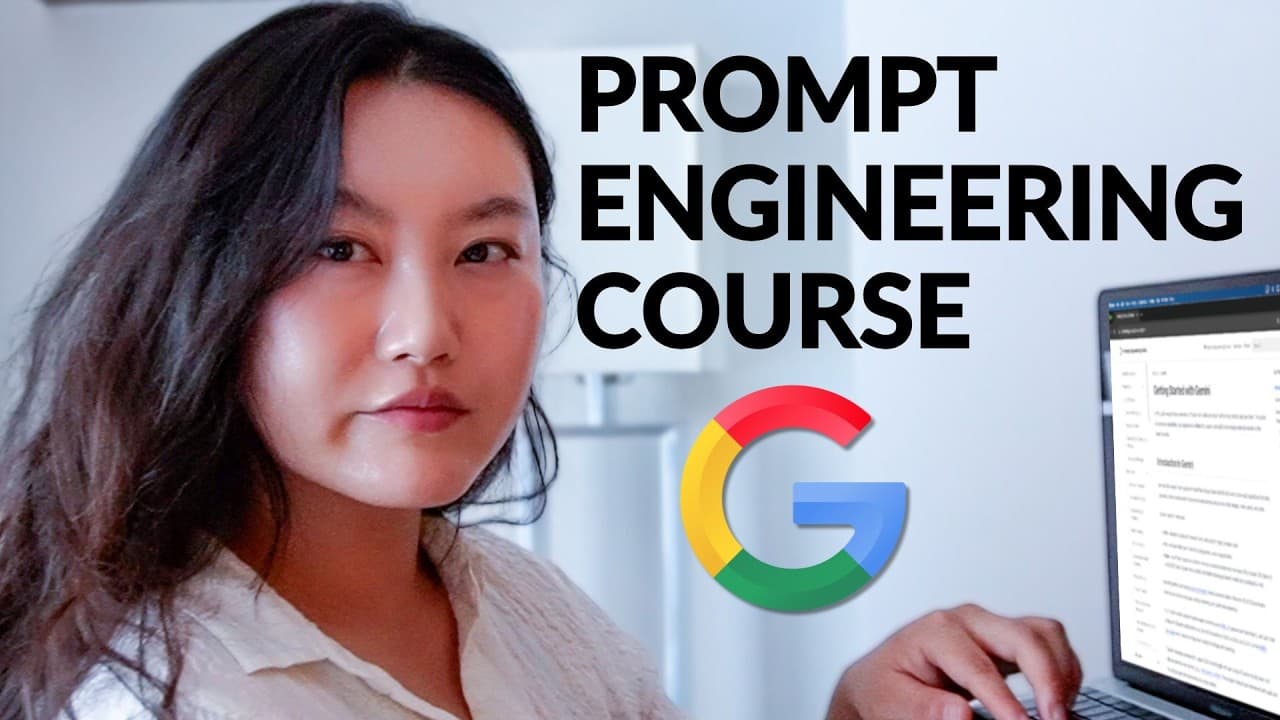
Mastering Google’s AI prompt engineering involves a five-step framework that enhances prompt design and interaction. Key techniques like prompt chaining and employing AI agents allow for advanced tasks, while iterative refinement, context, and references ensure more accurate and effective AI outputs.
Transcript
I took Google's prompt engineering course for you so here's the cliffnotes version to save you to 9 hours but it's not enough just to listen to me talk about stuff so I've also included a little assessment at the end of the video to help you remember everything that you learned because research shows that immediately reviewing information after you... Read More
Key Insights
- The course is divided into four modules: writing prompts, designing prompts for work tasks, using AI for data analysis, and employing AI as a creative partner.
- A five-step framework for designing prompts includes task, context, references, evaluation, and iteration, emphasizing the importance of refining prompts.
- Iteration methods include revisiting the framework, simplifying prompts, trying different phrasing, and introducing constraints to enhance AI output.
- Multimodal prompting allows interaction with AI through text, images, audio, and video, requiring careful specification of input and output formats.
- AI tools can generate hallucinations or biased outputs, so a human-in-the-loop approach is recommended for accuracy and ethical considerations.
- Advanced prompting techniques like prompt chaining, Chain of Thought, and tree of thought prompting enhance AI's reasoning and creativity.
- AI agents, such as simulation agents and expert feedback agents, can simulate scenarios and provide tailored feedback, enhancing learning and task execution.
- Designing effective AI agents involves setting personas, providing context, specifying interactions, and including stop phrases for controlled conversations.
Install to Summarize YouTube Videos and Get Transcripts
Explore YouTube Video Summarizer or Get YouTube Transcript Extractor
Questions & Answers
Q: What is the structure of Google's AI Prompting Essentials course?
The course is structured into four modules. Module one covers writing prompts, introducing frameworks for crafting them. Module two focuses on designing prompts for everyday work tasks, such as emailing and brainstorming. Module three deals with using AI for data analysis and presentations. Finally, module four explores using AI as a creative or expert partner, delving into advanced prompting techniques and agent creation.
Q: What is the five-step framework for designing prompts?
The five-step framework for designing prompts includes task, context, references, evaluation, and iteration. Task defines what you want the AI to do. Context provides additional information for better output. References offer examples for clarity. Evaluation involves assessing the output's quality. Iteration is the process of refining prompts to achieve desired results, emphasizing a circular approach to prompt design.
Q: How can multimodal prompting enhance AI interactions?
Multimodal prompting allows users to interact with AI using various modalities, such as text, images, audio, and video. This flexibility enables richer and more contextually aware interactions. Users can specify input and output formats, enhancing the AI's ability to understand and respond appropriately. Examples include generating social media posts with images or suggesting recipes based on photos of ingredients.
Q: What are some advanced prompting techniques discussed in the course?
Advanced prompting techniques include prompt chaining, Chain of Thought prompting, and tree of thought prompting. Prompt chaining involves guiding AI through a series of interconnected prompts. Chain of Thought prompting asks the AI to explain its reasoning step-by-step. Tree of thought prompting explores multiple reasoning paths simultaneously, useful for complex problems like developing novel plots or creating document outlines.
Q: How do AI agents function, and what are their types?
AI agents are designed to assist with tasks and answer questions, acting as experts in specific areas. The course covers two types: simulation agents and expert feedback agents. Simulation agents can role-play scenarios, like conducting interviews. Expert feedback agents provide personalized feedback on topics, similar to a tutor or consultant. Designing agents involves setting personas, providing context, specifying interactions, and including stop phrases.
Q: What ethical considerations are highlighted in the course?
The course emphasizes the need for ethical AI use, highlighting issues like hallucinations and biases. Hallucinations occur when AI outputs are incorrect or nonsensical. Biases arise from training on human content. To mitigate these, the course recommends a human-in-the-loop approach, where users verify outputs for accuracy and ethical considerations, ensuring responsible AI application.
Q: What iteration methods are suggested for refining AI prompts?
The course suggests four iteration methods for refining AI prompts: revisiting the prompting framework, separating prompts into shorter sentences, trying different phrasing or analogous tasks, and introducing constraints. These methods help improve AI output by providing clearer instructions, reducing complexity, and narrowing focus, ultimately enhancing the effectiveness of AI interactions.
Q: How can AI tools assist in data analysis and presentations?
AI tools can assist in data analysis by generating insights from datasets and teaching users specific tasks, like calculating averages in spreadsheets. For presentations, AI can help create content, suggest design elements, and enhance visual appeal. However, users must be cautious about inputting sensitive data and adhere to privacy policies, ensuring responsible use of AI tools in professional settings.
Summary & Key Takeaways
-
Google's AI Prompting Essentials course is structured into four modules, focusing on writing prompts, designing for everyday tasks, data analysis, and creative partnerships. It provides frameworks and techniques to enhance AI interactions.
-
The course introduces a five-step framework for prompt design and four iteration methods to refine AI outputs. It emphasizes the importance of context, references, and iterative refinement for effective prompting.
-
Advanced techniques like prompt chaining and AI agents are explored, enabling complex scenario simulations and expert feedback. The course highlights the need for ethical AI use and human oversight to mitigate biases and inaccuracies.
Read in Other Languages (beta)
Share This Summary 📚
Summarize YouTube Videos and Get Video Transcripts with 1-Click
Try YouTube Summary with ChatGPT & Claude or YouTube Transcript Generator
Explore More Summaries from Tina Huang 📚




Summarize YouTube Videos and Get Video Transcripts with 1-Click
Try YouTube Summary with ChatGPT & Claude or YouTube Transcript Generator