What Is Open Source AI and How Do You Use It? Explained in 17 Minutes
TL;DR
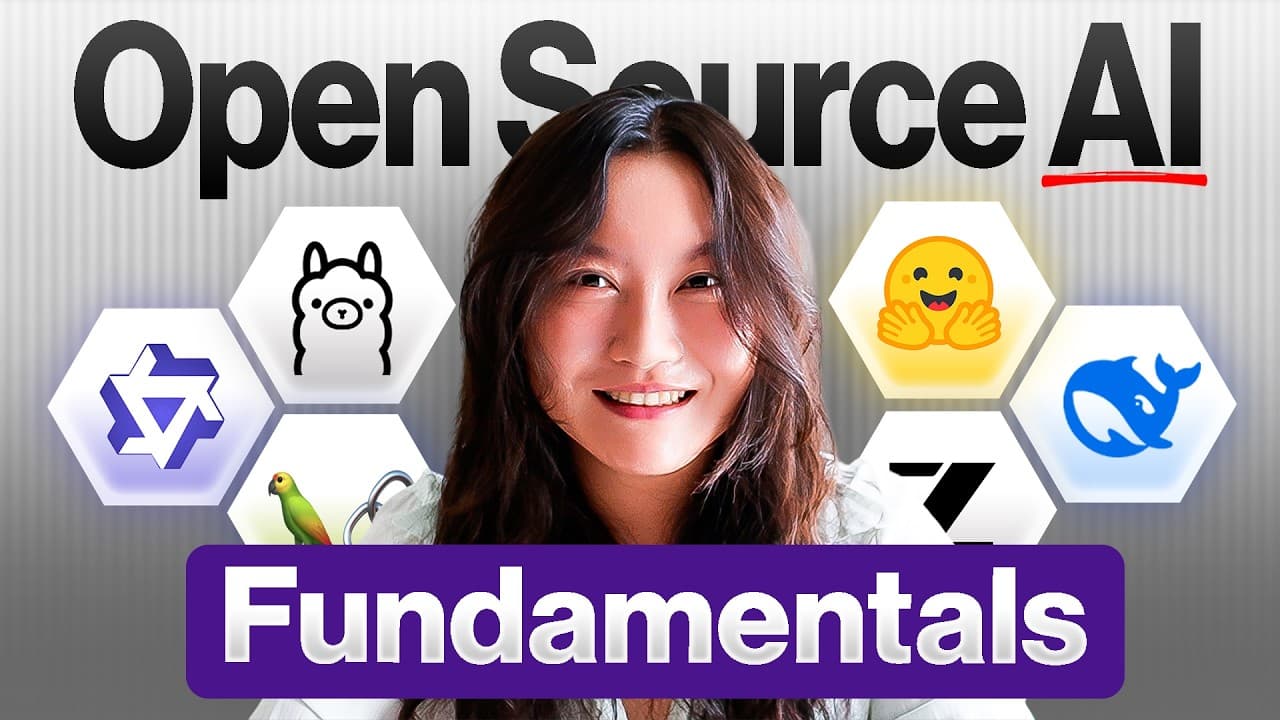
Open source AI makes core components publicly available so users can download, customize, audit, and deploy models on their own infrastructure. A local setup can begin with a model manager such as Ollama, while agent systems can add tools, knowledge, memory, guardrails, speech, and orchestration. The benefits include greater control, privacy, lower costs, and less vendor lock-in, but users assume responsibility for hardware, security, scalability, and uptime. Read on to understand the complete stack and tradeoffs.
Transcript
I learned all about open source AI for you. So here's the cliffnotes version to save you the hours and hours that I have spent digging into this topic and building with open source models and frameworks. So in this video I'm going to explain what is open source AI and why you should care about it. The open source AI stack if you want to build thing... Read More
Key Insights
- Open source AI is an approach in which some or all core components are publicly available, including model architecture, model weights, training or inference code, and licensing that permits use, modification, and redistribution.
- Closed source AI is accessed through controlled services such as APIs, web applications, or enterprise platforms because its model weights and training processes remain proprietary. The transcript identifies GPT, Claude, Gemini, and Grok models as examples.
- DeepSeek R1 marked a major shift in January 2025 because the transcript describes it as the first open source model able to compete with the strongest closed source models available at that time.
- The primary advantages of open source AI are deployment control, customization, lower cost, auditability, reduced vendor lock-in, and collaborative innovation. Users can deploy systems on premises, at the edge, or in a private cloud.
- Local deployment is a privacy option because an open source model does not have to run on its creator's servers. Users can download and host the model themselves, keeping deployment and data handling under their control.
- The main drawbacks of open source AI are setup complexity, hardware requirements, weaker out-of-the-box capabilities, and operational responsibility. Users must manage concerns such as security, scalability, maintenance, and uptime themselves.
- Quantization is helping make open source models smaller, allowing more of them to run on personal computers. Community-built frameworks and packages are also simplifying setup, maintenance, and scaling as the ecosystem develops.
- An open source AI agent uses the same basic components as other agents: models, tools, knowledge, memory, audio and speech, guardrails, and orchestration. The main difference is using an open source model and model-management software such as Ollama.
Install to Summarize YouTube Videos and Get Transcripts
Explore YouTube Video Summarizer or Get YouTube Transcript Extractor
Questions & Answers
Q: What is open source AI?
Open source AI refers to systems where some or all core components are publicly available. These may include the model architecture, model weights, training or inference code, and a license permitting use, modification, and redistribution.
Q: How is open source AI different from closed source AI?
Open source models can be downloaded, modified, audited, and deployed on infrastructure controlled by the user. Closed source systems keep their weights and training processes proprietary and are generally accessed through APIs, web apps, or enterprise platforms, as with GPT, Claude, Gemini, and Grok.
Q: Why should companies consider open source AI?
Open source AI offers deployment control, customization, lower costs, auditability, community-driven innovation, and reduced vendor lock-in. Companies can run models on premises, at the edge, or in a private cloud, then fine-tune them, modify their architecture, or add preferred guardrails.
Q: Can open source AI models run locally and keep data private?
Yes. Open source models can be downloaded and hosted locally instead of running on the model creator’s servers, giving users control over deployment and data handling. The computer must still have enough hardware to support the selected model.
Q: What are the disadvantages of open source AI?
Open source AI generally involves greater setup complexity, hardware requirements, and weaker capabilities out of the box. Users must also manage security, scalability, maintenance, infrastructure, and uptime because an external provider is not managing the complete system.
Q: What tools are needed to run an open source AI model?
A basic local setup starts with an open source model and model-management software such as Ollama. More capable applications can add tools, knowledge sources, memory, audio and speech components, guardrails, and orchestration.
Q: How do you build an AI agent with open source models?
Select an open source model, run it with model-management software such as Ollama, and connect it to the other required agent components. The transcript identifies n8n, LangGraph, LlamaIndex, OpenAI’s Agents SDK, and Google’s ADK as frameworks that can support no-code or code-based workflows.
Q: Why was DeepSeek R1 important for open source AI?
According to the page, DeepSeek R1 arrived in January 2025 and was the first open source model able to compete with the strongest closed source models available at that time. Its performance helped open the door for more open source models to appear on leaderboards.
Summary & Key Takeaways
-
Open source AI systems make some or all core components publicly available, potentially including model architecture, weights, training or inference code, and a license allowing use, modification, and redistribution. Unlike proprietary systems accessed through APIs or hosted applications, these models can be downloaded, customized, audited, and deployed on local or privately controlled infrastructure.
-
The main benefits are deployment control, customization, lower costs, auditability, privacy, community-driven innovation, and reduced vendor lock-in. The tradeoffs include more complicated setup, substantial hardware needs, fewer built-in capabilities, and responsibility for security, scalability, and uptime. Quantization, frameworks, and packages are steadily reducing these practical barriers.
-
The open source AI stack begins with a model and a model manager such as Ollama. Agentic systems then add tools, knowledge, memory, audio and speech, guardrails, and orchestration. Existing agent concepts still apply, while frameworks such as n8n, LangGraph, LlamaIndex, OpenAI's Agents SDK, and Google's ADK can support open source models.
Read in Other Languages (beta)
Share This Summary 📚
Summarize YouTube Videos and Get Video Transcripts with 1-Click
Try YouTube Summary with ChatGPT & Claude or YouTube Transcript Generator
Explore More Summaries from Tina Huang 📚

Summarize YouTube Videos and Get Video Transcripts with 1-Click
Try YouTube Summary with ChatGPT & Claude or YouTube Transcript Generator