10 Best TEDx Talks of All Time

Sep 15, 2026
16 min read
0 views
Last updated: September 2026
This is a ten-talk TEDx sequence, ordered as a path rather than a ranking. It is for viewers who want practical ideas about happiness, learning, relationships, action, confidence, connection, mental strength, and purpose.
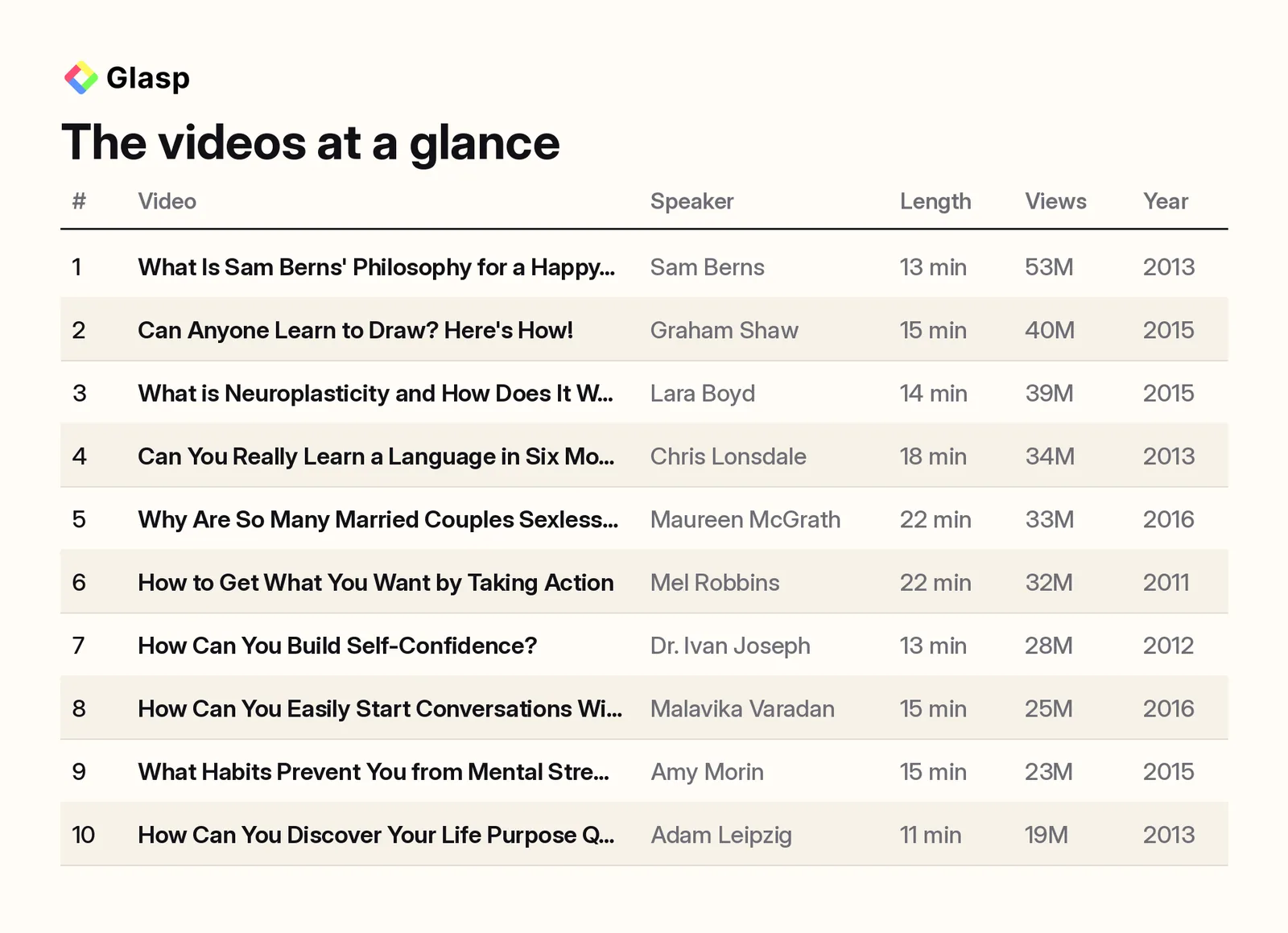
The full set runs a little over two and a half hours. Its most enduring videos include Sam Berns on a happy life, Lara Boyd on neuroplasticity, and Chris Lonsdale on learning a language in six months.
The videos on this list, in the order to watch them, are:
What Is Sam Berns' Philosophy for a Happy Life? (Sam Berns)
Can Anyone Learn to Draw? Here's How! (Graham Shaw)
What is Neuroplasticity and How Does It Work? (Lara Boyd)
Can You Really Learn a Language in Six Months? (Chris Lonsdale)
Why Are So Many Married Couples Sexless and Unhappy? (Maureen McGrath)
How to Get What You Want by Taking Action (Mel Robbins)
How Can You Build Self-Confidence? (Dr. Ivan Joseph)
How Can You Easily Start Conversations With Strangers? (Malavika Varadan)
What Habits Prevent You from Mental Strength? (Amy Morin)
How Can You Discover Your Life Purpose Quickly? (Adam Leipzig)
Total: 10 videos, 158 minutes of watch time (2 hours 38 minutes), and 326.7M combined views.
1. What Is Sam Berns' Philosophy for a Happy Life?

"My philosophy for a happy life | Sam Berns | TEDxMidAtlantic" · Sam Berns · 13 min · 53M views · 2013
In short: A happy life comes from accepting limitations while focusing on what is possible, choosing positive people, and keeping future goals in view.
Start here because Berns provides the outlook that supports every skill and challenge later in the sequence. Living with Progeria, he does not argue that limitations should be denied. He accepts what he cannot do, concentrates on interests and goals still open to him, surrounds himself with people who add joy, and keeps something ahead to anticipate. His philosophy connects happiness to attention, relationships, and forward movement.
The clearest example is his goal of playing snare drum in his high school marching band. A normal drum and harness weighed about 40 pounds while Sam weighed about 50, so the standard equipment was not workable. With help from his family and an engineer, he developed an apparatus weighing about 6 pounds. That concrete redesign let him play snare drum instead of treating the original constraint as the end of the goal.
Key takeaways
Sam accepts what he cannot do while directing his attention toward passions such as scouting, music, and comic books.
A supportive family and close friends bring him joy and help him look beyond the challenges of Progeria.
Always having something to look forward to helps him remain hopeful through difficult periods.
A lightweight snare drum apparatus allowed him to achieve a goal that standard 40-pound equipment had put out of reach.
Watch on YouTube · Read the summary and Q&A
2. Can Anyone Learn to Draw? Here's How!
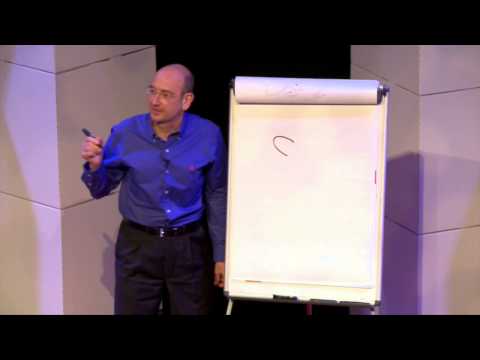
"Why people believe they can’t draw - and how to prove they can | Graham Shaw | TEDxHull" · Graham Shaw · 15 min · 40M views · 2015
In short: Drawing is a learnable skill when people replace a fixed belief about talent with an open mind, simple steps, and a willingness to try.
After Berns shows how to focus on what is possible, Shaw turns that outlook into a small, immediate test. He argues that saying you cannot draw usually reflects a false belief rather than a lack of ability. By breaking simple cartoons into manageable steps, he lets people experience progress directly. This second position makes the sequence practical: before studying how the brain changes, you can challenge a limiting belief with your own hand.
Shaw supports the exercise with three examples of people who learned to draw and gained confidence. The most concrete application involves stroke recoverers living with aphasia. Drawing gave them another way to express themselves when communication was difficult, helped them rebuild confidence, and supported connections with other people. The point is not that everyone must become a great artist. An open mind and a willingness to make the first marks can begin developing the skill.
Key takeaways
The belief that drawing is an inborn ability can stop people before they practice a skill they could develop.
Simple cartoons become approachable when they are divided into easy-to-draw steps.
An open mind and a willingness to try matter more than aiming to become a great artist.
Drawing helped stroke recoverers with aphasia regain confidence and communicate in another way.
Watch on YouTube · Read the summary and Q&A
3. What is Neuroplasticity and How Does It Work?

"After watching this, your brain will not be the same | Lara Boyd | TEDxVancouver" · Lara Boyd · 14 min · 39M views · 2015
In short: Neuroplasticity lets the brain adapt through chemical, structural, and functional changes driven by learning, practice, and behavior.
The drawing exercise demonstrates that practice can change performance; Boyd next explains the mechanism behind that change. Her account of neuroplasticity presents the brain as constantly changing rather than fixed. Learning and memory can involve increased chemical signaling, altered brain structure, and changed function. Behavior influences this process, so what a person repeatedly does matters to both skill acquisition and the brain's response to damage.
Stroke recovery makes the argument especially concrete. Neuroplasticity can support brain reorganization and the development of new neural pathways, allowing the brain to compensate for damaged areas and restore lost function. Boyd also stresses that the necessary dose of practice can be large and that people differ from one another. Because every brain is unique, personalized interventions based on individual biomarkers may work better than a single learning method applied to everyone.
Key takeaways
Neuroplasticity is the brain's ability to change and adapt through practice and learning.
Chemical signaling, structural alteration, and functional change all contribute to learning and memory.
Behavior and habits can direct plasticity toward positive or negative outcomes.
Individual differences mean personalized learning interventions may be more effective than one standard approach.
Watch on YouTube · Read the summary and Q&A
4. Can You Really Learn a Language in Six Months?
"How to learn any language in six months | Chris Lonsdale | TEDxLingnanUniversity" · Chris Lonsdale · 18 min · 34M views · 2013
In short: Lonsdale argues that an adult can reach fluency in six months by applying five principles and seven actions centered on relevant, comprehensible communication.
Boyd establishes that learning changes the brain, and Lonsdale follows with a specific system for directing that learning toward a second language. He says talent is not the deciding factor and immersion by itself is insufficient. The learner needs relevant content, language used as a communication tool, comprehensible input, physiological training, and a positive, relaxed state. These principles keep the process active and understandable rather than merely surrounding someone with unfamiliar speech.
His own experience provides one concrete case: he learned Mandarin Chinese fluently in six months using principles drawn from psychological research. He also describes a woman who had been told she lacked talent for languages but became fluent in Portuguese in six months after applying the five principles. The example reinforces his claim that the important conditions and actions are under the learner's control, including what input they choose and how they practice.
Key takeaways
Lonsdale proposes five principles and seven actions for learning a second language to fluency in six months.
Relevant content and comprehensible input matter more than immersion without understanding.
Language should be used as a tool for communication while its physiological aspects are trained through practice.
A positive, relaxed state supports learning, while talent is not presented as the determining factor.
Watch on YouTube · Read the summary and Q&A
5. Why Are So Many Married Couples Sexless and Unhappy?
"No Sex Marriage – Masturbation, Loneliness, Cheating and Shame | Maureen McGrath | TEDxStanleyPark" · Maureen McGrath · 22 min · 33M views · 2016
In short: Sexless and dissatisfied marriages can reflect declining excitement, poor communication, unresolved conflict, stress, negative sex education, or medical conditions.
The first four talks focus mainly on individual outlook and learning. McGrath shifts the sequence to what happens inside a long-term relationship, where habits, health, communication, and expectations meet. She explains that many married couples are not having sex and are dissatisfied with their sex lives. The excitement associated with a new relationship can diminish after a few years, but lower desire can also have social, emotional, and medical causes.
Her list of contributing factors is practical and varied: fear-based sex education can create shame, unresolved conflict can reduce intimacy, and stress or substance abuse can affect desire. Medical issues may include erectile dysfunction, cardiovascular disease, diabetes, and low testosterone. McGrath's proposed response is equally direct: communicate openly, address unresolved issues, prioritize intimacy, explore fantasies, maintain a positive attitude toward sex, and seek professional help when sexual dysfunction needs treatment.
Key takeaways
A mismatch becomes a problem when one partner wants sex and the other does not, even though some sexless couples are content.
Negative sex education can produce shame and attitudes that reduce desire and satisfaction.
Stress, unresolved conflict, substance abuse, and several medical conditions can contribute to a sexless marriage.
Open communication, attention to intimacy, and professional help for dysfunction can improve sexual satisfaction.
Watch on YouTube · Read the summary and Q&A
6. How to Get What You Want by Taking Action

"How to stop screwing yourself over | Mel Robbins | TEDxSF" · Mel Robbins · 22 min · 32M views · 2011
In short: Getting what you want begins with honest goals and immediate action outside your routine, even when motivation has not arrived.
After McGrath identifies issues that require frank discussion and attention, Robbins turns the sequence toward action. She argues that people often call themselves fine while remaining stuck without what they truly want. The solution is simple in theory but demanding in practice: be honest about the goal, make requests when needed, leave familiar routines, and take a first step without waiting for an external burst of motivation.
The five-second rule is her most concrete tool. When an idea or impulse appears, act within five seconds before the mind applies what she describes as an emergency brake and kills it. This does not remove effort from change. It creates a brief route past hesitation, after which consistent work still matters. Robbins also connects growth with new experiences, since breaking routine makes room for opportunities and ideas that stagnation excludes.
Key takeaways
People can remain dissatisfied when they tell themselves they are fine without what they actually want.
Motivation does not need to appear before action; the first step can come while a person still feels resistance.
The five-second rule calls for acting on an idea before hesitation turns into self-sabotage.
Personal growth requires leaving routine, trying new experiences, and asking others for what is needed.
Watch on YouTube · Read the summary and Q&A
7. How Can You Build Self-Confidence?

"The skill of self confidence | Dr. Ivan Joseph | TEDxRyersonU" · Dr. Ivan Joseph · 13 min · 28M views · 2012
In short: Self-confidence is a trainable belief in your ability to complete a task, built through repetition, positive self-talk, and constructive responses to feedback.
Robbins gets you moving; Joseph explains how repeated action can create the confidence to continue under pressure. As a soccer coach, he defines self-confidence as the belief that you can accomplish a task despite the odds, difficulty, or adversity. He ranks that belief above specific talents because ability is hard to use once doubt takes over. Confidence is therefore a skill to train, not a fixed quality someone either possesses or lacks.
His goalkeeper example turns the claim into a measurable routine. Joseph recruited a 6-foot-3 player who dropped every ball, then assigned him to kick a ball against a wall and catch it 350 times a day for eight months. The player returned with calloused hands and went on to play in Europe. Alongside repetition, Joseph recommends replacing negative inner speech with reminders of past accomplishments and interpreting feedback as material for growth.
Key takeaways
Joseph defines self-confidence as the belief that you can accomplish a task despite difficulty, odds, or adversity.
Repetition removes novelty and builds the familiarity needed to perform under pressure.
A goalkeeper improved through 350 catches a day for eight months and later played in Europe.
Positive self-talk and constructive interpretations of feedback help replace the negative messages that weaken belief.
Watch on YouTube · Read the summary and Q&A
8. How Can You Easily Start Conversations With Strangers?

"7 Ways to Make a Conversation With Anyone | Malavika Varadan | TEDxBITSPilaniDubai" · Malavika Varadan · 15 min · 25M views · 2016
In short: Starting with a greeting, then listening closely and finding genuine points of connection, can turn an encounter with a stranger into a meaningful conversation.
Once Joseph has treated confidence as a skill, Varadan applies that idea to a social situation many people avoid. She describes conversations as links connecting people and offers simple ways to create the first one. A greeting opens the exchange, while personal questions, common ground, requests for opinions, attentive presence, and remembered details help it deepen. The goal is not performance but a more genuine understanding of another person.
The smallest useful step is simply saying hello. Varadan notes that the worst result is that the other person does not want to talk, while silence removes any chance of finding out. If a conversation begins, skipping forgettable small talk for a personal question can invite a distinct story. A specific, sincere compliment also carries more meaning than generic praise such as "nice" or "awesome," which can sound insincere and be quickly forgotten.
Key takeaways
A simple greeting can break the initial barrier to speaking with someone new.
Personal questions and shared interests can move an exchange beyond unmemorable small talk.
Asking for opinions, staying present, and remembering details help form a stronger connection.
A specific and genuine compliment is more meaningful than generic praise.
Watch on YouTube · Read the summary and Q&A
9. What Habits Prevent You from Mental Strength?

"The Secret of Becoming Mentally Strong | Amy Morin | TEDxOcala" · Amy Morin · 15 min · 23M views · 2015
In short: Mental strength grows when destructive beliefs about yourself, other people, and the world are replaced with healthier thoughts and small behavioral changes.
Varadan looks at connections with others; Morin follows by examining beliefs that can distort those connections and a person's view of life. She groups destructive thinking into unhealthy beliefs about oneself, other people, and the world. Self-pity magnifies misfortune, giving others control gives away personal agency, and expecting life to reward hard work fairly creates disappointment. Mental strength begins by noticing and countering these patterns.
Social media envy is her clearest everyday example. Comparing yourself with polished representations of other people's lives can produce inferiority, inadequacy, and depression. Morin recommends accepting uncomfortable feelings, comparing yourself with your own past rather than with others, and recognizing that life is not always fair. Giving up one bad mental habit and taking small steps toward healthier beliefs can build resilience for difficult periods and tragedy.
Key takeaways
Destructive beliefs about oneself, other people, and the world can all undermine mental strength.
Social media comparisons with idealized lives can foster inadequacy, inferiority, and depression.
Treating other people as controllers of your life gives away agency over your reactions and choices.
Accepting discomfort and replacing unhealthy beliefs through small steps can strengthen resilience.
Watch on YouTube · Read the summary and Q&A
10. How Can You Discover Your Life Purpose Quickly?

"How to know your life purpose in 5 minutes | Adam Leipzig | TEDxMalibu" · Adam Leipzig · 11 min · 19M views · 2013
In short: A concise statement of purpose comes from knowing who you are, what you do, whom you serve, what they need, and how they change.
Close with Leipzig because his five questions turn the preceding ideas outward and give them a common direction. Purpose, in his account, is not defined only by identity or personal achievement. It requires knowing what you do, who benefits from it, what those people want or need, and how they change as a result. That focus on service can produce both a clear purpose and a concise personal introduction.
At his 25th college reunion, Leipzig found that 80% of his privileged, financially successful, and powerful classmates were unhappy and felt they had wasted their lives. The happier 20% knew their purpose, had studied for the joy of learning, pursued their passions, and chose work aligned with their interests. His five-part exercise takes about five minutes and directs attention away from self-interest toward the people a person's work serves.
Key takeaways
External achievement and positions of power did not prevent 80% of Leipzig's classmates from feeling unfulfilled.
The happier 20% understood their purpose, learned for joy, and followed interests that mattered to them.
Purpose can be framed through identity, work, audience, audience needs, and the transformation produced.
A concise purpose statement can work as a personal elevator pitch and begin a meaningful conversation.
Watch on YouTube · Read the summary and Q&A
Frequently asked questions
What are the best TEDx talks of all time?
Three enduring choices are Sam Berns' "My philosophy for a happy life," Lara Boyd's "After watching this, your brain will not be the same," and Chris Lonsdale's "How to learn any language in six months." Together they cover a practical philosophy for handling limits, the brain's capacity to change through behavior, and a five-principle system for accelerated language learning.
How long does it take to watch all ten TEDx talks?
The complete sequence takes 158 minutes, or 2 hours 38 minutes. The shortest video is Adam Leipzig's talk on life purpose at 11 minutes, while the longest talks are Maureen McGrath on sexless marriages and Mel Robbins on taking action, each at 22 minutes. The ten videos have 326.7M combined views.
What is neuroplasticity, and how does it help learning?
Neuroplasticity is the brain's ability to change and adapt through practice and learning. Lara Boyd explains that it operates through chemical, structural, and functional changes. Behavior and repeated practice influence those processes, supporting memory and skill acquisition. Because brains vary, she also argues that personalized interventions based on individual biomarkers may be more effective than one standard approach.
Can an adult really learn a language in six months?
Chris Lonsdale argues that an adult can reach fluency in six months by following five principles and seven actions. The principles emphasize relevant language, communication, comprehensible input, physiological training, and a positive, relaxed state. He learned Mandarin Chinese fluently in six months and says that immersion alone does not work when the surrounding language remains incomprehensible.
How do repetition and self-talk build confidence?
Ivan Joseph treats confidence as a skill. Repetition makes a task familiar enough that pressure is less disruptive, while positive self-talk replaces the negative messages that undermine belief. His goalkeeper practiced 350 catches every day for eight months, returned with calloused hands, and later played in Europe. Constructive responses to feedback support the same process.
What can couples do about low desire or a sexless marriage?
Maureen McGrath recommends open communication, resolving conflicts, prioritizing intimacy, exploring fantasies, and seeking professional help for sexual dysfunction. She also identifies stress, negative sex education, substance abuse, and conditions including erectile dysfunction, cardiovascular disease, diabetes, and low testosterone as possible contributors. A sexless marriage is a problem when partners are not both content with it.
Which TEDx talk should I watch first?
Start with Sam Berns on his philosophy for a happy life. His three-part approach, focus on what you can do, choose positive people, and keep future goals in view, gives the rest of the sequence a useful foundation. His lightweight snare drum apparatus also shows how accepting a limitation can coexist with finding another route to a goal.
Are older TEDx talks still worth watching?
Yes. Five talks here are from 2011 to 2013, including Mel Robbins on immediate action, Ivan Joseph on self-confidence, Sam Berns on happiness, Chris Lonsdale on language learning, and Adam Leipzig on purpose. Their claims concern practice, behavior, relationships, and decision-making, and their concrete exercises can still be applied directly.
How can I define my life purpose in five minutes?
Adam Leipzig asks you to identify five things: who you are, what you do, who you do it for, what those people want or need, and how they change as a result. Combining those answers produces a concise, outward-facing statement of purpose. It can also serve as a personal elevator pitch and open a meaningful conversation.
How to use this list
Watch these talks in the listed order. The sequence starts with how to face limits and test a belief, moves through how the brain learns and how practice becomes action and confidence, then applies those ideas to intimacy, conversation, mental habits, and service to others. If you only have twenty minutes, start with Sam Berns because his 13-minute philosophy sets up the outlook behind the rest. If you want the single video that explains why practice changes the learner, choose Lara Boyd on neuroplasticity.
Related lists
💡 Want summaries and transcripts for any YouTube video? Try YouTube Summary with ChatGPT & Claude.